Saturday, July 5, 2014

The Nart Saga

The Nart sagas are a collection of tales from the Caucasus about a group of ancient heros running around doing epic things–epic here meaning both the original definition and also sometimes hilariously awesome. Both Caucasian people (sensu stricto) and Ossetians tell stories of the Narts to one another and scholars think parts of them preserve ancestral Indo-Iranian mythos.

They certainly do have a lot of parallels with other Indo-Iranian ethnicities. For instance, there's an trickster like Loki and a story very similar to the Greek story of how Prometheus brought fire to humans. One big difference is that the leader of the Narts is a matriarch, not a patriarch. The Ossetians call her Satana, but variations of her name in other cultures include Satanaya and Sela-Sata.

The general tone of the sagas is remarkably matter-of-fact. If a Nart has to do something extraordinary, the fact that it's unusual is oftentimes remarked upon. Then again, there are unusual things that are treated like normal, everyday occurrences...like the story of how Satana got her son. And no...it is nothing like what you think. Very weird, though. I'm not going to go into that here because it's the sort of thing that should go behind an adult filter in our culture. I may still post some of the stories later, but with a specific warning that it's not my usual type of content.

I have John Colarusso's translations of the Caucasian versions into English (Circassian, Abkhazian, etc...), but at the time of printing he was only just starting to work on learning Ossetian. Which means I can't personally compare the Caucasian versions to the Ossetian to try to find bits that are uniquely Ossetian (and thus, Sarmatian in origin) and which bits are uniquely Caucasian. But fortunately, there's another Sarmatian in the SCA who knows Hungarian and there is a Hungarian translation of the Ossetian Nart Sagas. She's been reading through them recently and has posted some of her favorite excerpts here. I recommend taking a look. :)

Wednesday, June 4, 2014

Oldest Pants

Eurasian steppe nomads--bringing you pants since at least 1000 BC.
https://www.sciencenews.org/article/first-pants-worn-horse-riders-3000-years-ago
http://www.sciencedirect.com/science/article/pii/S1040618214002808

Wednesday, May 21, 2014

Gearing up for Europe

I'm heading to Europe this summer for paleo research, but I'll have downtime during evenings and weekends. I'd like to do some sightseeing. My interests are in pre-modern historical sites and the outdoors. For the outdoors, I'm specifically interested in places that are good for birding. For the historic sites, I'd be interested in a variety of things, but what I would most like to see is anything relating to Sarmato-Alan history. So far, I've found four of the latter type of places I'm interested in:

I'm going to visit the Louvre while in Paris and heading straight to their steppe nomad art. I'll just avoid the crowds around the Mona Lisa; she doesn't appeal to me anyways.

I'll also be going to the British Museum in London. They have items in their collection, but it doesn't look like anything's on display. Maybe they'll have something tangentially related, though. Even if they don't, they'll have other interesting exhibits.

I'm planning on taking a side trip to Ribchester in England to visit their Roman museum. Ribchester is one of the places Sarmatian auxiliary units were stationed. My trip lines up perfectly with a big celebration they're having with Roman re-enactors and a 3D recreation of what Ribchester looked like when it was a Roman fort.

I'd like to visit a museum or historic site on the Vandal-Alan coalition that invaded Gaul before heading into the Iberian peninsula. Anyone know of a place like that? Or a museum on a broader subject that displays their artifacts? I know there's the Gallo-Roman Museum in Lyon and I could stopover there for a few hours. But I can't tell from their website if they talk about the Vandals and Alans at all in the exhibits.

The places I'm going to are: Paris and Marseille in France; London, Isle of Wight, and Ribchester in Englad; Brussels, Belgium; Basel, Switzerland. I may also stopover in Luxembourg just to cross off another country.
In the fall, I'll be heading back and going to several places in Germany.

Monday, April 28, 2014

Extreme Schnoz: Saiga

Scientific name: Saiga tatarica
A higher clade it's part of: Antilopinae
Conservation status: Critically endangered
Current range: Patches in Russia, Kazakhstan, Uzbekistan, sometimes Turkmenistan, and Mongolia

  I'm ending the Extreme Animals series with one that the Sarmatians definitely encountered. We know this because it was important enough to be a subject of steppe nomad art. Also cool enough to be in two of my three forays into zoomorphic steppe art as illumination.


Source
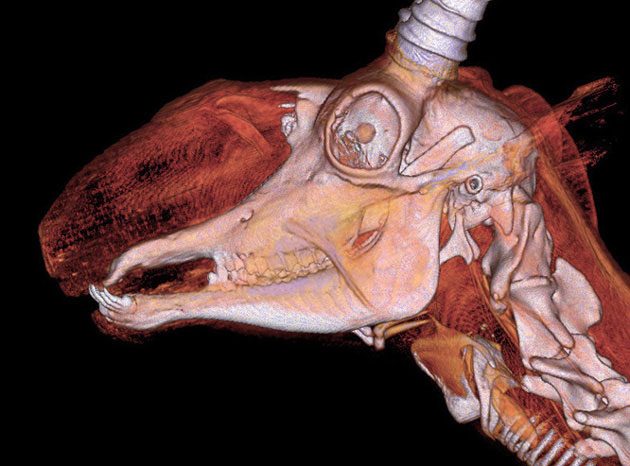
   The saiga is an antelope that's trying to be a tapir. They're only 2 to 2 1/2 feet tall at the shoulder. Adorable! Only the males have horns, but they all have giant noses. Their closest relative, another cold-adapted antelope called the Tibetan antelope, doesn't have this adaptation.
Tiny baby!
  Mammals are warm-blooded, which means we have to work to keep our body temperatures up. One of the easiest ways to mess with that is to breathe in air that's hotter or colder than our optimal body temperature...which is impossible not to do when you live in the cold steppes of Russia during the winter, like saigas, or the hot climate of the Sahara (like camels). There are two ways mammals work to counteract this with their nose: nasal turbinates and giant noses.
  Nasal turbinates are small, thin, mucosa-covered shelves of bone that stick out into the nasal passageway. They're called "concha" in humans, and,  having dissected one, I can tell you--ours are pretty pathetic. But as tiny and simple as ours are, you can still feel the effect that have on the temperature of the air we breathe. Go outside on a cold, cold day in winter. Breathe in through your nose. Then breathe in through your mouth. You will cool down much more quickly if you do the latter. Now imagine how much more effective that would be if you have turbinates like the seal below! Turbinates work this way because they're more surface area for the numerous blood vessels full of hot blood in their lining. This hot blood contacts the cold air and its temperature is evened out before it reaches your lungs.
A Hooded Seal at the Museum of Osteology in
Oklahoma showing nasal turbinates very well.
   Saiga have complex nasal turbinates like most mammals living in extreme climates, but they also add a giant fleshy nose. A saiga's turbinates don't stick out into the fleshy part of their nose--in fact the bony portion is quite far back in their head. But the fleshy part is still able to heat incoming air because it's bulbous (increased surface area) and has plenty of blood vessels running through it.
Their noses are mostly fleshy
  There are two subspecies: one in western Mongolia and one everywhere else. There range is extremely constricted compared to today. When the Sarmatians were around, they inhabited the steppes in an unbroken swath save for a small break between the ranges inhabited by each subspecies. Even farther back in time (into the Pleistocene), they were also found in North America. They're actually the only antelope that made it to the New World (Pronghorn aren't actually antelope; cattle are more closely related to saigas and gazelles than pronghorn are.).
Their population has been bouncing back and forth. They were almost driven extinct in the '20s, but were able to bounce back. Then the World Wildlife Fund got the bright idea to suggest people use their horns instead of rhino horns in Traditional Chinese Medicine. Because that makes so much more sense than telling people to just eat their own fingernails since it's made out of the same freakin' stuff and none of it does diddly-squat to help your cancer, virility, or anything else TCM practitioners claim...can you tell this subject makes me angry? I had to work not to violate my own no-cursing-on-the-blog policy. Surprise!--their populations dropped drastically. The timing of this suggestion unfortunately lined up very well with the fall of the Soviet Union. That meant economic troubles drove many of the now-poor people in these regions to turn to poaching saiga because their horns are easy cash and their meat fed their families. The fact that the males are larger and also the only ones to possess horns meant that they reached a point where there weren't enough males to mate with the females during rutting season, causing the population to crash even harder.
  Saigas have been protected in parts of their range since the '90s and were starting to recover, but their populations dropped again when a deadly, infectious disease started spreading through some of the herds, killing almost half of the population in the Kazakh Urals.
Graph produced by the Saiga Conservation Alliance
  But there's still hope. There's a captive breeding program at the Center for Wild Animals of the Republic of Kalmykia in Russia. The Saiga Conservation Alliance actively works to save these animals through research and public awareness campaigns. This includes both study of the animals themselves as well as where they're being hunted, who's poaching them, and why.

  Lastly, here's a documentary for my Russian-speaking readers (sorry, the uploader isn't letting me embed it). The saiga show up at about 3:35. The first couple minutes look like they're about some sort of rodent. A birch mouse, maybe? Skip to 10:27 to see some cute jumping and trotting and 11:00 for headbutting. And here's a video of a baby saiga because why not?

Monday, April 21, 2014

Extreme Cuteness: Tadpole-gobies

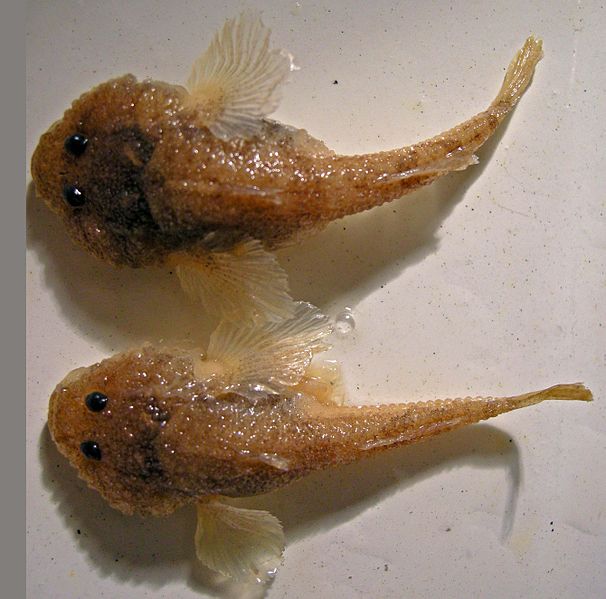
Azov Tadpole-goby
Scientific name: Benthophilus (20 species)
A higher clade it's part of: Gobiidae (gobies)
Conservation status: 8 Least Concern, 12 not evaluated
Current range: Fresh and brackish water in Caspian and Black Sea basins

Black Sea Tadpole-goby
Don Tadpole-goby
Tadpole-gobies are just adorable. Especially Don Tadpole-gobies! These abundant little fish live in the Caspian and Black Sea basins. Most of them couldn't have been encountered by Sarmatians because they live in deep brackish water or because they only live in parts of the Caspian Sea not adjacent to Sarmatian lands. Three species- the Don, Black Sea, and Azov Tadpole-gobies could have been encountered by them. They probably wouldn't have taken much note of them, though, because they're so tiny (2.6-5.9 in [6.6-15 cm]). These three live on the bottoms of lakes, deltas, and rivers.
They're carnivorous, eating small molluscs, insect larvae, and crustaceans. The species mentioned above live on sandy or muddy bottoms (depending on the species) with scattered empty shells. They need the shells because they hide their eggs underneath or inside them. They only live a year or so and die after spawning.
Tadpole-gobies diverged from the tribe they're most closely related to (Neogobiini) about 9 million years ago. Benthophilus diverged from the only other genus in its tribe (Benthophilini), Caspiosoma, about 5 Million years ago, coincident with the separation of the Black and Caspian Sea basins as they dried out. Tadpole gobies (at least, the ones sampled in the phylogenetic analysis listed below) diverged from one another about 2 million years ago, near the onset of the Pleistocene ice ages.


Neilson, M. E., & Stepien, C. A. (2009). Escape from the Ponto-Caspian: evolution and biogeography of an endemic goby species flock (Benthophilinae: Gobiidae: Teleostei). Molecular Phylogenetics and Evolution, 52(1), 84-102.

Monday, April 14, 2014

Extreme Length: Beluga Sturgeon

Scientific name: Huso huso
A higher clade it's part of: Acipenseriformes (sturgeons & paddlefish)
Conservation status: Critically endangered
Current range: Mostly Caspian and Black Sea basins, some in Adriatic Sea.

Source
  The beluga sturgeon is a contender for the largest freshwater fish alive today. It swims up rivers to spawn (which is when Sarmatians could have encountered them if they did). It does have the ability to live in brackish water, so that keeps it from holding that record in everyone's eyes. Regardless, it's the second longest extant bony fish after the Giant Oarfish, and might be the longest macropredatory fish.
  Unlike the Great Bustard from last week's post, these fish don't stop growing--a trait called "indeterminate growth". Species with indeterminate growth won't grow at the same rate throughout their lives, but their growth curves never quite reach an asymptote. That makes it hard to say what an average size is--especially when you factor in how heavily hunted they are. The average size sturgeon today is much smaller than the average size would have been during the Sarmatians' time. So to make things simpler, I'm just going to talk about record sizes today.
Source
  The record for largest beluga sturgeon was a female in the Volga River estuary. She was 24 ft (7.2 m) long--that's slightly longer than the longest verified Great White Shark (23 ft), and rivals the possible, but, it seems, unconfirmed, size of the Greenland  Shark. Its confirmed record is 21 ft, but it looks like the Florida Natural History Museum site says it could reach 24 ft. I can't find a trail leading back to the source of that information, unfortunately.
Source

  The sad story of the Beluga Sturgeon is that it's prized as having some of the best caviar and being the source of the best isinglass (a substance made from fish air bladders and used to clarify wine and beer, among other less common uses). In spite of its critically endangered status, it continues to be hunted. Even if only caviar were collected, caviar isn't collected after eggs are laid--its collected by slicing the gravid female open, thus killing her before she can lay her eggs. Sturgeons take a very long time to mature (15-25 years for this species). If the population isn't allowed to replenish itself, it will go extinct.
  Mediterranean populations are protected under the Bern Convention. The United States banned import of Beluga Sturgeon caviar from the Caspian Sea in 2005. But, unfortunately, that's not enough. It turns out you can't trust the labels on caviar jars and cans. Take a gander at the study referenced below (if I could link to a free pdf, I would). With the caveat that the study took place before the US ban, it still shows that just because it's labelled as one thing doesn't mean it actually contains it.
  The researchers collected caviar from the US and Europe from 1995-1997. Sometimes they were labelled with a species, sometimes ambiguously (e.g., river sturgeon, which is meaningless), and sometimes not at all. Nothing they sampled in Europe was mislabelled (it can from Iranian sources). The US caviar came from countries in the former Soviet Union and, depending on the year, 17-32% of sources were mislabeled. Some caviar labelled as American Sturgeon was actually Beluga Sturgeon (some of it wasn't even sturgeon--it was paddlefish). And a dishonest dealer just went right back to his old tricks after serving time for fraud.

  So...don't partake in caviar that might be from the former Soviet Union. Or better yet, not at all. Because all sturgeon species are in trouble.


Birstein, VJ, Doukakis, P and DeSalle, R, 1999, Molecular phylogeny of Acipenserinae and black caviar species identification, Journal of Applied Icthyology, v. 15, p. 12-16.
http://www.theguardian.com/uk/2003/nov/09/ukcrime.london

Monday, April 7, 2014

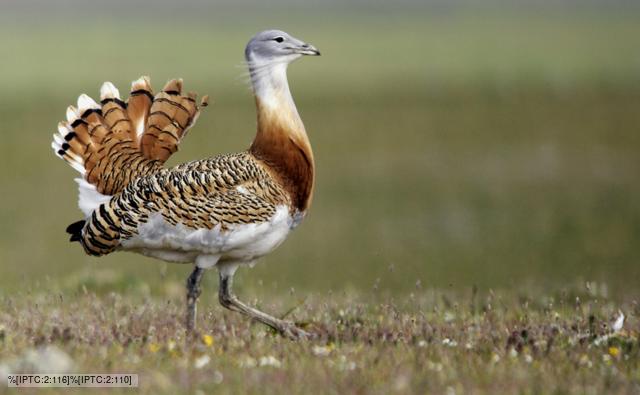
Extreme Weight: Great Bustard

Scientific name: Oris tarda
www.bbc.co.uk - Male demonstrating part of the display.
A higher clade it's part of: Gruiformes (cranes & allies)
Conservation status: Vulnerable
Current range: Spotty areas of grassland and steppe across Eurasia in the band of latitude stretching from Gibraltar to southern England, plus a small area in Morocco across from the Straits.

Birding in Portugal has a display/fighting video (skip to
1:05 for the bustards) and some fantastic photographs,
including this one. It demonstrates the sexual dimorphism
between the female (top) and male (bottom).
And yes...she is doing what you think she's doing.
The Great Bustard is the heaviest extant flying bird (also most sexually dimorphic in size). Well...depending on what you mean by "heaviest". It could mean (1) heaviest on average, (2) heaviest maximum in the range of sizes normally reached, or (3) heaviest record. The male Great Bustard's stats for those are (1) 21.3-29.8 lb (9.65-13.5 kg), (2) 40 lb (18 kg), and (3) 46 lb (21 kg). They're rivaled by their relative the Kori Bustard, whose weight surpasses it in (1) 30 lb (13.5 kg), ties it in (2) 40 lb (18 kg), and is beaten by it in (3) 44 lb (20 kg). For the record, I'm ignoring unconfirmed records because it's ridiculous how much those can be exaggerated, even when the teller doesn't mean to. The way our memories and perception work is annoying sometimes...

Like many Gruiformes, these birds display to attract mates. Because they're ground birds, they perform in leks much like the more local-to-Calontir prairie chickens.

I haven't seen any bustards in Sarmatian art, but they co-existed on the Russian steppes, so it's unlikely they never encountered them. Scytho-Sarmatian art tends to focus on mammals rather than birds–eagles being the exception–so it's not really surprising that they wouldn't depict them.