Showing posts with label AandS50. Show all posts

Thursday, August 20, 2015

New Grave Find and Iranian Nomad Social Media Group

A new group of Sarmatian kurgans has been found with at least 29 graves! They opened one up and found a double burial of what they are assuming to be a married couple.

And since my dissertation struggles have meant I've avoided spending time doing SCA stuff, Holly Herda over at Sarmatian in the USA was kind enough to set up that Iranian nomad social media group I talked about a while back. I got an equal number of votes for Facebook and Google Groups. Since there's already a good and relevant group on Facebook, Mongols and Russians and Scythians, Oh my!, we went with Google. She found out that Google is planning to phase out Google Groups, unfortunately, so SCA Iranian Steppe Nomads is a Google+ community.

Thursday, May 14, 2015

Horse Archers

Briefly popping in to share a video recently posted to YouTube. I'm still too deeply embroiled in dissertation and career stuff to play in the SCA at the moment.

Every fighting style has its pros and cons. Here's a video by Lindybeige discussing the cons of mounted archery in battle. Sarmatians mostly raided small villages with no fortifications, so the main point he discusses wasn't a frequent concern for them.


Saturday, September 6, 2014

Of Ancient Norse, Egalitarian Societies, and Burial Practices

Some of you may have seen an internet article like this one going around recently for a study that was actually published three years ago. But if your local library doesn't have the access to go behind the paywall of the original article, you might also find yourself being mislead. Here's a more accurate write-up of it close to the time of publication, and here's a write-up explaining where the newer misleading ones went wrong. I recommend reading through the comments of the last one; some of them are quite informative.

I first got wind of this study through one of the newer studies. I had a brain fail and didn't check the primary reference (shame on me!) before commenting on a friend's post that I wasn't surprised. The Norse did give us Valkyries and shieldmaidens, after all. And I'd heard from SCAdians with Norse personas that women in those cultures had much more freedom than more stereotypical medieval European societies. But then I saw the post explaining the errors and I was also not surprised. The game of Internet Telephone and bad science journalism strike again...

One of the comments reminded me of something that I've never explicitly stated (and I apologize for not doing so before)—when you hear or read about egalitarian societies of the past (or today)—it doesn't necessarily mean they're egalitarian because they believe in equality. It might be because they don't really have a choice.

<tangent>To bring in another of my bio/paleo analogies, terrestrial vertebrates can be bipeds or quadrupeds, but the description doesn't end there. They can be obligate or facultative bipeds or quadrupeds. There's a difference between an organism being bipedal because it has to be vs. bipedal because it wants to be. Raccoons, for example, are quadrupeds normally, but I've seen them pick up food in their front paws and run away on their hind legs. It was more useful for them to be bipedal at that point in time because they could carry more food that way.
</tangent>

In her book, Davis-Kimball recounts some time spent with a modern nomad group. Their chief was a woman. She asked the men what they thought about having a female leader. They looked at her like she was an idiot and told her she was their chief because she was the most qualified to be their chief. End of story.

If you're like me, you probably have a pretty privileged life. Living inside a decent building. Your access to the internet is good enough that you can afford to spend time on it reading my blog instead of doing necessary things like checking if your boss has e-mailed you recently. You can likely go to a nearby grocery store to buy your food. Maybe you even have the fallback of living with your parents if your job doesn't pan out.

But if you live a nomadic life on the steppes, or you're looking for new farmland across the sea, the future quality of your life is much less certain. You can't afford to tell half the population "No, stay home. We'll take care of everything here" or "You can't fight or be a leader because we want you to sew things and cook, even if you aren't terribly good at it". What an individual does is dictated by necessity as much as by their skill. If a male Viking spends all day raiding a nearby village, he's not going to be able to stay home and tend the fields. If your group needs a leader, you pick the best because you may not fare well in the winter if you don't. The way "civilized" society has been set up, we have more leeway with the mistakes we make. Crops didn't do well this year? That's okay. We've got plenty from last year in the freezer.

But having all that leeway means the powerful also have more wiggle room to let their personal preferences creep in. And in Western society, that means assuming males are more competent than females in many jobs and deserve more pay. Now before you counter that the pay gap is false, I've read the same 70% statistic as you and, like you, disregarded it because the study that number came from failed to account for various factors that would cause it to look more serious than it should. I didn't see any reason to believe the pay gap diatribe until I read this horrifying study. It's in an open access journal, so you have no excuse not to read it.

But if you're in a rush, here's the take-home message (before you go read the full thing later): Give people (male or female; it's so ingrained in our culture that it doesn't matter!) the resume of an applicant for a STEM field position. If the gender of the name is masculine, they are more likely to hire that person, offer them a higher salary, give them more career mentoring, and consider them more competent.

The thing that makes this study so convincing is that the only thing that changed on the resume was the gender of the name. Everything else on the resume—the achievements that actually tell you how good a candidate a person is—was the. Exact. Same. And there have been plenty of other studies showing similar biases (which is why female authors often abbreviate their names).

...So back to my original point—when you read about female warriors of the past, or female leaders of modern nomadic tribes, don't assume it means that society believes/d everyone is created equal. It might just be because they had/ve no choice but to act that way.

Remember the post on the Nart Sagas I linked to? Where there's a prophecy that "one day men and women will live peacefully as equals"? At first glance, it sounds all warm and squishy because it means they accept that it's possible for people to be equal regardless of gender. But also remember that wife kidnapping was a thing there. And forcing an unrelated woman to treat you like a son by doing something that, in our society, is sexual harassment was an accepted practice.

Early Sarmatian (or maybe just Sauromatian, I forget if it stopped with them) graves with weapons may have been 20% female, but that practice died off. By the time you get to Late Sarmatians, there are no more female warriors defending their tribes against the Huns or raiding nearby Roman settlements. And as for that 20% number, again, things aren't necessarily what they seem. Just because someone is buried with an object doesn't always mean they regularly used that object in life. Ancient Egyptians were buried with a book; that doesn't mean they were all librarians.

Like the Book of the Dead, the steppe nomad practice of burying weapons with people could be a ceremonial or religious thing (from what I've read, they did practice a sort of sword worship). Maybe that noblewoman was buried with a sword because her tribe felt that people of note should be buried with a symbol of power. Or maybe their mythology had dead souls paying their way to the afterlife with a sword, like the coins for Charos (note: I completely made that one up; I have no reason to actually believe that). Who knows? One could come up with any number of theories, both substantiated and unsubstantiated. The same goes for the occasional steppe nomad man buried with both weapons and mirrors (normally associated with female graves)—doesn't necessarily mean he was something like a Two-Spirit, which Davis-Kimball suggested. The assumption that grave goods are solely representative of use in life is rife with errors and where Davis-Kimball's book falls flat.

On the other hand, it doesn't mean that every case of being buried with weapons was like that. It is common practice, after all, to bury people with things they were attached to in life. Just remember that's it's not going to be a 1:1 correlation. If you want to be sure about a particular find, look for data like whether a particular sword was worn from use and whether the skeleton shows skeletal pathologies consistent with being a warrior.

Thursday, August 21, 2014

Sarmatian-related Objects in the British Museum

  I was actually able to find some Sarmatian-related things in the British Museum! Yay! Many of them were artifacts from sedentary cultures that were either traded from or influenced by their steppe neighbors, be they Sarmatian or contemporaries of the Sarmatians.

  First up is something a sedentary culture picked up from either the Sarmatians or a contemporary steppe culture. They liked to sew gold plaques on their clothing. There were some in a case of Parthian items from the 1st century AD.
  There are tiny holes on the edges for the thread. Not pictured above these were some gold leaves mimicking early Greek head wreaths. The label notes that the wreath was probably placed on a corpse, so in this case the gold plaques may have been a funerary-specific thing.


 There were also a type of small, three-sided arrowhead which were apparently indicative of Central Asian steppe cultures before some sedentary ones decided they were awesome and started using them themselves. They were apparently quick and easy to make and good at piercing armor. They were fired out of recurved bows—also introduced form the steppes.
 These are from a soldier's cemetary (Deve Hüyük) from the mid-6th to 4th century BC in northern Syria, which was then part of the Achaemenid Empire.

  This horse bit is from the same site as the arrowheads. Nothing was said about whether the style was native Achaemenid or steppe-influenced, but I've included it here since it's contemporary and may be of interest to equestrians.
  I wouldn't advise actually using these on your horses, though. The label noted that the knobs on the snaffle, while allowing control with very small movements, would be uncomfortable for the horse.


  They also found items in at least one female grave there. Bronze mirrors were also ritually buried with priestesses in steppe nomad kurgans. It used to have a wooden handle. The bone tube used to have a lid and contained some sort of makeup. The other items are a cloak brooch and bracelets with stylized calf's head motifs.
  Anyone know what the burial practices of an Achaemenid garrison would have been?  Would they bury wives of soldiers there as well? Would they have had a religious leader there? Or did women sometimes fight in their culture like the Sarmatians? The labels didn't say if these were found alongside martial artifacts or not.

  Fast-forward in time to the Sassanian Empire—the last Iranian empire before the spread of Islam. They made seal stamps out of various minerals. People, animals (real and mythical), plants, and inanimate objects were all possible images on the seals. ...So were tamgas. :)
  The BM display only had the one tamga seal (no provenance given), but you can see quite a few more in a private Austrian collection on this website.


   And, finally, there was the Ribchester Hoard. The hoard itself is too early to belong to any of the Iazyges Sarmatians that were stationed there, but other, later Roman artifacts were displayed in the same case. And some of them looked to be lifted from the Sarmatians. One of the re-enactment groups I'll talk about soon discussed how Romans tended to absorb weapon and armor styles from the people they conquered.
  There were a number of weapons in this case—swords, daggers, etc...—and one of them is a ring pommel sword. Ring pommel swords were popular among Sarmatian from the 2nd century to the 2nd century AD (mentioned in the Osprey book on them). They were also used by other Central Asian peoples, though it doesn't seem like they were very popular until later according to the discussion on this forum. About the time the Iazyges were first drafted into the Roman army, ring pommel sword became popular amongst Romans.
  This sword is from the 2nd-3rd century AD, Pevensey, East Sussex. It was found with coins from Emporer Commodus' reign (176-192AD). It was buried in the ground intact. The wood and leather scabbard(?) (I think they may have meant to say grip there...) rotted away, but the tin-coated bronze pommel is intact.

  I'll talk more about the Ribchester Hoard and the Sarmatian ala there in an upcoming post on the Ribchester Roman Museum.


Wednesday, July 9, 2014

Maybe Scythian Stuff in the Louvre?

Apologies for the wait. Between collections work, sightseeing, some professional service work, keeping up another blog to meet one of the requirements for one of my fellowships,and resting from doing all that, I'm only now getting time to write stuff up here. But more will follow shortly. :)

It turns out the Louvre doesn't actually have any Sarmatian stuff. I wish I'd saved the link that pulled Sarmatian stuff up on a search because I have no idea why it told me they did. They have one thing in the collections which references the Sarmatians (a Roman relief commemorating some of Hadrian's victories over them), but no actual stuff of their's according to a search through their online database. I went through the Iranian area (Iranian meaning cultures-and-empires-based-in-Iran, not all Iranian ethnicities) just to see what was there.

The database mentions an Achaemenid bracelet that might have been made by the Scythians. I found some artifacts on display that look familiar after having looked at a lot of pictures of Scythian metalwork. But there's no way to be sure they actually made it because the Louvre is an art museum and art museums do this thing where they hardly give you any information on the labels. Just name, material, date, donator, and date of aquisition.

---Dear art museums,
I know you want us to spend our time looking at the art pieces, but I would be able to appreciate them more if you'd give me a contextual framework in which to appreciate them. I know I could have rented an audio guide, but I highly doubt you consider the pieces I'm interested in important enough to tell me about them in there. And I know you sometimes have guided tours, but same thing there. So....more informative labels, please?
Sincerely,
Me---

So, given the lack of information (I only knew they were found within the boundaries of an Iranian empire because that's what the rooms' themes were.), there's no way for me to know if those pieces were: 1) made by the Scythians and traded to someone in an Iranian empire; 2) made by someone in an Iranian empire copying Scythian art style; or 3) representative of that Iranian empire's art style which happens to be similar to the Scythian's because they used to be the same people way, way back in the day. That being said, here are the artifacts I saw which might fall in one of the three categories above.

Colored relief of Assyrian griffins.
 Assyrian griffins look different from Scytho-Sarmatian griffins, but still quite fun. They have lion heads instead of eagle heads, horns instead of fin manes, and eagle back feet instead of lion back feet. But notice the colored blotches on their flanks? Look reminiscent of some Scythian style art you've seen before on this blog?

Bronze quiver plates (leather's rotted away) and arrows. 8th-7th centuries BC
The designs on the cases look nothing like Scythian cases (aside from griffins attacking a prey animal in the upper right being a familiar motif). But the cases themselves are the same type of design- bronze on leather with panels of scenes on them.

Bronze bracelets, 8th-7th centuries BC
Torses ending in animal heads were common in Scytho-Sarmatian jewelery, though these specific designs don't ring any bells for me.

Something made of bronze. That's all the label said.
 The label called these branches. They look vaguely reminiscent of the "Tree of Life" motif, but I don't know if it's an actual correlation or the human tendency to see patterns even when they aren't there.

Bronze plaque. Label says "Fin du Fer I"....End of the Iron Age?
There were several openwork plaques similar to the above. From far away they look like deer heads seen from the front. Close up, they're made of a pair of ibexes, sometimes with extra ibex or dragon heads popping out of strange places. They reminded me of Scythian art, though no particular pieces are coming to mind. And since I'm traveling, I don't have my books with me to search for them.

So that was the Louvre. Next up, the British Museum, where I had a bit more luck.

Saturday, July 5, 2014

The Nart Saga

The Nart sagas are a collection of tales from the Caucasus about a group of ancient heros running around doing epic things–epic here meaning both the original definition and also sometimes hilariously awesome. Both Caucasian people (sensu stricto) and Ossetians tell stories of the Narts to one another and scholars think parts of them preserve ancestral Indo-Iranian mythos.

They certainly do have a lot of parallels with other Indo-Iranian ethnicities. For instance, there's an trickster like Loki and a story very similar to the Greek story of how Prometheus brought fire to humans. One big difference is that the leader of the Narts is a matriarch, not a patriarch. The Ossetians call her Satana, but variations of her name in other cultures include Satanaya and Sela-Sata.

The general tone of the sagas is remarkably matter-of-fact. If a Nart has to do something extraordinary, the fact that it's unusual is oftentimes remarked upon. Then again, there are unusual things that are treated like normal, everyday occurrences...like the story of how Satana got her son. And no...it is nothing like what you think. Very weird, though. I'm not going to go into that here because it's the sort of thing that should go behind an adult filter in our culture. I may still post some of the stories later, but with a specific warning that it's not my usual type of content.

I have John Colarusso's translations of the Caucasian versions into English (Circassian, Abkhazian, etc...), but at the time of printing he was only just starting to work on learning Ossetian. Which means I can't personally compare the Caucasian versions to the Ossetian to try to find bits that are uniquely Ossetian (and thus, Sarmatian in origin) and which bits are uniquely Caucasian. But fortunately, there's another Sarmatian in the SCA who knows Hungarian and there is a Hungarian translation of the Ossetian Nart Sagas. She's been reading through them recently and has posted some of her favorite excerpts here. I recommend taking a look. :)

Monday, April 28, 2014

Extreme Schnoz: Saiga

Scientific name: Saiga tatarica
A higher clade it's part of: Antilopinae
Conservation status: Critically endangered
Current range: Patches in Russia, Kazakhstan, Uzbekistan, sometimes Turkmenistan, and Mongolia

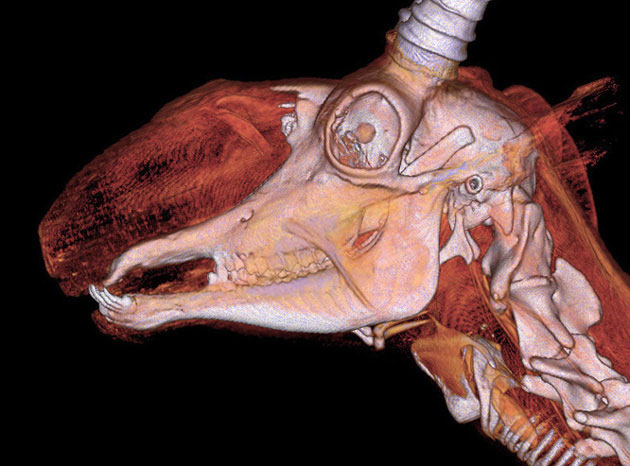
  I'm ending the Extreme Animals series with one that the Sarmatians definitely encountered. We know this because it was important enough to be a subject of steppe nomad art. Also cool enough to be in two of my three forays into zoomorphic steppe art as illumination.


Source
   The saiga is an antelope that's trying to be a tapir. They're only 2 to 2 1/2 feet tall at the shoulder. Adorable! Only the males have horns, but they all have giant noses. Their closest relative, another cold-adapted antelope called the Tibetan antelope, doesn't have this adaptation.
Tiny baby!
  Mammals are warm-blooded, which means we have to work to keep our body temperatures up. One of the easiest ways to mess with that is to breathe in air that's hotter or colder than our optimal body temperature...which is impossible not to do when you live in the cold steppes of Russia during the winter, like saigas, or the hot climate of the Sahara (like camels). There are two ways mammals work to counteract this with their nose: nasal turbinates and giant noses.
  Nasal turbinates are small, thin, mucosa-covered shelves of bone that stick out into the nasal passageway. They're called "concha" in humans, and,  having dissected one, I can tell you--ours are pretty pathetic. But as tiny and simple as ours are, you can still feel the effect that have on the temperature of the air we breathe. Go outside on a cold, cold day in winter. Breathe in through your nose. Then breathe in through your mouth. You will cool down much more quickly if you do the latter. Now imagine how much more effective that would be if you have turbinates like the seal below! Turbinates work this way because they're more surface area for the numerous blood vessels full of hot blood in their lining. This hot blood contacts the cold air and its temperature is evened out before it reaches your lungs.
A Hooded Seal at the Museum of Osteology in
Oklahoma showing nasal turbinates very well.
   Saiga have complex nasal turbinates like most mammals living in extreme climates, but they also add a giant fleshy nose. A saiga's turbinates don't stick out into the fleshy part of their nose--in fact the bony portion is quite far back in their head. But the fleshy part is still able to heat incoming air because it's bulbous (increased surface area) and has plenty of blood vessels running through it.
Their noses are mostly fleshy
  There are two subspecies: one in western Mongolia and one everywhere else. There range is extremely constricted compared to today. When the Sarmatians were around, they inhabited the steppes in an unbroken swath save for a small break between the ranges inhabited by each subspecies. Even farther back in time (into the Pleistocene), they were also found in North America. They're actually the only antelope that made it to the New World (Pronghorn aren't actually antelope; cattle are more closely related to saigas and gazelles than pronghorn are.).
Their population has been bouncing back and forth. They were almost driven extinct in the '20s, but were able to bounce back. Then the World Wildlife Fund got the bright idea to suggest people use their horns instead of rhino horns in Traditional Chinese Medicine. Because that makes so much more sense than telling people to just eat their own fingernails since it's made out of the same freakin' stuff and none of it does diddly-squat to help your cancer, virility, or anything else TCM practitioners claim...can you tell this subject makes me angry? I had to work not to violate my own no-cursing-on-the-blog policy. Surprise!--their populations dropped drastically. The timing of this suggestion unfortunately lined up very well with the fall of the Soviet Union. That meant economic troubles drove many of the now-poor people in these regions to turn to poaching saiga because their horns are easy cash and their meat fed their families. The fact that the males are larger and also the only ones to possess horns meant that they reached a point where there weren't enough males to mate with the females during rutting season, causing the population to crash even harder.
  Saigas have been protected in parts of their range since the '90s and were starting to recover, but their populations dropped again when a deadly, infectious disease started spreading through some of the herds, killing almost half of the population in the Kazakh Urals.
Graph produced by the Saiga Conservation Alliance
  But there's still hope. There's a captive breeding program at the Center for Wild Animals of the Republic of Kalmykia in Russia. The Saiga Conservation Alliance actively works to save these animals through research and public awareness campaigns. This includes both study of the animals themselves as well as where they're being hunted, who's poaching them, and why.

  Lastly, here's a documentary for my Russian-speaking readers (sorry, the uploader isn't letting me embed it). The saiga show up at about 3:35. The first couple minutes look like they're about some sort of rodent. A birch mouse, maybe? Skip to 10:27 to see some cute jumping and trotting and 11:00 for headbutting. And here's a video of a baby saiga because why not?

Sunday, April 6, 2014

Ossetian Language

Surprise Sarmatian post! Which means I'm procrastinating and will be getting back to work immediately after posting this...

I recently had a conversation with someone which prompted me to try again to find internet sources for listening to or learning bits of the Ossetian language. The Ossetian language is a direct descendant of the Scytho-Sarmatian languages with the Alanian language as the bridge between them. It's the only living member of the Northeast Iranian language group, though modified through proximity to Caucasian languages. The three dialects are the extant Dagor–spoken in western North Ossetia, Iron–spoken elsewhere in Ossetia and the standard for the written language, and the now-extinct Jász language–which was spoken in Central Hungary from the 12th through 15th? centuries. The living full languages closest to Ossetian are Pashto and Yaghnobi in the Southeastern Iranian language group, spoken in Afghanistan and Tajikistan, respectively.

I had more success finding sources this time (as in I had success at all). Quite a bit of it is in Russian, so those of us who don't speak it are at a severe disadvantage. But here are the links I've found:
http://ossetian.free.fr/
http://ossetic-studies.org/en/links
Here's a video of a man speaking Ossetian, but the description says he shifts into Georgian sometimes and I don't know which is which.
And the Wikipedia page actually has quite a bit on phonetics and grammer lifted from the research of Vasily Abaev, though I can't understand the phonetics table.
http://en.wikipedia.org/wiki/Ossetic_language
What I would really like, though, is audio tracks accompanied by the letters and a discussion in English (French is fine too). If any of you know of a site or audiobook or anything like that, please let me know.

The first link is the closest I've found to that. No audio, but it has the words written in English phonetics along with the Cyrilic. I'm sure I'm butchering the pronunciation without audio to reference, but it's at least better than nothing. And as for emphasis, I only know from that Abaev says the difference between "a ___" and "the ___" in Ossetian is the emphasis–the former puts the emphasis on the second syllable, the latter the first.

I'm thinking it might be fun to incorporate some of these while at events–especially if in a zone where "period" is required...which I can't go in yet because I don't have a full period kit. Not enough time or money to put together at the moment. :/
Some that SCAdians might be familiar enough with, or you may use often enough for frequent companions to easily learn are below. The format is English word- Ossetian written alphabet- English phonetic pronunciation. All are from ossetian.free.fr.
Hello                        Салам                 salam
     SCAdians may recognize this because it sounds like (or at least very similar to) the Arabic word for "peace", used in a similar way. Think "peace be upon you/and upon you peace".
How are you            Куыд цæрyт?     Kwyd tsærut?
Goodbye(1)             Фæндараст         fændarast
Goodbye(2)             хорзæй баззай    horzæï bazzaï
     I'm not sure what the difference is.
Please                      дæ хорзæхæй     dæ horzæhæï
Thanks (so much)     (стыр) бузныг    (styr) buznyg
Yes                          о                          o
No                           нæ, нæы             næ, næy
I am sorry                ныххатыр кæн    nyhhatyr kæn
Excuse me               бахатыр кæн       bahatyr kæn

Saturday, February 15, 2014

Jász Linkdump

I mentioned the Jász in a previous post (I had used the descriptor Jassic, but have been told that's an Anglicized version, so I won't be using it again.). There's a Jász man named Attila Fábián Rigó on facebook who posts a lot of good historic information. I recommend following him and browsing through his photo albums. :) He and a friend have done some amazing recreations of pieces from the Golden Deer of Eurasia book which I at first mistook for the real things. They exhibited them at the Jász World Meeting last summer. He's an administrator of a genetic survey called the Ossetian DNA Project (his section is the Hungarian Jászság DNA Project). It's in progress, so there isn't a lot of explanation of the results up on the web yet, but keep your eye on it if it peaks your interest. So if you want to know more about the Jász, here's a linkdump he sent me for you to browse.
http://en.wikipedia.org/wiki/Asii 
http://s155239215.onlinehome.us/turkic/70_Dateline/alan_dateline_En.htm
http://en.wikipedia.org/wiki/Kangju
http://en.wikipedia.org/wiki/Asud  
http://www.jatland.com/home/Ahlawat
http://www.jaszmuzeum.hu/

Friday, January 10, 2014

Ask the readers: Animals

One year ago today, we adopted a cat from the local shelter. Tali'Miller-Camp vas Iowa (yes, that is a Mass Effect reference) is a pet- an animal kept for pleasure. But unless your SCA persona is upper class and probably late period, the animals s/he could have kept are unlikely to have been purely pets- they would have had some sort of practical use.

What kind of animals did your persona (or their culture if not them, specifically) keep? What breed? Is it or breeds descended from it still around today? What were they used for?


Unlike my other "Ask the Readers", I can actually answer this one! Collectively, Sarmatians kept horses, cattle, sheep, and dogs.

Apologies for the lack of centering (it's at the top).
Turns out I don't have an image of this on my computer.
I'll replace it with a better version when I get home.

The sheep and cattle they kept for food, wool, and leather. Scythians did too and you can see an example of Scythians making a sheepskin shirt on a beautifully intricate torse made by the Greeks.


Mongolian horse and rider
Image source: http://www.studiomme.com

Their horses were their livelihood. They were meat, clothing, milk, wealth, transportation, and mounts all rolled into one. They would have been short and stocky compared to the horses we're accustomed to seeing in the West today- probably a lot like horses kept by modern steppe nomads.


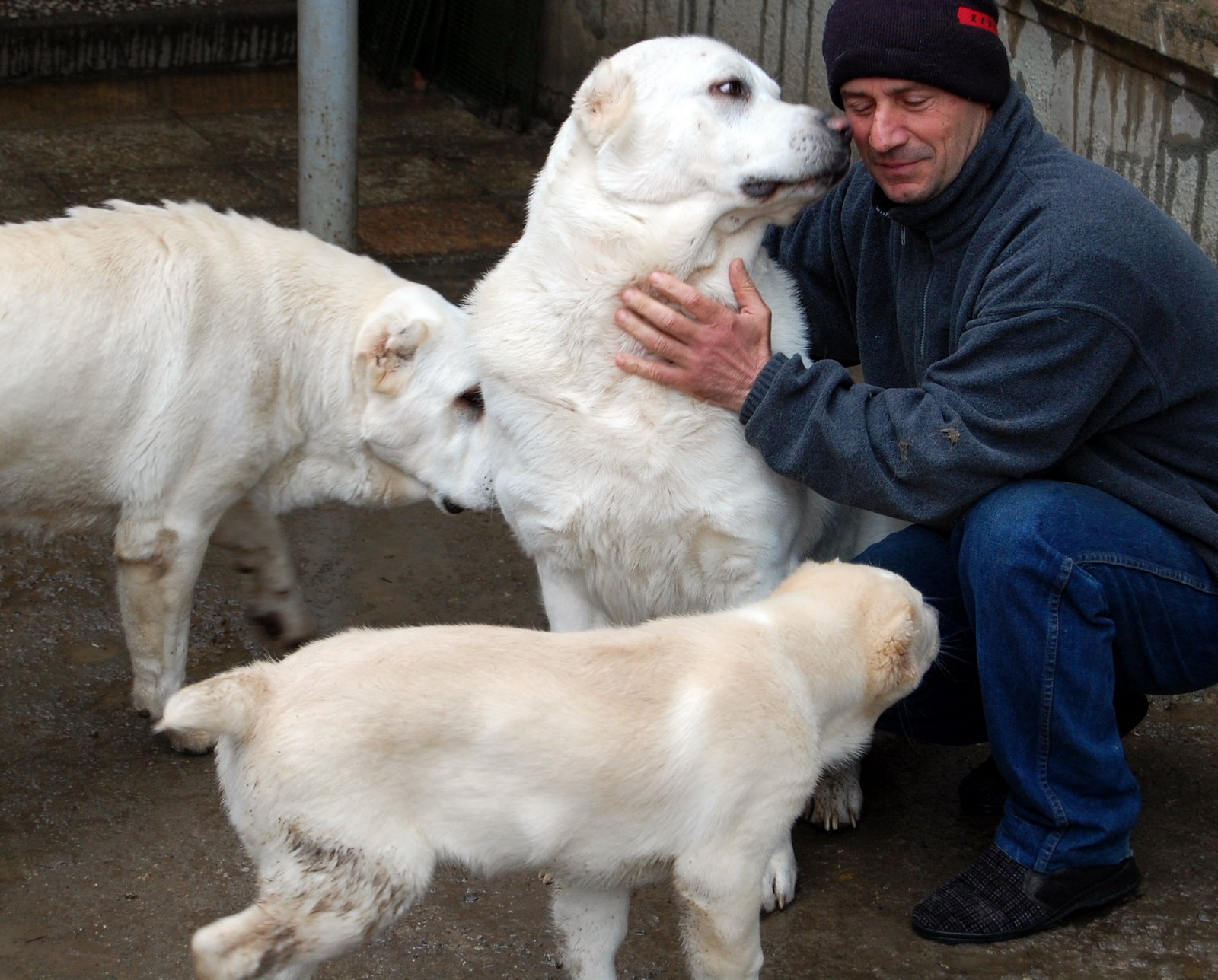
Kazbegi type Georgian Mountain Dog
Image source: http://kaukasus.blogspot.com

Their dogs were big molossers who served as livestock guardians and war dogs. The dogs of the Sarmatians sensu stricto were Sarmatian Mastiffs. The breed kept by the Alans was the Alaunt (which would have been partially descended from the Sarmatian Mastiff. The word 'Alaunt' later came to be used for a general phenotype, rather than a particular breed, in Europe. The original Alaunt probably looked similar to the Kazbegi type Georgian Mountain Dog, which is probably a descendant.

(References will be when I get home. Sorry!)

Monday, April 22, 2013

2013 Two Truths and a Lie #3


FALSE

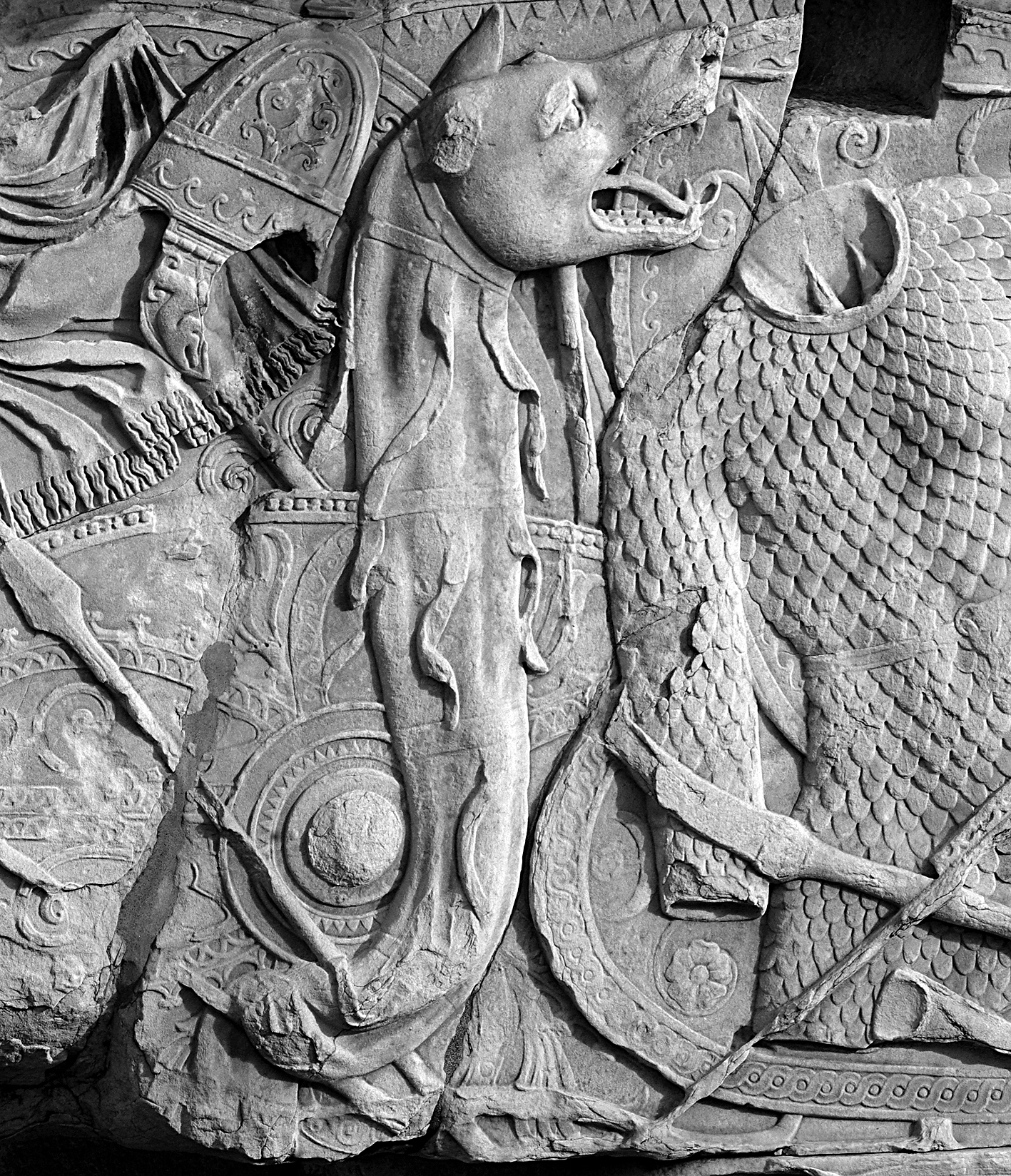
   Which might be confusing if you've seen the picture below with no context.
  Trajan's Column is an impressive record of both of the Dacian Wars. The part relevant to us is the exterior of the column, which has a spiral frieze carved on it. Many of the "barbarians" depicted on it are Dacian, but Sarmatians take part and make an appearance.
  On the column, there's a panel showing the Sarmatians fleeing from the Romans. Both they and their horses are decked out in scale mail from head to toe. However, no one thinks this is an accurate representation of what the Sarmatians would be wearing. Because let's face it....it just seems ridiculous. Can you imagine a rider sitting on scale mail pants while his horse is trotting? Or a horse trying to run with a tube of scale mail around its legs scraping against the scale on its side? This depiction could be based on the scared and exaggerated memory of a survivor, an artistic flight of fancy, or a miscommunication between the two. Elsewhere on the column, hauberks are depicted as spoils of war with no evidence of pants. 

 Ammianus and Pausanias, two classical authors from different centuries, both describe Sarmatians as wearing scale cuirasses made from horse hooves. Pausianus mentions that they are sewn on with horse or cattle hair and Ammianus adds that they are sewn to a linen shirt. Neither of them mention scale pants. Frustratingly, though, no hoof cuirasses have been found in any Sarmatian archeological finds. I haven't done much serious research into Sarmatian armor, but current opinions seem to hold that a mix of metal scales and lamellar plates are more likely/common.


Pausianus, Periegesis
Ammianus Marcellinus, Res Getae
Brzezinski, R., and Mielczarek, M., 2002, Men-at-Arms: The Sarmatians 600BC-450AD, Osprey publishing.


Monday, April 15, 2013

2013 Two Truths And a Lie #2

TRUE

  Just not directly. And who knows from whence it ultimately came.
  When people talk about "origins" or "causes", many don't distinguish between direct, ultimate, or steps along the way. Sarmatians are only one of many candidates for the ultimate origin...saying they're a step along the way is the more conservative (and, IMO, more likely) assumption.
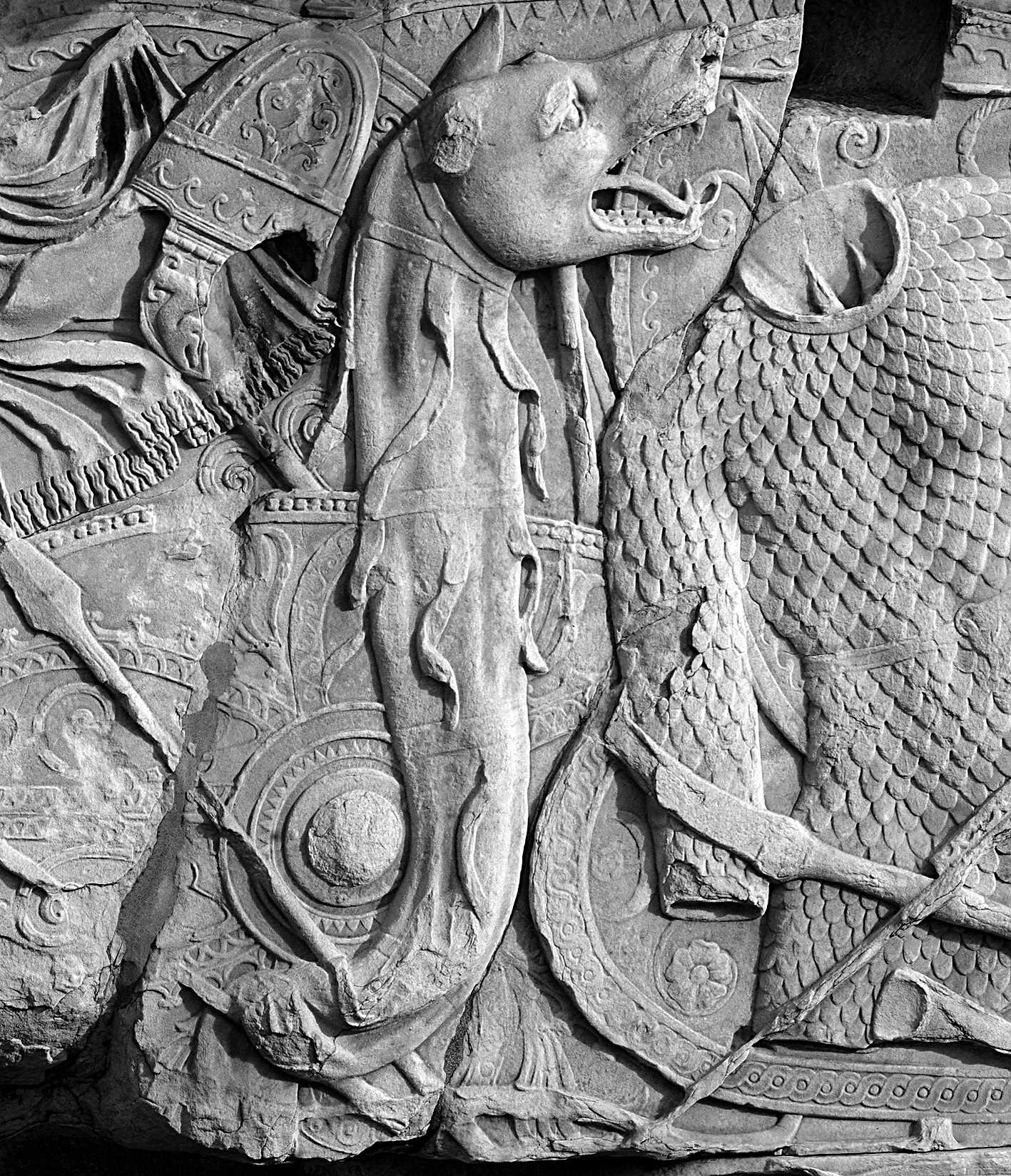
A Dacian draco on Trajan's Column- note the wolf
head and the complicated construction with
multiple rings and streamers on the tube.

  For the direct origin of Roman draco standards, look to the Dacians. By the end of the 1st century AD, the Romans associated the dracos with the Dacians they had recently defeated in the Dacian Wars. Which means they probably got it directly from them (though they also knew Scythians [he likely meant the Sarmatians] had them, as Arrian wrote about dracos making a fearful sound).
  Draco origins are discussed by Mihailescu‐Bîrliba (2009) in his analysis of a funerary monument in Chester. This happens to be the picture on the background of this blog. He makes a very convincing argument for a Dacian direct origin as well as for the monument actually depicting a Dacian, not a Sarmatian, as was previously thought. Which means I have to find a new background picture... *grumble*

  The ultimate origin of draco standards is a point of contention among scholars. Dacian, Scythian, Thracian, Sarmatian, Parthian, Persian, and even ancient Indo-Iranian have all been proposed. There are two issues to be considered when looking for the ultimate origin.
1) Where do we first see or read about them?
2) What was their original use?


On first appearances:
  We have to be careful with first appearances. First appearance dates (FADs) are statistically highly unlikely to be the first existence date. This is acknowledged in paleontology by differentiating between FADs and what we call "ghost lineages". A ghost lineage is a stretch of time during which, based on phylogenetic hypothesis, a clade or species had to of existed, but we have no physical evidence of it.
  Unfortunately, sorting out the history of cultural artifacts is so much more complicated than evolutionary trees that can be sussed out based on morphological and molecular evidence. So no such thing as a ghost lineage for dracos, but we still need to acknowledge that the first time we see evidence of one is not necessarily evidence of the first one. If there's a large enough stretch of time between FADs in different cultures (the size of "large enough" TBD by scholars more knowledgeable than I), then we can say, "Yes, this culture probably had it before that one." But this far back in time and with so many illiterate cultures involved, what's a few decades to anyone? Considering how widespread dracos were in the ancient world, unless we know that one group encountered it in another before adopting it (e.g., Romans and Dacians), I don't think it prudent to consider first appearance to be synonymous with [almost] first existence.
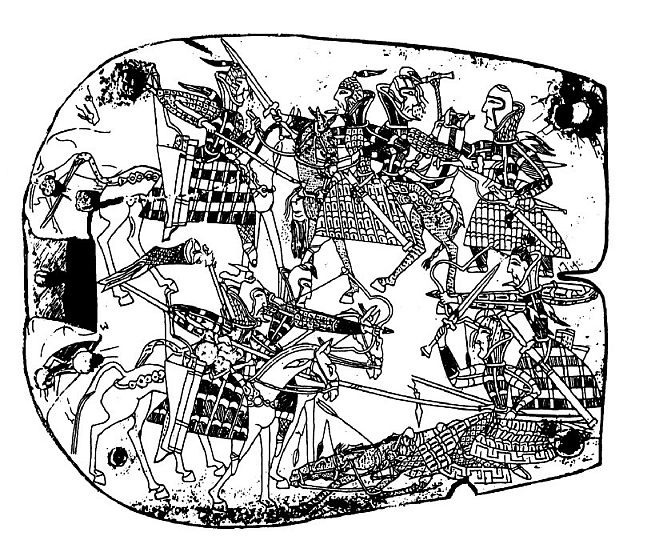
Orlat battle plaque from Sogdiana/Uzbekistan-
note the tube of fabric on a stick at center left.

  So far as I know, there is no evidence of an animal head on a pole with fabric streaming behind it showing up in one culture well before another (please, please correct me if you know better than I). There is a depiction of a headless one held by horse archers in Sogdiana (modern Uzbekistan) which might (with a very heavy emphasis on the "might") be from the last centuries BC. It might also be from the 4th or 5th century AD. I don't feel comfortable using it as evidence of an early depiction until the professionals have reached a consensus.

    I've seen an argument that the Dacians had them as far back as the Bronze Age based on bracelets- you can find zoomorphic bracelets in their area which have wolf heads (the Dacians used wolf heads, not the dragons the Romans used) on either end. But assuming that's a depiction of a draco 1) ignores the fact that other people across Eurasia also had zoomorphic bracelets with animal heads, and 2) requires a pseudoscientific practice- seeing what you want to see instead of being objective about it.
  It's zoomorphic art. It has nothing to do with dracos except to reflect the animals preferably depicted by each culture. Just because the head is on the end of a long thing doesn't mean the bracelet shaft represents the fabric tube. The end is just the intuitive place to put an embellishment on a bracelet that isn't shaped like a full circle.


On original use:
  Wind sock, religious purposes, group symbology (ethnic or military unit), and intimidation in war are all possible uses of a draco standard (though I'm personally less inclined to consider the religious use a possibility [lack of evidence and the whole copout thing I've talked about before]). When looking for an ultimate origin, it doesn't matter what it was used for along the way (so Roman use is irrelevant). What matters is the original use because it might narrow down the possibilities for its origin. The Romans remarked on them making frightful sounds, so it definitely intimidated them, but that doesn't mean that was the original intended use. If it were originally a war standard, it probably came from a culture which fought battles fairly regularly and most likely against other cultures that later adopted it. If it were originally a wind sock, the culture inventing it would had to have used archers in battle and they would likely need to be standing still for at least part of the battle. Wind socks will pick up forward movement which would then need to be compensated for, making them more difficult to use (or impossible if the horse were moving fast enough).

  I personally find the wind sock argument to be the most convincing. The arguments against it are: 1) wind socks are only useful to archers when the sock is stationary, 2) the enemy would get more use out of them, 3) wind socks are modern inventions, and 4) considering the different types of heads, why wouldn't group symbolism be the more likely original use?

  Counterpoint 1: Yes, being stationary is important. This point assumes that horse archers always fought while moving. We know the Scythians started their battles with stationary volleys. Unless we have known battle tactics for all cultures which might be the ultimate originators, we can't use this as a reason to nix the wind sock theory compeltely. (As a side note, Sarmatians did not use this tactic to my knowledge, which is why I don't think they were the ultimate originators of dracos, considering I favor the wind sock theory.) I've heard that forward movement can be corrected for when it comes to wind indicators, but I have no experience in this and don't know how easy/hard it would be or to what degree it can be corrected.

  Counterpoint 2: Yes, holding a wind sock would tell enemy archers how to adjust for wind near the group with the draco. However, flags and banners also show wind speed and direction and that didn't stop plenty of cultures from using them as standards regardless of whether or not the enemy could also use them as wind indicators. I'm not an archer, but it does make sense to me that an arrow would be more affected by wind the farther away it is from its shooting point given the loss of speed. There was an archery instructor online arguing in favor of the wind sock theory, though, so I'm left to assume that wind still influences the shot shortly after the arrow leaves the bow. Are any of you reading this archers who can add to this argument?

  Counterpoint 3: The term, sure. But the device? Draco standards are tubes of fabric on a pole braced by something so they stay open on the pole end. That's what a windsock is. It's true that we don't have evidence of it being used as a wind indicator by archers (though we have evidence of archers holding them). But quite frankly, all discussion of what draco standards were originally used for is heavily doused in speculation regardless of which camp you fall in. I personally find it hard to believe that no archer in pre-modern history ever thought to use a piece of fabric on a stick to tell wind direction in battle. There just wouldn't be time to repeat the test over and over using sparse test shots, pieces of grass, or a wet finger. If the wind changed in the middle of battle, you risk wasting arrows if you don't have a constant indicator. And since we use windsocks at airports instead of flags, I have to assume that the windsock design is more accurate than a simple flag as a wind indicator.

  Counterpoint 4: Why not just the heads, if that were the case? The fact that their back ends are all colorful, open tubes makes it more likely that the head type was changed after the fact to reflect personal/cultural preference.

  In short, I can't come up with a good reason for going to the trouble and expense of making a tube of fabric and bracing it open with something hard when a flat piece of fabric (i.e., a flag or banner) would do just as well for a military standard/rallying point or group symbology. As for the intimidation effect- I think it more likely that its additional use as this was a happy accident. Even the Highland Bagpipes, whose purpose was to intimidate the enemy and rile up the side using it, didn't come out of a vacuum- other types of bagpipes were around before that and co-opted for this use.
  As for religious or nationalistic use... Let's use the Dacians as an example. They thought wolves were pretty much the most awesome things ever, which is why their dracos have wolf heads. ...But why would someone think "Hey, let's make a depiction of a wolf!" and come up with a wolf head on the end of a fabric tube instead of just painting a wolf on a flag? Jumping straight to a draco is just not parsimonious in the slightest. You have to carve the wood, attach the metal on top of it, sew the fabric into a tube, and attach it to the head. It's so much easier to just paint a wolf on a piece of fabric. So regardless of who invented them or what feelings about religion or nationality dracos may or may not have invoked, I just don't buy the idea of "originally religious/nationalistic" in the slightest.

  If you think about geography, Dacians having them first doesn't make sense. Put a drop of dye in water and what happens? It spreads out in all directions. The Dacians are at one side of the area where draco standards are found and they weren't only interacting in one direction. Given that we don't have an instance of one culture having them well before another, it makes more sense to me that draco standards would either come from somewhere near the center of their known range, then spread out in all directions or a common ancestral culture had them and we just don't see the early evidence. Like I've said before, absence of evidence is not evidence of absence. It should be approached cautiously, but should still be considered.


tl:dr: Romans got draco standards directly from the Dacians. We don't know who they ultimately came from, but Sarmatians had them before Romans. This blogger thinks that the Sarmatians were not the ultimate origin and that the Dacians got them from farther east. The Sarmatians and Dacians interacted, so that's one possibility for how the Dacians got them.

And as a side note- this marks my halfway point to completing my A&S 50: Persona challenge!

Mihailescu‐Bîrliba, L., 2009, A funerary sculptured monument of Chester and its representation, Studia Antiqua et Archeologica XV.

Mode, M., 2006, Heroic fights and dying heroes- The Orlat battle plaque and the roots of Sogdian art, Eran ud Aneran- Studies presented to Moris Il'ic Marsak on the occasion of his 70th birthday, Libreria Editrice Cafoscarina, Venice, Italy, 718 pp.

Rostovtzeff, M., 1922, Iranians and Greeks in South Russia, Clarendon Press, Oxford, UK, 260 pp.

Monday, April 8, 2013

2013 Truth or a lie #1


TRUE

Figure from Felt Tents and Pavilions by Dr. Peter Andrews. The bottom one is the combo tent and wagon mentioned below. Kerch, circa 600 BC.

  Khan Mundzuk of Horde Ernak told me about this amazing book on steppe nomad housing by Dr. Peter Andrews called Felt Tents and Pavilions. It's expensive, so getting it via library loan is the way to go unless you can afford to splurge. If you want to make your own tent, cart, wagon, or what-have-you, it's definitely a must-have. Most of the book discusses Altaic nomad housing because more is known about it, but there's an entire chapter on Iranian nomads.
Fresco of a Sarmatian tent from Kerch, 1st century AD, figure from Andrews (1999).
  A lot of what we know about Iranian tent-wagons comes from children's toys. It seems toy wagons were all the rage among barbarian kids. :) The toys are quite detailed and really comparable to the actual things as evidenced by wall paintings of the same types of dwellings. The tent on the bottom wagon above could be taken down and set on the ground whenever the Sarmatians found a place they wanted to camp (and Scythians; the toys above are probably Scythian based on the time and place, but identical to Sarmatian toys).
  The complicated toys he referenced actually have removable tents, so this isn't just an imaginative flight of fancy. It seems weird to not choose to stay off the ground. The only reason I can come up with for making a tent removable is that they could be increased in volume after removing them from the wagon. Maybe the frame had different joints on it- while traveling, the joints creating a smaller internal diameter could be used, and upon arrival at a camp site, the base of the tent could be expanded by using the outer joints?
Also from Andrews (1999). Possible construction of tents.
  Not all Sarmatian and Scythian dwellings were like this. The top two toys above came from the same place and time as the wagon with a removable tent. The middle one kind of reminds me of the little stand-alone storage compartments motorcycles can pull. Another type of Sarmatian dwelling is shown in the fresco above from the same place in the 1st century AD. The type of dwelling an individual had probably depended on wealth, availability of materials, and how much space was needed.

Andrews, P., 1999, Felt Tents and Pavilions, Melisende UK Ltd., 1632 pp.

Wednesday, March 20, 2013

Thoughts on kurta patterns

  Over the past half a year, I've intermittently been rethinking my original ideas about kurta patterns. Some of it is based on a class I attended, some of it on looking further at pictures of the child's kurta and other depictions of kurtas, and some of it from a recent comment on a past post.

Pattern pieces and their shape
  I had originally thought the front flaps would be trapezoids whose bottom width is from hip to hip, but when you look at the child's coat- it's bottom is only a little wider than the top. Laid out so that the opening is vertical down the center, the outside edges pretty much go straight down. The extra bits on the side are gores.

  Jadi Fatima showed her class at KWARCS a Mongol pattern she'd recreated that used gores and gussets like that on the side. The two gores on the armpit were trapezoids as opposed to the triangles anyone who's ever made a generic T-tunic using a period pattern is used to. There were two additional long trapezoids running from below the armpit to the hem.  It looks like the child's kurta eschews the gussets and just has two gores running down the side.

  Scott, the commenter I previously mentioned, makes his kurtas with triangular gores. He described his pattern as follows:
  My kurta uses these long triangular gussets that function as armpit gussets as well. I have found this to be the easiest and most practical way to go about it. I basically use a 3,3,5 pattern, that is rectangular body panels 3 units wide and 5 units long, sleeves 3 units long and 2 units in circumferance at the widest point. Then I can simply alter the width of the triangular gusset and taper of the sleeve to achieve a good fit. For instance, mine is 1m long, with 60cm wide body panels, 60 cm sleeves that are cut 40 cm wide tapering to 25 cm. The triangular gusset starts about 15cm down the sleeve and is 50 cm wide at the bottom hem and is made up of all the scraps, 3 pieces in one and five in the other. If you just leave the front panel whole instead of splitting it, you have a Byzantine style tunic like the one found in that cave in Turkey, or you can make a narrower side gusset, split the front panel and you have a kaftan pattern.

Keeping kurtas closed
  I had thought that the hem should lie horizontally when the kurta is flattened on the ground, but the child's kurta is opened in such a way that it's pointed in front instead. I have a really hard time keeping my crappy attempt at a kurta closed and was considering adding some sort of button to the inside for practicality's sake.

  That still left me wondering how Sarmatians and others would have kept theirs' closed, because I've never seen any sort of internal fastener. That doesn't mean they don't exist- All the pictures of seen of Sarmatians wearing kurtas have them crossed in only one direction (and Sulimirski mentions this), so maybe they had some sort of fastener on the inside and we just don't have one preserved today [that I know of].

  The one Gamble made for me actually stays closed on its own because the fake silk brocade on the inside creates enough friction that it doesn't budge much. The moleskin on the mine has a slick inside surface that wants to move. I'm sure leather would create friction more like the brocade does. Quilted cotton, too. So maybe fasteners just wouldn't have been needed?

Open vs. closed
  The kurtas of the Scythians on the Greek-made jug and jewelry are barely crossing and have a vertical slit down the center. Someone sent me a link to a Scythian A&S entry in another kingdom (Northshield or Midrealm, I don't remember which), which also demonstrated the vertical opening down the center. I really wish I could find that link, because they created an entire outfit and it was gorgeous. After flipping back and forth through depictions of kurtas with vertical openings (I'm going to call this "open") and those with flaps crossing the front of the body (I'm calling this "closed"), something Jadi had said years ago at Dragon*Con  (and repeated at KWARCS) struck me- what if it's the same pattern, just worn differently by the Scythians than by the Sarmatians?

  She had been trying to figure out a pattern for an open kaftan. I don't remember if it was Persian or Mongol. She just couldn't get the neckline right. She'd already made a closed kaftan from the same culture and was standing in front of the mirror one day while the kaftan was unbelted and hanging open and realized she was wearing the open kaftan. It was the same exact garment.

  This kaftan had fasteners in the same place as you see on Mongol kaftans and some extra attachments on the inside edge of the underflap. Going horseback riding? Cross the flaps and fasten the overflap at the armpit to keep the wind off your front. Walking around town on a hot day? Attach the outer flap to the inside buttons so that there's a vertical slit down the middle.

  Under the assumption that Iranian steppe nomads didn't have fasteners, one could either cross or not cross it before putting on the belt depending on which culture you're emulating. If they did have fasteners, it could be a similar setup to the Persian kaftan.

Friday, January 25, 2013

Turnshoes Part 1: From Foot to Paper

  I am sorely in need of period shoes and have held off buying any because I want Sarmatian shoes and nothing I've seen sold in the SCA looks like them. Our new A&S officer does a lot of leatherworking and he and his wife host craft days about once a month, so I'm finally getting around to doing it. This is a rather lengthy process, so this will be a mulit-part post.

  The first thing you need to do is figure out how to turn the 3D shape of your foot into a 2D shape to cut out of leather. The shape you end up with after doing the steps in this post is not the final pattern. It's a key to what shape your pattern needs to fit and can be used to figure out any turnshoe pattern be it Sarmatian, Norse, or whatever. There are multiple ways to do this. I used the tape method.

Materials:
Two pairs of socks
Two plastic bags
Masking or artist's tape
Fabric measuring tape
Scissors
A marker that can write on the tape (like a permanent marker)
Paper good for pattern drafting
A buddy

Step 1: Prepwork
Apologies for the poor image
quality. I forgot to take my
camera and had to use my phone.
  Put on two pairs of socks (yep, one over the other). One should be the thickness of the socks you'll wear with these shoes. The other should not be thin because it gives you wiggle room. Then stick your feet in plastic bags. They should at least reach your ankle. It doesn't need to go higher no matter how tall your boot. That part is added on later. You'll be taping on top of the plastic bag. The directions I used did not include the plastic bag, but we didn't have any sacrificial socks. If you've got some odd socks, you can skip the plastic bag and just cut through the outer sock.
  
Step 2: Make a Tape Shoe
  You might want a friend to do this part for you so you can stand like normal. Use pieces of tape no more than 3 inches long to tape over your toes (one end on top of your toes, the other on the underside). This is to create the shape for the end of your foot. Then wrap pieces about 7 inches long around your feet to cover the rest of you foot up to the ankle. Overlap each successive piece about a third of their width.

Step 3: Mark Off Parts of Foot
  You'll want your friend to do the marking while you stand. Between the socks and tape, things won't be quite obvious, so flex joints where relevant to help them out. Flex your toes so they can see where their base is. Draw a line separating the toes from the rest of the foot. Now do the same right in front of the base of your leg. Draw a longitudinal line between the big toe and the rest and continue it up the crest of your foot. Draw a vertical one along the back point of the heel. Find the ankle bones that stick out to the sides and draw vertical lines leading from them to the ground.
  Wrap the measuring tape horizontally around the ankle joint. Extend the ends onto the top of the foot. It will not be completely horizontal in front of the leg. To keep the tape flat against the foot, the ends will curl in towards the center of the foot. Make a mark where they cross. Make two more marks on either side of your toes where they start to curve into  the relatively flat sides of the feet.


Step 4: Demarcate the Sole 
  Stand on the paper. Use the marker to draw the shape of your feet onto the paper. Make tick marks everywhere there's a line or mark on your foot. Cut out the two soles. Next, have your friend hold each sole against the bottom of your foot and make an outline of the sole on the tape.

Step 5: Cut off the Tape
   Cut down the vertical line along the inside of your heel to where it meets the sole outline. Cut along the sole outline to the tick mark where your toe curves. Now you can take your feet out. You don't need to wear the socks anymore, either. Continue cutting the sole away from the top of the foot.

Step 6: Flatten the Tape
  Cut away any excess plastic around the edge and on the underside. The parts around the toes and heels are not going to flatten without some modifications. Make small cuts 1 cm long every 1.3-2 cm between the two toe-curvature tick marks and around the heel line. This will help you flatten those parts down. There will be some folding where the leg meets the top of the foot; that's fine.

  Now you have a 2D version of your foot and are ready to make a pattern.

Brzezinski, R., and Mielczarek, M., 2002, Men-at-Arms: The Sarmatians 600BC-450AD, Osprey publishing.

Kohler, K., Die Trachten der VölKer in Bild und Schnitt:

 Frazier, J., 2008, The Basic Craft of Turnshoes, The Compleat Anachronist, i. 140. 

Tuesday, December 25, 2012

A Sarmatian timeline


Below is a general timeline of Sarmatian activities. Much of it is taken from the New Penguin atlases, and sometimes the only information given is their spot on the map. Other times, they're discussed in more detail in the text. I've supplemented in a few additional notes from elsewhere and will continue to update this post as needed.
Note that overall, there is a general trend among western steppe nomads to eventually be pushed westward by tribes moving in from the east.
  • By 415 BC, the Sarmatians are inhabiting the Russian steppes north of the Caspian Sea.
  • By 192 BC, the Sarmatians are pushing the Scythians westward.
  • By 145 BC, Sarmatians can be divided into three sub-groups (Jazyges, Roxolani, and Alan), each group's area is delineated east-west by major rivers. 
  • By 79 AD, the Sarmatians are being pushed westward to the point that the Roxolani cause the Jazyges to be displaced to the Hungarian steppes.
  • By 230, the Jazyges have been further restricted by Vandals moving in from the north, while the Roxolani are actually pushed back toward the Alans by the Goths moving in from the west.
  • By 305, the Roxolani and Jazyges are no longer on the map. Their areas have been taken over by Asding Vandals and Ostrogoths.
  • By 362, the Alans are feeling the heat from three sides- the Ostrogothic Empire to the West, the Finns to the north, and the Huns to the east. They live in a small area between the Black and Caspian seas north of the Caucasus Mountains. They then expand south into  the mountains.
  • Throughout all this, approximately 250,000 people live on the steppes between those two seas at a given time.
  • By 406, the Huns have taken over the steppes, pushing Germanic tribes west- along with a clan of Alans. The Vandals, Suevi, and the Alan clan invade Gaul at the end of the year.
  • By 420, the aforementioned barbarian pillagers have moved into the Iberian peninsula. As part of a bargain with Rome, the Visigoths pushed most of them into the northwest corner before returning to Gaul.
  • In 429, the Asding Vandals leave their corner of the Iberian peninsula, pick up the Siling Vandals and Alans left in the south, and 80,000 men, women, and children cross the Straight of Gibraltar into Africa. Rome has to cede the western provinces (the northernmost parts of modern Morocco and Algeria) to them in 435. In 442, they trade them for modern Tunisia. The Alan king had died in battle before this and the clan was absorbed by the Vandals they traveled with.
  • By 476, the Alans who stayed behind during the Huns' rule have regained ground in and around the east Caucasus.
  • By 600, the Khazar Turks have pushed the Alans out of their northern reaches. The Alans are able to push the Huns back slightly to the west.
  • By 661, the Khazars have expanded and now rule the Alans.
  • By 1030, the Alans are back on the map in the east Caucasus. (It's a long stretch of time, but stuff happened in between which was not intimated in the book.)
  • By 1071, the Alans now hold almost all of the steppes between the Black and Caspian seas and north of the Caucasus. The Kingdom of Georgia is to their southwest.
  • By 1092, the Alans have lost some of their northern lands and gained some in the eastern Caucasus.
  • From 1221-1222, a group of Mongols originally sent to pursuethe Shah out of his empire to the south fights their way through several groups' lands, including the Alans, and deep into Russia. The Mongol attacks are damaging, but Genghis Khan dies before he can take advantage of them.
  • In 1236, the Mongols return to the Russian steppes. No one has bolstered their defenses and the Alans fall under Mongol subjugation along with other groups. 
That is the last they are mentioned in the New Penguin books, but the Encyclopaedia Iranica gives more information on their eventual fate from other references. After devastating wars in the 14th centuries, the Alans split into three groups- one moved into the foothills of the central Caucasus and became the Iron and Digor Ossetians still around today. Another migrated to Hungary and became the Jasz (It seems I was wrong before about them being descended from the Jazyges. Though I'm still puzzled by the name parallel.) The third took up with the Mongols and were sent to China as guards (the Mongols and Chinese called them "Asu" or "As"), where they were eventually absorbed or killed in battle.

McEvedy, C., 2002, The New Penguin Atlas of Ancient History, 2nd ed., Penguin Books.
McEvedy, C., 1992, The New Penguin Atlas of Medieval History, Penguin Books.
Yule, H., 1913, Cathay and the way thither: being a collection of medieval notices of China, Vol. III, Hakluyt Society, London.
The History of Yuan (pīnyīn: Yuán Shǐ), 1370, ed. Song Lian, Ming Dynasty Bureau of History, China.