Showing posts with label persona. Show all posts

Saturday, December 22, 2012

Happy Christmahannukwanzuleid!

  It's the holiday season again! Cultures around the world celebrate this time of year in some form or another, and with good reason. Winter was a lot rougher before we had the ability to produce various foods well into the winter. The winter solstice marks the time when the days stop shortening and begin their slow climb back into the longer days of summer. If you were worried about surviving the winter, that's a good spot to put your thumb and say "things will get better now". ...In spite of the fact that the worst of winter weather comes in January, but anywho.

  So now that spring is approaching, think about what that would mean to your persona. Did his/her culture observe a winter solstice celebration? What did they call it? What sort of festivities did they have? Are any of their traditions still around today? If the holiday itself is still observed, in what ways was it different back then?

  One of these days I'll ask you guys a persona question I can actually answer for my own. Curse their lack of a written language!

Tuesday, August 28, 2012

Steppe Nomad Symbolism for SCA Armory


   I’ve talked about tamgas being a heraldic tradition of steppe nomads before, but what if your particular culture and time didn’t have tamgas, didn’t use them as heraldry, or you just don't want one? There are still plenty of ways to make your Western-style armory reflect your steppe persona. Just think about symbolism that would have been important to your culture and put that on your device or badge. Mine their art for ideas as well as thinking about their modes of life.
    Below are some ideas. Can you think of any others? Add them in the comments!

Weapons
    Steppe nomads were not exactly a peaceful lot. They raided, they were mercenaries, they fought against empires that threatened them… They also got a lot of their sustenance from hunting. Bows (think Mongol-type bows, not longbows) and arrows were used both for hunting and in combat (Parthian shots ftw!). Some Sarmatian tribes, like the Iazyges, used long lances in combat. Swords and daggers were also prolific (swords in particular held strong symbolic significance for some, such as the Alans). When you emblazon them, just pick the type your persona would have had. Sarmatians were known for swords with little to no guard and ring pommels. They also had dirks which they carried in sheaths strapped to their thighs rather than hanging from their belts as Westerners would have done.
Ring pommels were popular between the 2nd cent. BC and 2nd cent. AD around the Black Sea and Hungarian Plain. They were usually 50-60 cm long, and sometimes had semi-precious stones set in the rings. These are from the Odessa Archeological Museum. (Brzezinski and Mielczarek, 2002)

Vestments
    What would your persona wear? What type of kaftan did their culture have? Were their boots distinctive? What about hats? What type of armor did they wear? Any torques or other commonly-worn accessories? All of these are possible charges.

People
    People are not common in armory- partially because most don’t care for them as charges and partially because they’re harder to draw/sew/embroider/etc… for most. If you do like them, though, you can have people standing around, people riding horses, people shooting bows, etc… Just give them the sort of racial features and proportions your nomads would have had, dress them up in their clothes, and make any other accoutrements persona-appropriate.
Models of dwellings from
Kirch, Crimea circa 600 BC.
(Andrews, 1999)

Wagons and Tents
    Steppe nomads did not simply sleep on the ground or in a bedroll; they had wagons and tents (which or what they look like depends on your persona). You could have a tent or wagon simply placed on your device, show them being drawn or carried by horses, cattle, or camels, or you could have multiples arranged to symbolize an encampment (heraldic options for this are semy, in orle, a semy on a bordure, or in a train (try “on a fess, x wagons/pack animal”).
  
Horses
    The single most important animal in a steppe nomad’s life is their horse. They are transportation, source of dairy, indicator of wealth and status, pack animals, mount during hunting or combat- everything. This makes them an extremely appropriate charge for a steppe nomad’s armory. 
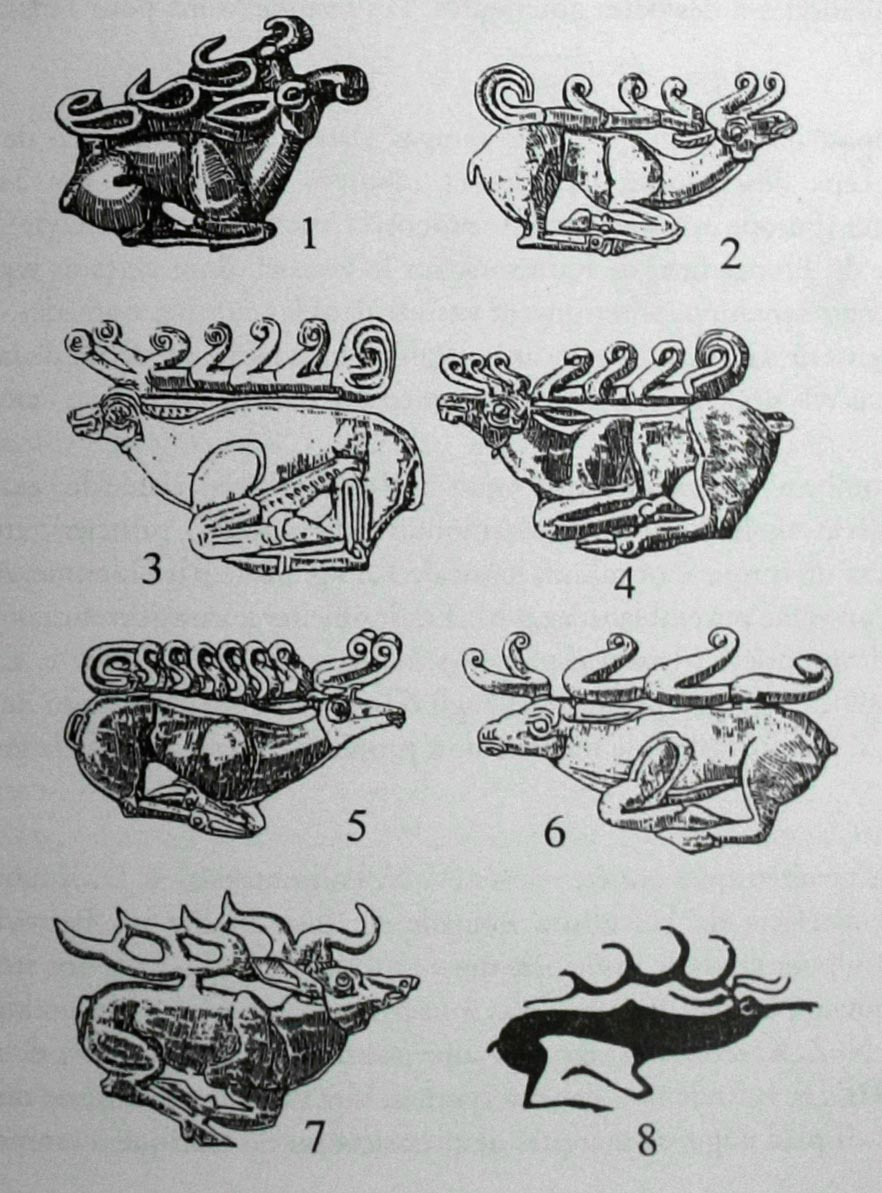
Running deer from: 1-2)The Ukraine,
3-5) Russia, 6) Iran, 7) Kazakhstan,
8) Mongolia. (Lebydynsky, 2011)

 Deer
    Early steppe nomads- both Iranian and Altaic- really like deer as art subjects. This wonderful figure from Lebedensky’s Tamga book illustrates the uniformity of just one deer motif. They sculpted, painted, and sewed them standing, lying down, being attacked by predators, with their legs turned 180 degrees (registering that might be hairy, though you could display it that way), and running. In Western (and SCA) heraldry, courant invokes the image of legs extended, but the steppe depiction is the moment in the stride where the legs are tucked under the body.

Griffins
    Griffins are of huge importance to Iranian steppe nomads. Unlike later Western griffins, it isn’t simply the back half of a lion glued onto the front half of an eagle with ears. You take something that looks like a lioness (or maneless male lion), add bird wings, a beak, pointy, feathery ears, and a fish-fin type crest running down the length of its neck. If you want to get really fancy, have it vulning (standing on top of and attacking) a deer or ibex. Depending on your culture, the deer’s legs may or may not be twisted 180 degrees from the front of the body.

 Camels
Phalera with two Bactrian camels.
Bronze, Filippovka, 4th cent. BC.
(The Golden Deer of Eurasia)
They have pompadour mullets!
    Camels were (and are) important to many Altaic nomads. A fairly common theme that you see in nomadic art is two Bactrian camels with fangs standing side-by-side and biting each others' back legs. I seriously doubt that particular pose could be registered, but the “combatant” pose was created with the intention to show animals attacking one another, so try registering that instead (the word may be changed to “respectant” during registration since they’re herbivorous). Alternatively, you could have them standing and facing one another (statant respectant). Then when you display it, shift it to the form more appropriate to your persona.

Monsters
    You don’t often see unique chimerical monsters in SCA heraldry, but they do exist and are completely registrable (there are currently 37 registered). You just have to blazon the different parts they’re made of. Some steppe nomads left behind depictions of chimerical monsters. The most common example it to start with either a deer or a horse. Say you have a deer- you can give it a bird beak. You may put stylized griffin heads on the ends of its antler tines. The blazon would read something like "a monster composed of the beak of an eagle and the body of a deer, with antler tines ending in gryphon heads". If you start with a horse instead, you do the same thing while adding deer antlers.
In steppe terms, this is a lion-headed, goat-horned gryphon (with front leg proportions more akin to a goat, but still ending in paws). Because of the difference between medieval gryphons and early steppe gryphons, this chimaera would be better blazoned as "a bird-winged monster composed of an ounce's head, paws, hindquarters, and tail, a goat's horns, ears, and forequarters, and a dragon's neck" if you want to register something like this in the SCA. It could be taken to be couchant (lying down) or sejant erect (sitting, but with front legs raise), but make it more obviously one or the other for registration purposes. It's wings are addorsed and inverted if you want to blazon that detail. Remember that steppe art involves squishing and stretching things to fit the space.
From a scabbard made by a Greek with Scythian designs and for a Scythian. Gold, PLACE, TIME. (From the Lands of the Scythians)
 What Not to Have
   Once you've come up with a steppe-themed charge, you might find that you want to put a little bit more on your device but don't want the rest of the obviously steppe options. Instead, you might find yourself flipping through the PicDic or medieval armorials for possible charges. What should you avoid if you want it to still make sense for a nomad? Big ships, for one- horse nomads have no reason to go sailing (unless you want to be one of those Iazyges who went to what's now England, or an Alan who crossed Gibraltar to raid with the Goths, but those were one-off trips). That's not to say they didn't fish in rivers or any of the seas in or near the steppes- you can occasionally find a zoomorphic fish- but big whales? No. Pelagic fish? No. Also avoid any objects which postdate your particular culture or that they never would have encountered. Maunches, for example- the angel-armed sleeves- are not from a time or place in which they could be encountered by a Saka. Farming implements (aside from some involved in animal husbandry) would also be uncharacteristic. If your persona didn't have a written language, books and quill pens wouldn't make much sense. Unless you have evidence that a steppe nomad encountered tales or depictions of New World fauna, it would be best to avoid them considering how temporally and geographically restricted knowledge of them was in SCA period. These are just a few examples. Basically, just do your homework and use your best judgement when picking charges not specific to steppe nomads. :)

One Final Note
   Keep in mind with all of these that if a steppe nomad motif looks much different from the Western standard, there is the risk of it not being registered if submitted as such. I’m not saying it couldn’t, but keep in mind that typical SCA heralds have to be able to blazon it consistently. Stylized zoomorphic art has been registered in the past, but so far as I know it isn't anymore, so definitely avoid that aspect when drawing for submission. When it comes time to display your armory, though, show everyone your steppe persona!


From the Lands of the Scythians: Ancient Treasures from the Museums of the USSR, 3000 BC-100BC, Metropolitan Museum of Art Bulletin, Vol 32, no. 5, 1975.

The Golden Deer of Eurasia: Scythian and Sarmatian Treasures from the Russian Steppes, The Metropolitan Museum of Art, 2000.

Brzezinski, R, and Mielczarek, M, 2002, Men-at-Arms: The Sarmatians 600BC-450AD, Osprey publishing.

Andrews, P, 1999, Felt Tents and Pavilions, Melisende UK Ltd.

Lebydynsky, I, 2011, Les Tamgas: Une "Héraldique" de la Steppe, éditions errance.

Sunday, January 1, 2012

Ask the Readers: New Year's Day

Post idea stolen from Juturna, who posts questions for writers to think about.
A fun thing to do to develop your persona is to think about what they may have been doing at a given time of year. Would your persona have done anything to celebrate the arrival of a new year? Winter is about to hit full force- what sort of preparations would they be making? What would they do to pass the time indoors?

I have no idea if Sarmatians had any sort of  celebration this time of year. Holidays falling around cross-quarter days, solstices, and equinoxes were definitely tied to agriculture (when to harvest, when to plant...). It's possible they could also be tied to calving and breeding, which would be the more prominent interest of the Sarmatians given their nomadic lifestyle, but I don't recall that being mentioned in my Archaeoastronomy class.
The steppes of Eurasia would have gotten pretty cold in winter. I imagine fur-lined kurtas, pants, and caps would be made and mended right about now if they weren't already, as well as any repairs to the covering of the wagons they lived in. I'm not sure what they would have done to pass the time.

Monday, December 12, 2011

Scytho-Siberian zoomorphic art style as illumination

  This weekend some of us in the Shire roadtripped down to Kansas City for Kris Kinder.  Kris Kinder is mainly a holiday market where craftsmen can sell their wares, but it’s also where a lot of meetings take place. There are meetings for specific offices (chatelaine, chronicler…), and meetings for special interest guilds (fibers, scribes…). The arts & science type of groups sometimes have challenges where the members decide on a thing to make. Members work on their pieces and everyone’s are collected and given to Their Majesties as largess (items they can then give out to people as thank you gifts).
  The Winter Scribal Challenge this year was to decorate a bookmark or card with illumination and calligraphy that you did yourself. The idea was that you would be stretching yourself out of your comfort zone if you normally only do one or the other. The pieces that ended up being collected seemed to come solely from illuminators as most only contained a word of text (and actually none in a couple cases…), and there was some fantastic illumination done. I wrote “Home is where the Heartland is” (the name of our kingdom is Welsh for heartland) and was surprised that I was the most verbose. My calligraphy sucks, so it didn’t look great, but I did try, which was the point of the exercise.
  We were each supposed to do two- one to give to Their Majesties and one to give to another scribe who contributed pieces. I think only myself and one other person ended up taking pieces home, so the rest went to Their Majesties. I saw a style on a couple of the bookmarks that I’ve seen before but know nothing about (tri-lobed ivy leaves with bezants scattered about), so I took one to study and practice from.
  Aside from the one class on bianchi girari I attended, I know nothing about illumination styles, and I have yet to actually try any. I wanted to do something Sarmatian for my first non-pre-print illumination, but Sarmatians didn’t illuminate—they didn’t have a written language around which to paint pretty pictures. They do have a very distinctive zoomorphic art style, however.  They used it in goldsmithing, leatherwork, feltwork, metalworking, and all kinds of stuff that’s not painting parchment or vellum. The closest  to it is their tattoos (which I would love to find some pictures or reproductions of).  So what to do?—take advantage of the “creative” in Society for Creative Anachronism.
  I did my illuminations in the Scytho-Siberian zoomorphic style- one a Scythian variant and one a Sarmatian variant. The first, the Scythian piece, is based on a torse and quiver cover pictured in "From the Lands of the Scythians". The colors I used don’t have any particular significance because the artifacts are all in gold; they’re just what I felt like doing.


  You’ll notice this isn’t zoomorphic so much as straight realism. It's because these pieces were made by Greeks with Scythian themes and motifs for the Scythians. Scythians and Sarmatians love griffins. They also love to have predators attacking their prey. I decided to have my griffin attack the big letter ‘H’. See that fin on the neck and head? That’s something that Scytho-Sarmatian griffins have which Western griffins don’t (likewise with the short fin around the back of the jaw and the lion front limbs). The griffin on the quiver is actually shown pinching a chunk of flesh in its beak, so I replicated that here.

   The floral motif inside the ‘H’ and the border both come from the torse. I didn’t draw any birds strewn amid the flowers like on the torse just to keep it a bit simpler. There are several different types of flowers shown (or at least a couple different views of one and a thing that could be a leaf or a flower which I don’t know the identity of). There’s the main vine with branches splitting inside leaves (kind of like on corn stalks), then there’s the really skinny vines which end in the flowers that wrap around those main vines. 

  The Sarmatian piece is the one which actually shows the zoomorphic style. Both designs come from gold plaques shown in "The Golden Deer of Eurasia". For this piece, I painted both gold, in salute to their origin, with complementary colors filling the white space and closed shapes to make it stand out more.

I picked one of the deer plaques and reproduced it inside the H, once on each side, then added more points to the brow tines (based on a third plaque not pictured here) inside the horizontal bar so it wouldn’t be empty.The shape behind the deer is actually a leg that's been twisted up behind the animal. Twisting limbs is fairly common in this style.
 The saiga antelope is my favorite part from both of these bookmarks. I really like this particular version of the zoomorphic style. It has such nice swoopy curves and shapes. Everything just flows together. I had to make the hindquarters less tall than they were in the plaque in order to have it fill the space better, but it’s otherwise a direct reproduction of the plaque.
After drawing and painting him, I feel really inspired to make an entire scroll illuminated in that style. Someday when I have time…

From the Lands of the Scythians: Ancient Treasures from the Museums of the USSR, 3000 BC-100BC, Metropolitan Museum of Art Bulletin, Vol 32, no. 5, 1975.

The Golden Deer of Eurasia: Scythian and Sarmatian Treasures from the Russian Steppes, The Metropolitan Museum of Art, 2000.

Monday, November 28, 2011

KWHSS: Conflict-checking armory

In period, when close relatives (fathers, sons, brothers...) were all alive and kicking, they would do slight variations of a theme to show that, while they were related, they were not the same person. Typically, these devices were only one step away from each other, like having a field of a different color, or adding a chief. In some places and times, there were specific ways one was supposed to change their device based on how they were related to the current holder of the unchanged arms- a first son would add a label, for example.
In SCA armory, two differences are required to show that you make no claim of relation to the person bearing similar arms. You can, of course, ask for letters of permission to conflict (LoPtC) regardless of relationship, but when designing your armory, don't submit it if you know of a conflict and haven't received a LoPtC.

There were a series of conflict-checking classes at KWHSS. The one I went to was run by Pipa Sparkes, who supplied a very handy cheat sheet which I've been using extensively. To conflict check, you'll want to access the SCA armorial and/or ordinary (oanda.sca.org) and potentially the compiled precedents (http://heraldry.sca.org/laurel/precedents.html).
You'll also need to know how to read a blazon. The field comes first, followed by a comma. Then comes the primary, followed by any secondaries, tertiaries, peripherals, and lastly overall charges.
So, in:
Azure, on a bend between two cups Or, an arrow azure
the field is azure, the bend is the primary charge, the cups are secondaries, and the arrow tertiary. In:
Sable, a gryphon passant within a bordure argent
the field is sable, the gryphon is the primary, and the bordure is the peripheral.
In: 
Argent, three bendlets azure and overall a cross moline gules
the field is argent, the bendlets are the primaries, and the cross is overall.
Sometimes there are no primaries, so in:
Or, a tierce gules.
the field is Or and the tierce is a peripheral.


So now that you know what your charge groups are, you're ready to do some conflict-checking.

Step 1: Identify the primary charge group.
A) Addition or removal of primary charges means no conflict.
A rose does not conflict with a lack of primary charges.
B) Substantially different primary charges on simple armory means no conflict.
Simple armory is armory with no more than two charge types which both lie directly on the field. In my previous post, the triskelion of legs is one type of charge while the bezants are another. There's nothing else on the device, so it's simple armory. The pall with an overall gryphon, however, is not simple armory because the overall charge does not lie solely on the field. Note that all charge types must be substantially different (a cross and a sword  in bend can potentially conflict with two crosses in bend).

So look for armory that has the same type of charge(s) as your piece. A leopard's face does not conflict with a sword.  If your piece has a wolf's head as the primary and someone else's has a dog's head, they can potentially conflict because there isn't much of a difference between a wolf and a dog as far as heraldry is concerned. Knowing what charges do and don't conflict is simply a matter of learning it through a mixture of common sense (a cat looks nothing like a shoe) and memorizing or looking through precedents (the SCA does not grant a difference between rampant and salient, for example).

If, via these two rules, nothing conflicts, then congratulations! Your device probably has no conflicts (Make sure to ignore "transparent charges" like laurel wreaths. I won't go into that right now.). Skip to Step 3. However, if you have a list of potential conflicts, you must now make sure none of them are less than two steps away from yours (In our jargon, these are called "clear differences", or CDs. However, this will probably change when the new rules go into effect, making it "distinct changes", or DCs.). So on to-

Step 2: Counting differences
Pipa did a fantastic job with her cheat sheet, so all but the italics is basically copied and pasted directly from it.
A) Field difference (i.e., my field is different; what does this mean for me?)
          i) Charged fields (other than uncharged peripheral ordinary): all field changes=1 CD Max
          ii) Field-primary armory has uncharged peripheral charges only: chief, bordure, base, canton, gyron, orle, flaunches...
                    (a) Substantial change of partition type= no conflict
                    (b) Complete change of tincture (including furs and field treatments) = no conflict
                    (c) Other field-primary armory: all other changes= 1 CD
          iii) Fieldless vs. field/less, tinctures vs. no tinctures, & Japanese mon= 1 CD
B) Addition/removal of charges on field= 1 CD
C) Addition/removal of charges overall= 1 CD
D) Tincture changes (including furs) to charges on field= 1 CD
E) Type changes to charges on field= 1 CD
F) Number changes to charges on field (note that a semy can be anywhere from 6 to however many the person/heraldic artist cares to put on there)
          i) 1, 2, or 3 vs. any other number- 1 CD
          ii) 4 vs 6+= 1 CD
          iii) 5 vs. 8+= 1 CD
          iv) 6+ vs. 7+= no CD
G) Arrangement changes to charges on field (charges in fess vs. charges in pale)= 1 CD
H) Posture changes to charges on field (this is the attitude and only major changes count, i.e. rampant vs. passant as opposed to statant vs. statant reguardant)= 1 CD
I) Addition/removal of tertiary charges= 1 CD
J) Changes to tertiary charges
          i) At least 2 changes to tertiary charges= 1 CD Max
          ii) If all of the following are true= 1 CD Max
                    (a) 1-2 types of primary/secondary charges: (1) simple and void-able, and (2) correctly drawn with an interior substantial enough to display easily recognizable charges
                    (b) No overall charges
                    (c) Substantially changing the type of all charges of a tertiary group

If, at this point, you still have at least one potential conflict, either seek out an LoPtC from the holder of the armory or change your design to avoid conflict altogether. If you have successfully removed all of the potential conflicts via at least 2 CDs each, then you get to go on to the last and final test-

Step 3: Visual test
This one doesn't come up often because being two CDs clear usually makes pieces of armory look completely different, but on occasion devices which don't technically conflict still look a lot alike and will be counted as a visual conflict. For example:
The submitted device:
Per fess azure and argent, a pale counterchanged
The registered armory:
Party of six azure and argent
A party of six means the field is divided per fess and then into three columns of equal width. A pale is a thick stripe down the middle which could potentially be the same width as the middle column of the registered device. Both have azure in the upper left corner and alternate from there. These look a lot alike, so even though they are clear of each other (the submitted device has a primary charge- the pale, while the registered armory has no primary charge), they visually conflict.

Monday, November 7, 2011

My name passed! My device didn't.

Just a quick update to say that my name has passed, so Aritê gunê Akasa is official now! Yay! My device, however, did not. It was not due to any mistakes in the blazon or emblazon; it was due to conflict which shouldn't really be a conflict.
A weird thing about rule sets is that they can be fantastic and thorough but the way they interact, occasionally things that should work don't. My submitted device unfortunately conflicted with something that it would not visually conflict with, which is what the rules are set up to avoid. The color scheme for my device and the registered badge are the same. I have ordinaries in point, the already-registered device has ordinaries in fess. This arrangement, while blazoned in SCA heraldry, is not always done in period heraldry and can be displayed either way when a specific arrangement is not given, so no CDs there. Both armorial pieces have an overall charge. My charge is animate, the registered one is inanimate. This means that even though I get a CD for a change in the type of overall charge, I don't get a CD for attitude because the animate charge can't be in the inanimate charge's attitude and vice-versa. 
A commenter on Oscar had mentioned trying to get a LoPtC, or Letter of Permission to Conflict (though now I'm not so sure that actually happened), but either the people could not be reached or did not want to give it. The registered badge is actually for a baronial order, so if it was the case that they didn't want to give a letter, I can't fault them for that decision.
I'm not angry or anything; it's just one of those unfortunate rare cases. Now I just need to figure out how I want to alter my device to get one more CD.
In the SCA, a common way to do this is to add something like a bordure, orle, or chief. I don't really want to do that... Making my overall charge face the opposite direction might work, but I'm not left-handed, which is the medieval reason for making something face to sinister. I could flip my ordinares so they point the other way, but I don't like the way that looks. Perhaps I could change the number of ordinaries?
On the plus side, it was pointed out to me by HL Caoimhin McKee that my ordinaries would be closer together in period than I drew them, so it's a chance for me to make my device more period. It's also an opportunity for me to fix the animal's tail...I'm probably the only one who cares, but I made it look like a closely-related animal's tail rather than the blazoned animal. And to use different line weights on the animal, since I didn't think of that before submitting it.

EDIT: I've come up with the new design! I'll be handing the paperwork off to the Shire herald on Sunday. And I actually like it more with these modifications.  Now that I know how to conflict check (hm...I should post about this), I did that and nothing came up. I'd also be the first person in the SCA to have a particular motif on my armory, so I'm printing off the appropriate bits from the period roll of arms I found it on. I should do a post on how to design a device too...

Wednesday, October 19, 2011

Can I Register a Tamga in the SCA?

This is part one of the post I've been promising since this summer. It's ended up being very long, so I've split it into three parts. The second part is where you'll actually be able to see all the tamga that have been found, where, when, and which tribes were using them. In the third, I'll post a list I've compiled of the elements used to construct them.
 
Sarmatians had symbols called tamga* which were used by some Sarmatians in the same way badges are used in the SCA.* They have been found scratched in stone, as openwork designs in belt buckles, on leather straps, spearheads, the backs of bronze mirrors, and elsewhere. They represented a person (or group of people) and his/her/their possessions and are in line with the representation of "me" and "mine" that Western heraldry has. Great! You're a Sarmatian and you can register Sarmatian heraldry! Woot!

...It's not quite that simple, unfortunately...

  SCA heraldry is based on middle and late period Anglo-Norman styles. This is great for Western European personas and for the sake of standardization, but it's much harder to register something which does not follow those rules. The end-all deciding factor on whether a non-Western European piece of armoury can be registered or not is this- "Can it be blazoned in a way a Western European would understand?" The idea behind this is that the SCA was founded on Western European ideals. Other cultures are treated as though they were visiting that region.

  This has created problems in the past in terms of perfectly period things being registered: The Japanese have their own style of heraldry called "mon" which function as family crests. There is a comma-shaped charge called a tomoe. They're a fantastic choice for someone with a Japanese persona....until they go to register it. By precedent, they cannot be registered in the SCA because if a visiting Japanese person went to register their arms with a Western group, without every single herald being handed a picture and told that "this is a tomoe", you can't hand the blazon to any herald and expect them to be able to emblazon it.
  Now, that doesn't mean a SCAdian with a Japanese persona can't use tomoe in their heraldry- it means they can't register it. Registering is done to prevent conflict. It means that someone can't come along and say "I like your device. I'm going to use it as mine too!" (or accidentally come up with the same/similar design). If someone sees your device on the field, they know it's you and not someone else. But when registering a perfectly period device is not possible because of the way the rules are set up, not registering it and trusting in others to play nicely is the way to go. One could set up their own heraldic jurisdiction to regulate mon, but it wouldn't have official power in the SCA, so all comers would, again, be trusted to play nicely on an honor system (and it would be up to them whether to even take part). Honor systems are more likely to work in the SCA than out of it (courtesy and medieval chivalry and all that); you're more likely to be "copied" by accident than on purpose.

  So what about tamgas? Well...they, quite frankly, would look nothing like anything to a Western herald. They're doodles of geometric shapes. It's all lines, so any closed shapes are automatically voided (Think of fill vs. border when making a circle in Photoshop or Illustrator. Tamgas are never filled.). Some of them are the same as something seen in western heraldry (voided triangles, for example). Others sort of look like something seen in western heraldry (there's one shape which requires no stretch of the imagination to see a stylized water bouget). Others...you would have to know the history of that particular pictograph (like one which represents an Iranian rooster). And occasionally you run into one that looks like someone who was really drunk just made a squiggle; those should probably be discounted for use in the SCA (how would you conflict check a squiggle?).
  So, like Japanese mons, your options are three-fold: 1) Forget about doing [your] period heraldry and just go with standard SCA heraldry; 2) Design a tamga for yourself and never try to register it (perfectly reasonable); or 3) Try to make one which could be registrable under certain circumstances and see what happens.

I'm going with option 3.

  Now, my main arms are standard SCA-type heraldry (Argent, three piles inverted in point throughout azure and overall a raven striking sable wings elevated and addorsed.). Sarmatians are not my only love in the SCA; I love Western heraldry and wanted my own arms. But for a badge- which is how Sarmatian tamgas were used for most of their history- I'm trying to register a tamga.
So now that you've decided to try to register a tamga- what do you do? Well, for starters, document, document, document. I've included all the tamga documentation I've found in this post, so look at the designs and read the references. For most tamgas, you're going to be invoking the Regional Heraldic Style rule: if it was used for your persona, you can ignore the Western rule that says you can't do it.
  I've presented the potential problems you may run into in two ways: first as a discourse, and some again as a potential conversation between submitter and herald. Read whichever you prefer (or both).

Discourse-
Recognizability from a distance- Western heraldry is meant to recognizable from a distance on the battlefield. Objects are thick instead of being thin lines. Tamgas are typically recorded as thin lines. I'd suggest  thickening the lines for registration, then you can display it as thin lines if you so wish.
Slot machine heraldry- Most tamgas are made of three different elements. "Slot machine heraldry" is a term for having three different coprimary charges (i.e., a flower, a star, and a wolf; not as in three flowers). There are no period examples of this in Western heraldry, so it is not allowed.
Period charges- Some tamga element could look like something known to Westerners, but not known to have been used in heraldry. It doesn't mean you can't use it, just that it's a "Step From Period Practice", or SFPP. Two SFPPs in the same device/badge means it's unregisterable, so limit yourself to one weird element if you don't want to risk running afoul of this.
Fieldless charges- Western devices are [mostly] objects on a background color. You wouldn't take a gold lion and put it on a red background in one place, then a purple background in another and say they represent the same person. Badges, on the other hand, can be fieldless (the symbol represents you regardless of the color fabric (or other thing) you end up sticking it on. Tamgas are fieldless, which is fine except that SCA fieldless designs must have all objects conjoined in some way. Most tamgas are like this, but some are elements in proximity, but not connected to, one another.
Tincture- Tamgas don't have tincture. They're just lines and could be any color, or be gouged out of some hard surface instead of painted or whatnot. SCA heraldry requires tincture except in certain cases (See "tinctureless" devices like the laurel wreath. They exist because the symbols themselves are very important.) I don't know of any non-important SCA-wide armorial elements considered to be tinctureless, so pick a color for your tamga to have. There's a limited number of badges you can have (four, I think), so you won't be able to grab up every color possible for that device. It's a  problem we have to live with.
And the doozy...
Armorial identifiability- A design has to be recognizable in two ways: 1) If I show you the blazon, you can draw the same emblazon that I have in my head, and 2) If I show you my emblazon, you can write the same blazon as me. Tamgas run into problems here because that won't always work with a Western herald.

Some examples of what could happen in the submission process:
It works easily from blazon to emblazon (also addresses line thickness)-
Sarmatian: I want a circle (not filled in) and an upside-down 'V' shape attached to its bottom.
Western herald: Like this?
Sarmatian: Yes. The lines are all thicker than what I had in mind, but that's the right shape.
Western herald: It needs to be considered visible from afar, so we'll register it with thick lines and you can display it with thinner lines.
Sarmatian: Okay, works for me.
It works easily from emblazon to blazon (also addresses colors)-
Sarmatian: Can you blazon this for me?

Western herald: That would be "An annulet and a chevron couped conjoined in pale." What colors were you thinking about?
Sarmatian: Oh, no colors. It's just lines.
Western herald: Well, we can make it fieldless so you don't need to have a background to your shape, but the lines themselves need to be a specific color.
Sarmatian: Okay, then I'll register one badge of each of the colors.
Western herald: There's actually a limit on how many pieces of armory one person can have. {Something in my memory says four badges, but I'm not certain and can't find it.}
Sarmatian: Hm...Well, let's go with one badge in a light color and another in a dark color. How about white and black? {This is so the symbol can be put on an object of any color and still be in good contrast if you so wish.}
Western herald: That would be argent and sable.
Sarmatian: Oh, and blue is my favorite color. It's in my Western device. Let's do that too.
Western herald: Another in azure, got it.
Not-so recognizable elements- 
Sarmatian: I want to register this.
Western herald: The square works, but what is that?
Sarmatian: It's a pictographic representation of an Iranian rooster.
Western herald: ...I'm having trouble seeing that. Do you have documentation for it?
Sarmatian: Yep, it's right here in this journal article.
Western herald: Okay, I see it, but I don't think we can register it looking like that.
Sarmatian: Why not?
Western herald: If I told another herald to draw a rooster on top of a square, they'd draw an actual rooster. It needs to be consistently emblazonable.
Sarmatian: Hm... I see your point. What if I submit it as an actual rooster and display it as the stylized element?
Western herald: That might work. Let's try it.

Slot machine heraldry-
Sarmatian: I want to register this- its "A chevron inverted couped, a triangle voided, and a crescent inverted all conjoined in pale."
Western herald: That's an insta-boing for slot machine heraldry.
Sarmatian: But it's period for my persona.
Western herald: Okay, then document it and let's see if you can get a regional exception.
Unconjoined elements-
Sarmatian: How about this? (Fieldless) A crescent and a fess couped, both in pale sable.
Western herald: If the badge is fieldless, the elements need to be conjoined. Either conjoin them or give yourself a tinctured field.
Sarmatian: Mm... I don't really want a tinctured field. It doesn't work with tamgas. I've got this documentation showing unconjoined tamga elements.
Western herald: Include it and we'll see if it passes.

  Please keep in mind that these are only conceivable ways to work around the Rules for Submission to register your period tamga. Even if you can get a regional exception for something, I don't know about multiple exceptions on the same device. Another possibility- the regional exceptions would only count for the stylized design, not the Westernized emblazon, but the stylized design itself isn't registrable, which means the variety of registrable tamgas would be very small and not at all representative.

  I'm submitting one myself once my current device submission goes through. If I'm remembering correctly, you need to register a device before you can register a badge. I'm hoping I won't need to resubmit. Commentary only gave one reason to- a conflict with a device that doesn't look like it, but because of the way the rules work, counts as conflicting. If they got a letter of permission to conflict, it can be passed (here's hoping!).
The tamga I'll be submitting is purposefully designed to address several potential problems so I can generate discussion addressing each of them. It will contain some easily recognizable elements and one that will require documentation to be blazonable (which I will be providing for the heralds). I'll be including both the tamga design and an unstylized version of the blazon. It would be great if the tamga itself were registrable.....but I very seriously doubt it is. It has three different elements, so we'll see if I get a regional exception for slot machine heraldry. I did make a conjoined tamga since those are the most common, which means someone else will need to attempt the unconjoined type.
  On top of all this, I'm including extensive documentation on what tamga are, what purpose they served, and why they are period for me (Which means you won't need to send in quite so much if you try to register one after me[assuming it passes, of course].). I'm crossing my fingers. We'll find out about half a year from now (the submissions process takes a while...).

EDIT: There are new Rules of Submission so very close to being put into play. The new rules are friendlier to non-Anglo-Norman heraldry and require that the submission look like it would have in period. This means no drawing a Western emblazon to pass a tamga (yay!!!). So just draw your tamga like a Sarmatian (or other steppe or Turkic persona) would. But still make sure to include documentation for all the standard SCA heraldry rules it violates. I'm not sure what this means for registrability, though... Unless the College is willing to register a blazon like "a tamga composed of...." it might not be possible to register tamga now. We shall see (whenever I get around to finishing translating Lebydnsky). If not, display them anyway. They're your period. Being standard SCA period is far less important than being true to your own if you're that into your persona.

*--Sarmatians were not the only ones with tamga; they're widespread among Asiatic nomads are adopted by some other groups after the fact. Different cultures have different flavors of tamga, however. I only describe Sarmatian tamga here.
*--Sometimes you will find texts which say tamgas were ancient mystical and occult symbols. Saying something is mystical in archeology or anthropology might be true, but other times it's a copout for "I have no clue why it exists." (Paleontology and biology experience a similar phenomenon, but for us, saying a feature was/is for display is the copout. Again, sometimes right or likely, sometimes not.) The texts saying tamgas are mystical are older.  I'm inclined to think they're also outdated.


Brzezinski, R., and Mielczarek, M., 2002, Men-at-Arms: The Sarmatians 600BC-450AD, Osprey publishing.
Nickle, H., 1973, Tamgas and Runes: Magic numbers and magic symbols, Metropolitan Museum Journal, vol. 8, pp. 165-173.
Sulimirski, T., 1970,  The Sarmatians, vol. 73 of Ancient Peoples and Places, Praeger Publishers, Inc.
ТАМГА (к функции знака), В.С. Ольховский (Историко-археологический альманах, No 7, Армавир, 2001, стр. 75-86)

Friday, October 14, 2011

Kurtas

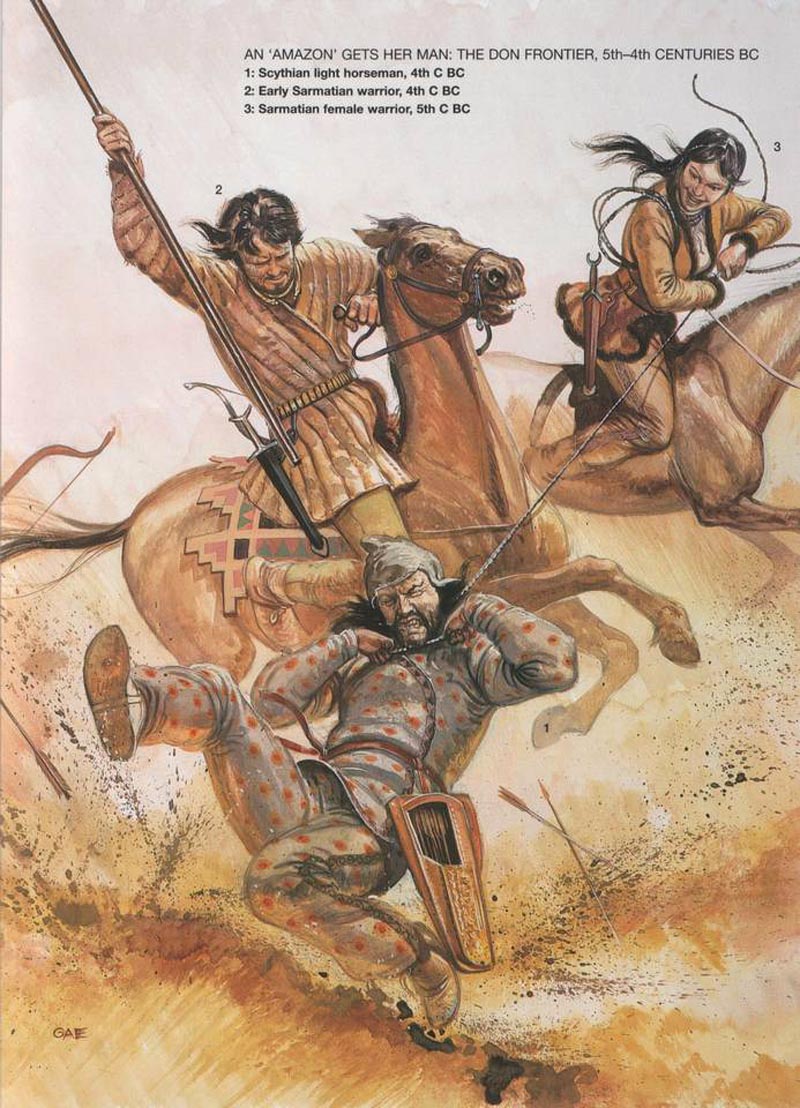
  Sarmatians are usually pictured with a type of jacket called a kurta over their tunics. Kurtas are a type of kaftan, which are worn in various forms by Asian peoples such as Mongols and Indians. Picture a T-tunic in which the front is made of two triangular flaps which cross one over the other and you'll have the general appearance of a kurta (for Sarmatians, it seems the right flap goes on top). The Sarmatians cut them off at mid-thigh and they could have slits up the sides. This kept them from bunching up and pulling or whatnot while riding a horse. Some sort of trim could be included.
The man on the horse is wearing a quilted kurta. The one being attacked is a Scythian. I'm not sure what the woman's jacket was based on.
Wrist straps
  The ends of the sleeves could be longer than the wrist (though they weren't all this way). The reason for this was to create a hand flap which functioned as a sort of glove when the temperature was cold. If you don't want the glove, you pull the end back over your wrist. There's an image of Scythian men with this same modification and they have straps hanging down which would have been sewn to the inside of the sleeve. I'm guessing the straps were used to tie the hand flap closed. In the image, they had the flaps folded back over their wrists and let the ties hang. It looks like the ties end in a big triangular shape.
A pot made by Greeks. They seemed to have made a lot of things depicting the Scythians for the Scythians
  The fronts of these Scythian jackets look a little different from Sarmatian kurtas, though- this particular style has two slits in front- one over the mid thigh and one over the inner-thigh. I haven't seen this in any Sarmatian kurtas.
Scythian kurta with multiple slits
A polka-dotted Scythian
  Sarmatian kurtas could be made out of leather (deer is common) or cotton (which can be quilted). They could also be lined in fur (squirrel seems to be common). Cotton might seem out of time for those of you who have Western personas, but it was around and used for clothing in the East long before it showed up in the West. They could be decorated with floral or geometric designs. Little gold plaques which would have been sewn on are commonly found in kurgans. Fabric paint is another option which is known to have been used by Scythians (One known paint pattern- polka dots. C'est amusant.). There's a leather saddle with felt appliques preserved, so it seems like a logical inference to say leather kurtas could too, but I haven't seen any examples illustrating this. You have the option to include it if you lean heavily towards the "creative" side of the SCA, but unless I find evidence of it, I don't really feel comfortable including them on mine. For the most part, though, Sarmatian kurtas seem relatively unadorned in comparison with Scythian ones.
  Most of the documentation you find will be in images of the Sarmatians created by other people. We actually did get very lucky, though, in that a child's kurta was preserved in a Siberian kurgan, which is now housed in the State Hermitage Museum in St. Petersburg, Russian.
Child's Fur Coat
Fur; l. 35 cm
Tashtyk Culture. 3rd - 4th century
Oglakhty Burial VI, Grave No. 4 (Excavations of Prof. L.R. Kyzlasov), South Siberia, Khakassia Republic, left bank of the River Yenisei, near Mount Oglakhty, Russia
Source of Entry:   Archaeological Expedition to Khakassia of the Moscow State University. 1969

  I just made my first kurta in time to wear at the St. Denys' Day event. I wanted to go the leather route, but unless I had gotten lucky and found enough for sale at an event, my cheapest option was to invoke the unwritten "Ten Foot Rule" (if it looks genuine from ten feet, it's acceptable [unless on enchanted grounds]). Which means that this financially-limited student used tan moleskin from Joanne's Fabrics to imitate deer leather.
  I did some things wrongly because my measurements turned out to be wrong- the jacket doesn't go past my hips, for one- but given that I'm a novice seamstress making my first kurta, I wasn't expecting perfection (another reason I used cheaper fabric). From a lot of the depictions, it seems like they didn't have inserts (gores and gussets), but I didn't trust my patterning skills (or lack thereof) to make one without gussets in which I my arms would still have full mobility, so I included them. But then I more closely examined the child's coat above, and it looks to have gores that go all the way from hem to armpit sewn next to roughly rectangular front pieces. The shape modifications around the arm-body seam look similar to those in the above depiction of Scythian men. I'll try this solution in my next run and see how that goes.
  Because I used woven fabric instead of leather, I had to hem all ends that weren't cut on the bias, though the child's coat didn't have them except maybe on the ends of the sleeves (one side looks like it was hemmed but the other doesn't; not entirely sure what's going on there). Other options I chose were: side slits, no hand flaps, and no decorations
  Below are results of the pattern I actually used. Once I make another, I'll do a second post about the modified pattern. Don't make your own with this pattern, it's only here for future reference so you can see the differences from it and from a standard T-tunic build. There are so many things wrong with it...


Finished product

Waaaaay too short

*--Unless otherwise specified, pictures of artifacts all come from "From the Lands of the Scythians"

From The Land of the Scythians: Ancient Treasures from the Museums of the U.S.S.R., 3000 B.C. - 100 B.C. (Metropolitan Museum of Art Bulletin, Volume XXXII, Number 5, 1975)
Brzezinski, R., and Mielczarek, M., 2002, Men-at-Arms: The Sarmatians 600BC-450AD, Osprey publishing.

Sulimirski, T., 1970,  The Sarmatians, vol. 73 of Ancient Peoples and Places, Praeger Publishers, Inc.

Wednesday, September 7, 2011

Updates on old posts

I've been reading through T. Sulimirski's The Sarmatians, which was the first instance of current Sarmatian research being gathered into one place. I found a handful of new Sarmatian names in it which I have added to the Personal Names post:
Abeacus
Amage (old name, new instance at a later time?)
Eunones
Galatus
Sauromates
Spaldines
Tasius
Zosines
In looking for more information on these people, I ran across catalogues of coins minted in Bosporus which bore Bosporan kings of Sarmatian descent with Iranian (Sarmatian) names, which gave me even more names to include:
Asander
Aspurgus (old name, new spelling)
Eupator
Inithimeus
Pharsanzes
Rhadamsades
Rhescuporis, Rheskuporis
Synges
Teiranes
Thothorses, Theothorses

I've also added these references to the reference list.
Additionally, Sulimirski's book is so important that I will be writing a post devoted solely to reviewing it once I finish reading it.

Sulimirski, T., 1970,  The Sarmatians, vol. 73 of Ancient Peoples and Places, Praeger Publishers, Inc.
http://www.wildwinds.com/#
http://www.forumancientcoins.com/ 

Saturday, July 23, 2011

KWHSS: Heraldic Regions of Europe and RfS VIII 6b

The hiatus is still in effect, but I've gotten quite a lot done in the past few days and was in the mood to write, so have an unexpected post.

Another talk I went to at KWHSS was on the Heraldic Regions of Europe. If your persona is not Anglo-Norman and you would like your armory to reflect that, there are certain cultural nuances you should learn about and take into consideration.

Heraldic armory, in the sense that typically comes to mind, started in Western Europe and spread eastward (Other types originated elsewhere [such as the mons of Japan], but bear more resemblance to European heraldry in intent than in design.). Like any other style of anything, the farther you get from the source, the less resemblance it bears to the original, and the more local flavor gets thrown in. This means, for example, that some things which are rare in England are common in Germany.  It also means that some things which would not be allowed in England or France are allowed, and often quite common, elsewhere. SCA heraldry does have a rule to allow such regional style. It's in the Rules for Submission, VII 6b:

"6. Documented Exceptions. - An armorial design element that is adequately documented as a period practice may be deemed acceptable even if it violates other sections of Part VIII (Compatible Armorial Style).
Such design elements will be accepted only on a case-by-case basis and only in armory comparable in style and complexity to the documented period examples. The strength of the case for such an exception increases in proportion to: the similarity of the documented examples to the submitted armory; and the number of independent period examples offered as evidence.
a. General Exceptions - In most cases the documentation for a proposed exceptional armorial design element should be drawn from several European heraldic jurisdictions.
The strength of the case for such an exception increases in proportion to the geographical and chronological breadth of the supporting period evidence.
b. Regional Style - Alternatively, a proposed exceptional armorial design element may be documented as characteristic of a specific regional armorial style.
 In such cases the submitted armory may be registered provided that all of the following conditions are met. (1) The submitter explicitly requests an exception to the other sections of Part VIII (Compatible Armorial Style) on the grounds that the submitted armory exemplifies a specific regional style. (2) Documentation is adduced to show that exceptional design element was not uncommon in the regional style in question. (3) Documentation is adduced to show that all elements of the submitted armory can be found in the regional style in question."

In other words, state your case, prove your assertion, and go all-out (no half-English/half-Polish armory). I'll discuss this rule more in my promised Sarmatian-related post. For now, let's go back to the heraldic regions of Europe.


The speaker used Christopher von Warnstedt as his main source. There are four main provinces of European Heraldry, with a fifth category made up of all the border provinces which, in period, mixed regional styles:
I) French-British
II) German-Nordic
III) Latin
IV) East European
V) Border Districts
These are very broad areas and regional differences are going to be present in each (such as Catalan vs. Italian in the Latin Province), but it's a good starting point for someone researching their persona's heraldry.

Some differences are on the way armory works within and between family members. This is uncommon in the SCA, so focus purely on design elements unless you're specifically registering armory similar to a family member (you will likely need permission to conflict).

French-British
 Includes: North and Central France and the British Isles
  • Patterns and semys frequent
  • Furs common
  • Change of arms is common
  • Change of crests is rare
  • Marks of cadency between family members usual
  • Change of tincture common
German Nordic
 Includes: Germany, Scandinavia, Finland, Baltic states, North and Central Switzerland
  •  Furs extremely rare
  • Quartering rare until 15th century
  • Human figures, lions, and eagles all common
  • Unusal "monsters" created and used in armory
  • [Germany] Very different sense of contrast (or lack thereof...); some colors on top of other colors (ex: sable eagle, azure field)
  • Change of arms very rare
  • Mark of cadency usually a change in crest
  • Cadency marks on shield usually absent
  • Change of tinctures very rare
Latin
 Includes: Iberian Peninsula, Southern France, Italy
  • Patterns and semys common
  • (Spain) Labels often couped, ordinaries sometimes combined into one (faja-palo, jefe-chevron,etc...)
  • Change of arms common
  • Change of crests rare
  • Cadency marks on shield usual within families
  • Change of tinctures common
  • Shield shape different from other regions

East European
 Includes: Croatia, Hungary, Poland,Lithuania, Romania, Russia
  • Tamgas and tamga-derived shapes common
  • Negative charges
  • Argent on gules and argent on azure dominant
  • Quartering almost unknown
  • Field divisions, ordinaries, and subordinaries rare
  • (Hungary) Azure field with a charge on a vert trimount common
  • Heraldic clan system
  • Inescutcheons with paternal arms common
  • Marks of cadency almost unknown
Border Districts
 Includes: Netherlands, Belgium, Luxembourg, Alsace-Lorraine, Rhineland, Southern Switzerland and Austria, Czech Republic, West and East Prussia, Silesia, Hinter Pomerania
  • Study your province's history and location- Who has ruled it in the past? What regions are next to it?

von Warnstedt, Christopher, 1970, "The Heraldic Provinces of Europe", The Coat of Arms XI (84): pp.129-30.