Friday, January 10, 2014

Ask the readers: Animals

One year ago today, we adopted a cat from the local shelter. Tali'Miller-Camp vas Iowa (yes, that is a Mass Effect reference) is a pet- an animal kept for pleasure. But unless your SCA persona is upper class and probably late period, the animals s/he could have kept are unlikely to have been purely pets- they would have had some sort of practical use.

What kind of animals did your persona (or their culture if not them, specifically) keep? What breed? Is it or breeds descended from it still around today? What were they used for?


Unlike my other "Ask the Readers", I can actually answer this one! Collectively, Sarmatians kept horses, cattle, sheep, and dogs.

Apologies for the lack of centering (it's at the top).
Turns out I don't have an image of this on my computer.
I'll replace it with a better version when I get home.

The sheep and cattle they kept for food, wool, and leather. Scythians did too and you can see an example of Scythians making a sheepskin shirt on a beautifully intricate torse made by the Greeks.


Mongolian horse and rider
Image source: http://www.studiomme.com

Their horses were their livelihood. They were meat, clothing, milk, wealth, transportation, and mounts all rolled into one. They would have been short and stocky compared to the horses we're accustomed to seeing in the West today- probably a lot like horses kept by modern steppe nomads.


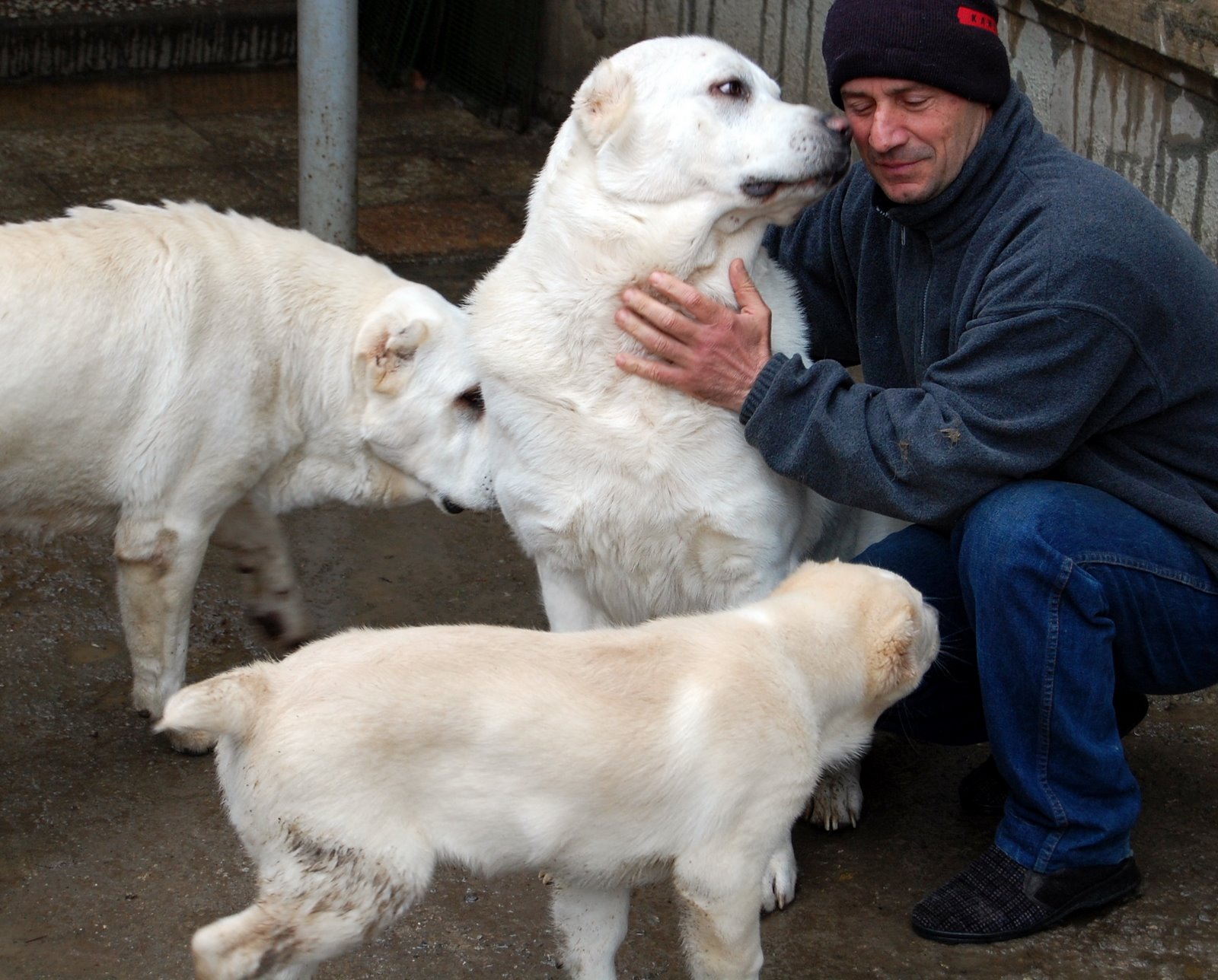
Kazbegi type Georgian Mountain Dog
Image source: http://kaukasus.blogspot.com

Their dogs were big molossers who served as livestock guardians and war dogs. The dogs of the Sarmatians sensu stricto were Sarmatian Mastiffs. The breed kept by the Alans was the Alaunt (which would have been partially descended from the Sarmatian Mastiff. The word 'Alaunt' later came to be used for a general phenotype, rather than a particular breed, in Europe. The original Alaunt probably looked similar to the Kazbegi type Georgian Mountain Dog, which is probably a descendant.

(References will be when I get home. Sorry!)

Tuesday, December 31, 2013

Blog news (good this time!)

Hello everyone! Many, many apologies for the extended hiatus. GPA comes before SCA, as they say, though in my case it was partially school and partially career stuff eating up all my time and energy. But now the semester's over, I've had time to rest and recuperate, and I'm able to doing SCA stuff again. I'm expecting to go back to the once a month frequency I kept before. I don't foresee doing any long posts anytime soon because I do still have quite a bit of paleo research and writing to do.
I'm heading to Thailand for some of that research in a couple days. I may have limited internet access until mid-January, so I've already written and scheduled the first one of the new year to come out while I'm away. See you on the 10th!

Wednesday, November 27, 2013

Still too much mundane stuff to deal with

  HIATUS IS CONTINUING TO LATE DECEMBER
  Mid-November has come and gone and I still haven't posted. If you don't care why, you can stop reading or skip to the end (there's nothing Sarmatian or SCA in this post). If you want an explanation, here it is:

   I've unfortunately had more work than I expected when I set the date. I've had to reformat and resubmit a paper several times now for different journals. I was expecting it to be in review all semester, but the first journal rejected it straightaway as "nothing against the paper, but it's inappropriate for this journal; submit it to a paleo journal instead". Which was crap because that journal publishes paleo papers all the time. One of its top three downloads last year was a paleo paper on a group with no living relatives. It's published a description of a single specimen in a group with no living relatives. Unfortunately, there's a not-insignificant portion of neontologists who have it out for paleontology, and I suspect the editor who was assigned to my paper may be one of them.
  The second was also rejected as not right for the journal's focus, but that time it made sense. I really only tried there because I was in the middle of finishing things before two close deadlines and it didn't require a ton of reformatting.
  The third was sent back by a technical editor because I missed a bunch of the formatting changes, so I'm currently working on that so I can resubmit it to that journal. At the same time, I'm playing massive catch-up on both the grading I've gotten behind on and my gross anatomy class. My grade is uncomfortably low because it's not the sort of class you can take and not spend oodles of time studying- but unfortunately I've had to spend all my time writing a massive grant proposal so I can go do research in Europe and Asia next summer and fall, reformatting and resubmitting the paper so I can tell the grant committee that no, really, I am trying to get a paper published on the work I did with the money you gave me before, and doing research and making a poster for the academic meeting a month ago. Which left me with no time to do anything else. With rare exception, I even cut out all the things I do for fun at the beginning of the semester- no dance class, no video games, no arts & crafts, no SCA, no birding, no Pathfinder... It's royally sucked and I'll be glad when it's over...so long as I can pull my grade up in anatomy.

  My anatomy final is December 19th. I'll probably want to take a few days to rest and recuperate before diving into SCA research. We aren't going anywhere or having visitors for Christmas, so that won't keep me from doing research. But it does take quite some time to research and write each of these posts. My goal is to get one out before the end of the year. If I'm feeling motivated, maybe it will be two.

Monday, July 1, 2013

Not Dead Fred

I'm still here. I've been kept very busy with mundane research and prepping for a hafla that happened this past weekend. I meant to write posts during that time and just haven't had the time/inclination to complete one. I've tried a couple times and haven't felt like the result is post-worthy. Honestly, it's a bit more stress than I want to deal with right now. I'd really like to get even a small something out, but I really need to finish these two paleo papers posthaste. So this is a belated hiatus announcement. Unless the Sarmatian bug bites me between now and then, expect me to be back in late August.
EDIT: Make that mid-November. I'm going to be in a constant state of busy and stressed until then.

Sunday, May 12, 2013

On Concussions


  I crashed my bike going downhill on a turn underneath a bridge on Tuesday. There had recently been some flooding. I didn't realize how much sand was on the path until it was too late. My tires lost traction and I wiped out. I propelled myself away from the bike so I wouldn't get tangled up in it and landed on my left side.
  I had thrown my arms out, so the impact when my face hit the cement was partially softened. I was also wearing a helmet, so my braincase didn't make contact with the ground. It could have been a lot worse (always wear a helmet!). I wasn’t paying attention to it at the time, but the soreness of my jaw the next day told me my teeth had clacked together fairly hard.
  I felt blood dripping down my cheek and when I pushed myself up, a decent-sized patch of skin over the heel of my thumb had been torn away and was now stuck to the cement. I stood up and the world was rocking back and forth. My balance wasn’t off, though, so I didn’t wobble. I moved off the path and sat down in the sand just to be safe.
  My mind was telling me that I had been thinking about various and sundry things just before the crash and that it was really important for me to continue doing so. It felt like I really had been thinking them, but it didn’t make any sense the more I thought about it- or rather tried to. I couldn’t hold on to any one thought for very long. I stopped listening to my mind and started taking stock of my injuries. Both of the heels of my hands and both of my elbows were scraped up. I felt big bruises on the inside of my right knee and on my left hip. The corner of my mouth was starting to swell and so was my left jaw. The cheek that was bleeding was swelling enough to obstruct the lower corner of my vision a bit.
  My bike was still on the path. So were my camera and the binoculars I had just borrowed from the bird club. I didn’t want anyone running over them or crashing themselves, so I got up and moved them off the path. My brain was still insisting that I needed to think about fake memories, so I didn’t trust myself to leave yet even though I felt physically able to. I went to sit back down and wait some more when my husband called.
  He was on his way home from work and was calling to say hi. After a short normal conversation aside from the part where I couldn’t remember a word I wanted to say, I told him I had crashed and could he come get me. I was staying very still. I didn’t need to move and I didn’t want to risk hurting myself more. He biked over, checked me out, and handed his lighter bike off to me. We walked them the ten minutes it took to get back home.
  He washed my wounds. I was still staying as still as I could. I panicked, got testy, and started crying a little when he bumped a large, painful, invisible bruise and when he wanted to treat my wounds in ways I didn’t want them to be treated. He put me in warm PJs and I laid down on the couch and took a nap.
  I didn’t think it was wise to go in to work, so a friend subbed for me. I tried to get some work done, but couldn’t concentrate on doing research.
  I had checked my pupils when we got home and they were normal. I hadn’t passed out and I wasn’t nauseous. I didn’t think I had a concussion, and my initial facebook post on the matter reflected that. My sister, who is a phenomenal emergency room RN, called several hours later. I was acting normal and feeling fine, if a little sore. I stood up quickly to take her call into the bedroom because we had been watching something on TV and I couldn’t hear her over it (I keep my phone on the lowest volume to protect my hearing).
  I told her my symptoms. She said it sounded like a mild concussion. When I was staying very still, I was in a type of shock even though I was aware and it seemed like I was choosing to do those things. You don’t need all the stereotypical symptoms to have a mild one. Because I would need to walk all the way to the hospital and they would give me an expensive MRI, she thought I should be okay not going to the doctor so long as I didn’t throw up and didn’t get worse. If I did, we would need to head there immediately. An older, more experienced ER RN confirmed her assessment and advice the next day.
  As we talked, I started feeling a little nauseous. I stopped talking and motioned for Gamble to take the phone as I hovered over the toilet and focused on breathing. I didn’t throw up and the nausea quickly passed. I had just stood up too quickly too soon after the crash when I answered her call.
  She told us what to do to take care of me (including waking me up halfway through the night to make sure my brain was functioning normally). I developed light sensitivity that evening, which tends to happen to me when I get colds or the flu. Gamble wouldn’t turn all the lights off because he wanted to be able to see me. He kept careful watch over me and I just focused on resting. I woke up in the morning with a small headache (it was gone by the end of the day).
  I was tired and spent most of Wednesday napping, watching Dirty Jobs on Netflix, or browsing the internet in short spurts. On Thursday, Gamble walked me into town to see one of my labmates defend his dissertation in the morning (he passed!). I stayed and listened to students give presentations in my last class of the school year. I went to the bar where my lab group was celebrating but got tired pretty quickly, so I went back home and rested some more. On Friday I was very tired and light-headed because some loud, rude neighbors woke me up that night and I couldn’t fall back asleep for the longest time. I was still tired on Saturday because I had pushed myself too hard on Friday after not getting a good night’s sleep. I slept more than I was awake. I feel more energetic today, but I’m still going to take it easy. I’m okay. I’m recovering.


  I’m telling you all this on my SCA blog so you have an idea of what you might expect if someone at an event, demo, or meeting shows these symptoms after a potential head injury. Even a mild concussion is no joke. Being able to identify one is especially important if the person who might have it is a fighter because they’re the ones most likely to find themselves in a situation where second-impact syndrome or post-concussion syndrome could occur.
  Post-concussion syndrome is basically an extension of your recovery. If you don’t get the rest you need shortly after the concussion, you can take months to heal instead of days.
  Second-impact syndrome is more serious. When you get a second head injury (even a very minor one) while your concussion symptoms are still there, your brain can swell very rapidly and herniate, resulting in death.  
  Chirurgeons- Strongly advise your fighters to sit out the rest of the event. Many will listen; some won’t. If you’re dealing with one of the “some”, tell their inspirations to keep on them about it if they insist on fighting anyways. Ask their shield brothers to keep a close watch on them and to take hits for them in melees if they can. Entreat their tournament opponents to be chivalrous and avoid headshots.
  Fighters- please don’t risk it. We would rather see you fighting again next month and for years to come. Risking your health and potentially your life isn’t valiant. Even if you don’t think you have a concussion (I didn’t at first), better safe than sorry. It’s surprising how mild the symptoms of a mild (but still dangerous!) concussion can be at first.

  Here are the symptoms to watch out for. Some may manifest immediately; others may show themselves over the course of the day or into the following weeks:
  •  any change in thought patterns after a blow to the head
  • headache/feeling of pressure in head
  •  dizziness/ being unsteady on your feet
  •  the world looking like it’s moving
  •  confusion/disorientation/amnesia
  •  falling unconscious (though this isn't actually common and isn't necessary for a concussion as it used to be thought)
  •  uneven pupils
  •  ringing in ears
  •  insomnia or excessive sleepiness
  •  sudden change in emotional response (irritability, crying, neurotic behavior, etc…)
  •  difficulty thinking of random words/ inability to concentrate
  •  nausea or vomiting
  •  slurred speech
  •  sensitivity to light or sound
  •  taste or smell being off
  •  dental trauma

Here are ways to reduce your risk of receiving one while fighting:

  • Pad your helmet well, but don’t overstuff it. You need to both distribute force and lengthen the amount of time your head spends slowing down and stopping. Have some money to burn? Use Kevlar padding. It stops bullets because it meets the two needs above so well.
  • Replace your foam padding fairly regularly. You’re supposed to throw a bike helmet away after a crash because the foam will have been condensed to the point of being less useful or even completely useless. Heads get whacked a lot in SCA fighting and they compress foam too. Compressed foam won’t slow down hits the way new foam will.
  • Wear a mouth guard to keep your teeth from clacking together. I have a friend who studies concussions and he says that clacking your teeth together actually plays a big part in whether or not you get a concussion and how severe it is. Enamel and dentine, the two substances that make up most of each tooth, are the hardest, most dense substances in the human body. The jawbone they attach to is the densest bone. When your teeth collide, shock waves travel through them very well and your jaw attaches right next to your brain cavity. You don’t want a big shock wave from your teeth and jaw being sent to your brain on top of the direct impact.
  • If someone is hitting way too hard, call them out on it. Maybe they’re from a harder-hitting kingdom and haven’t figured out how much to recalibrate. Or maybe they just aren’t thinking/being considerate. If they continue, report their unsafe behavior to a marshal. 


How to decrease your recovery time and reduce your risk of a second injury soon after:

  • Stop fighting. Even if it’s the first day of Pennsic and that’s the only reason you came. It sucks, but just don’t do it. The sooner you stop, the sooner you’ll be back in full form for later events.
  • Rest. Don’t go to post-revels, bardic circles, late balls, or camp parties. Get some sleep. Or even just lie there listening to the insects singing if it’s a summer camping event. Just don’t stay up late and don’t get up too early. Take plenty of naps during the days following the concussion. Take as many days off from work as you can manage and work as little as possible for a while.
  • Don’t think too much. Your brain is the pickiest eater of all. It only uses glucose, the simplest sugar, and right now that glucose needs to go towards repairing your brain, not using it. This is the one I’m having the most issues with. I need to think to do my work, but instead I’m having to force myself to be a couch potato. I can’t read books because it’s tiring. Even this post took several sessions to write because it was so draining.
  • Eat well. Keep that glucose coming in. Getting a balanced diet probably helps too. It couldn't hurt.

Males vs. females:   
  A lot of the information one can find out there about concussions are geared towards males because of all the male athletes out there getting concussions (especially in [America] football). Female secondary symptoms are often different from male secondary symptoms. I’m female, so the experience I described above might not align with what most fighters would experience. Males are more likely to be confused, disoriented, and experience amnesia. Females are more likely to be sensitive to noise, feel drowsy, and experience brain swelling (so the advice to stop fighting goes double for females because rapid brain swelling occurs during the potentially fatal secondary-impact syndrome). 
  Some studies show that females are more likely to get concussions (68% more frequent in female soccer players than in male soccer players). Other studies contend this point, saying that females show higher rates because our culture is more protective of them or because females are more likely to report symptoms. The jury is still out, but it seems like sports doctors as a whole recommend considering sex as a possible factor in how severe/frequent concussions are and how long to expect the recovery times to be. So, for now, be extra careful, female fighters.


Monday, April 22, 2013

2013 Two Truths and a Lie #3


FALSE

   Which might be confusing if you've seen the picture below with no context.
  Trajan's Column is an impressive record of both of the Dacian Wars. The part relevant to us is the exterior of the column, which has a spiral frieze carved on it. Many of the "barbarians" depicted on it are Dacian, but Sarmatians take part and make an appearance.
  On the column, there's a panel showing the Sarmatians fleeing from the Romans. Both they and their horses are decked out in scale mail from head to toe. However, no one thinks this is an accurate representation of what the Sarmatians would be wearing. Because let's face it....it just seems ridiculous. Can you imagine a rider sitting on scale mail pants while his horse is trotting? Or a horse trying to run with a tube of scale mail around its legs scraping against the scale on its side? This depiction could be based on the scared and exaggerated memory of a survivor, an artistic flight of fancy, or a miscommunication between the two. Elsewhere on the column, hauberks are depicted as spoils of war with no evidence of pants. 

 Ammianus and Pausanias, two classical authors from different centuries, both describe Sarmatians as wearing scale cuirasses made from horse hooves. Pausianus mentions that they are sewn on with horse or cattle hair and Ammianus adds that they are sewn to a linen shirt. Neither of them mention scale pants. Frustratingly, though, no hoof cuirasses have been found in any Sarmatian archeological finds. I haven't done much serious research into Sarmatian armor, but current opinions seem to hold that a mix of metal scales and lamellar plates are more likely/common.


Pausianus, Periegesis
Ammianus Marcellinus, Res Getae
Brzezinski, R., and Mielczarek, M., 2002, Men-at-Arms: The Sarmatians 600BC-450AD, Osprey publishing.


Monday, April 15, 2013

2013 Two Truths And a Lie #2

TRUE

  Just not directly. And who knows from whence it ultimately came.
  When people talk about "origins" or "causes", many don't distinguish between direct, ultimate, or steps along the way. Sarmatians are only one of many candidates for the ultimate origin...saying they're a step along the way is the more conservative (and, IMO, more likely) assumption.
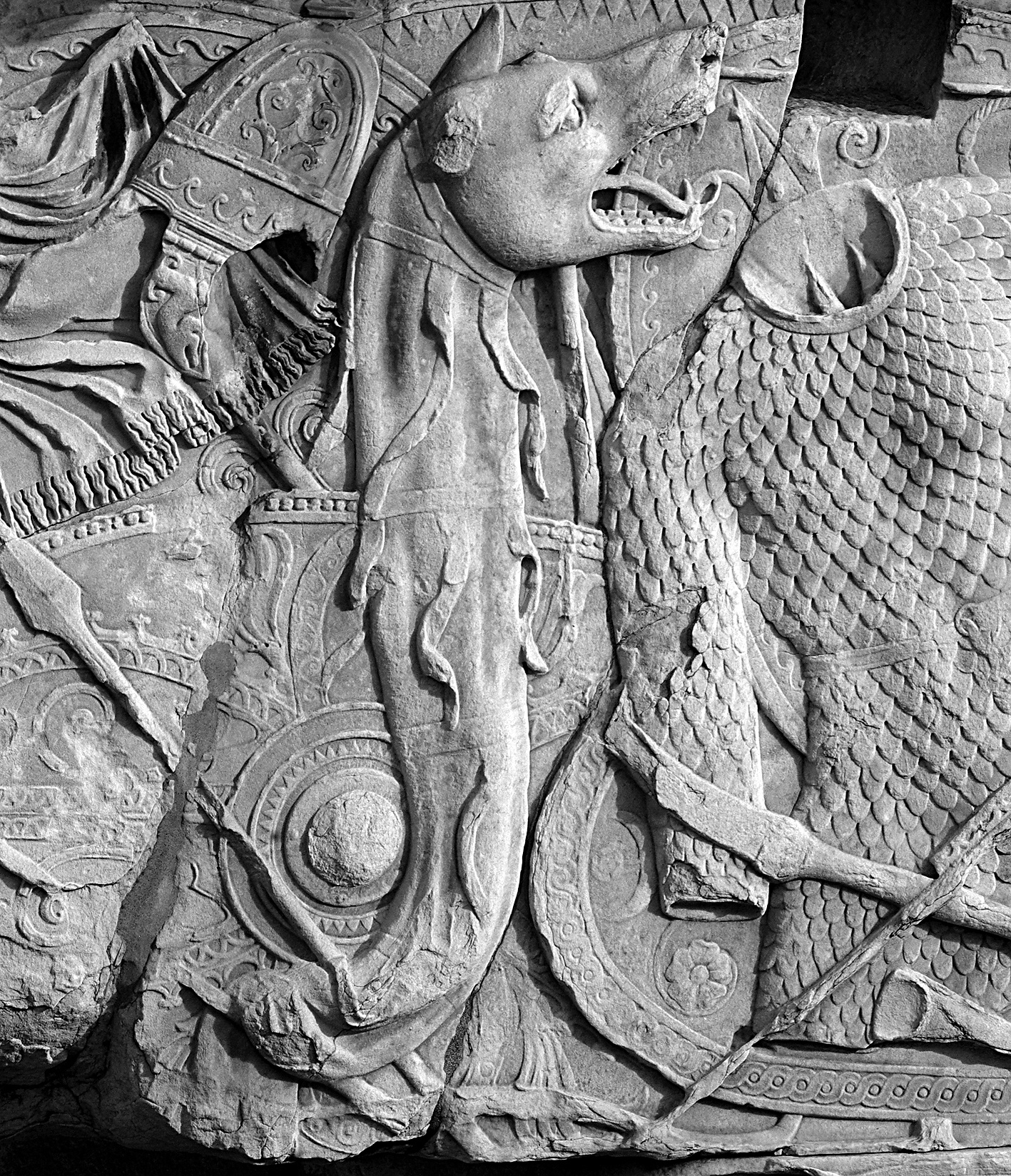
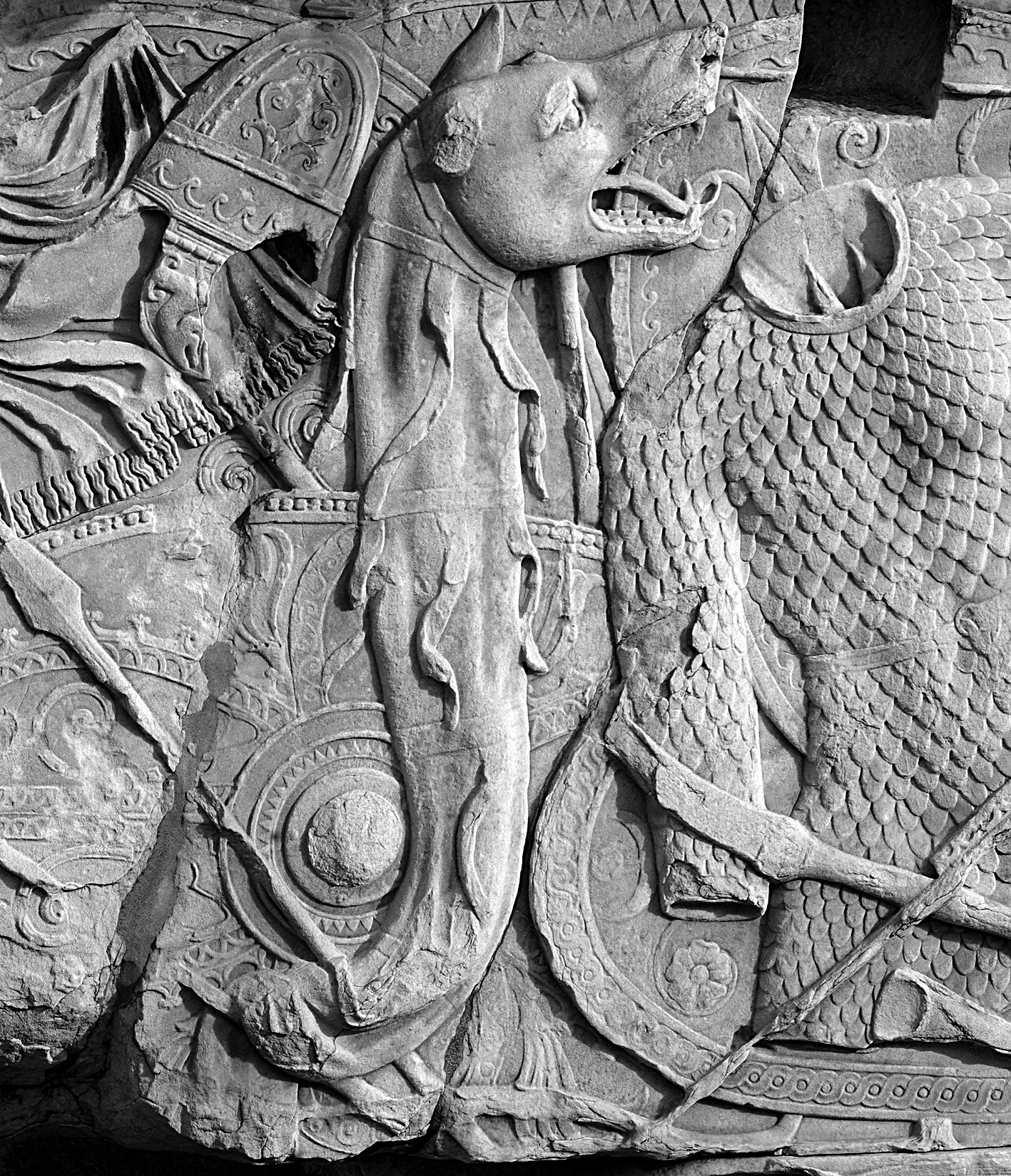
A Dacian draco on Trajan's Column- note the wolf
head and the complicated construction with
multiple rings and streamers on the tube.

  For the direct origin of Roman draco standards, look to the Dacians. By the end of the 1st century AD, the Romans associated the dracos with the Dacians they had recently defeated in the Dacian Wars. Which means they probably got it directly from them (though they also knew Scythians [he likely meant the Sarmatians] had them, as Arrian wrote about dracos making a fearful sound).
  Draco origins are discussed by Mihailescu‐Bîrliba (2009) in his analysis of a funerary monument in Chester. This happens to be the picture on the background of this blog. He makes a very convincing argument for a Dacian direct origin as well as for the monument actually depicting a Dacian, not a Sarmatian, as was previously thought. Which means I have to find a new background picture... *grumble*

  The ultimate origin of draco standards is a point of contention among scholars. Dacian, Scythian, Thracian, Sarmatian, Parthian, Persian, and even ancient Indo-Iranian have all been proposed. There are two issues to be considered when looking for the ultimate origin.
1) Where do we first see or read about them?
2) What was their original use?


On first appearances:
  We have to be careful with first appearances. First appearance dates (FADs) are statistically highly unlikely to be the first existence date. This is acknowledged in paleontology by differentiating between FADs and what we call "ghost lineages". A ghost lineage is a stretch of time during which, based on phylogenetic hypothesis, a clade or species had to of existed, but we have no physical evidence of it.
  Unfortunately, sorting out the history of cultural artifacts is so much more complicated than evolutionary trees that can be sussed out based on morphological and molecular evidence. So no such thing as a ghost lineage for dracos, but we still need to acknowledge that the first time we see evidence of one is not necessarily evidence of the first one. If there's a large enough stretch of time between FADs in different cultures (the size of "large enough" TBD by scholars more knowledgeable than I), then we can say, "Yes, this culture probably had it before that one." But this far back in time and with so many illiterate cultures involved, what's a few decades to anyone? Considering how widespread dracos were in the ancient world, unless we know that one group encountered it in another before adopting it (e.g., Romans and Dacians), I don't think it prudent to consider first appearance to be synonymous with [almost] first existence.
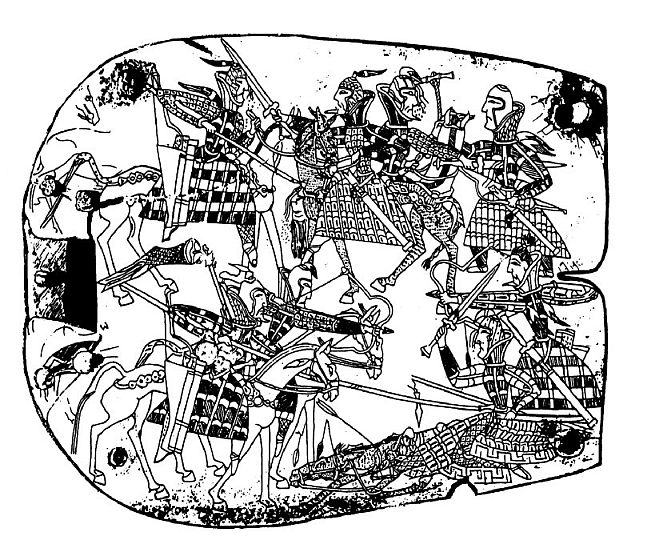
Orlat battle plaque from Sogdiana/Uzbekistan-
note the tube of fabric on a stick at center left.

  So far as I know, there is no evidence of an animal head on a pole with fabric streaming behind it showing up in one culture well before another (please, please correct me if you know better than I). There is a depiction of a headless one held by horse archers in Sogdiana (modern Uzbekistan) which might (with a very heavy emphasis on the "might") be from the last centuries BC. It might also be from the 4th or 5th century AD. I don't feel comfortable using it as evidence of an early depiction until the professionals have reached a consensus.

    I've seen an argument that the Dacians had them as far back as the Bronze Age based on bracelets- you can find zoomorphic bracelets in their area which have wolf heads (the Dacians used wolf heads, not the dragons the Romans used) on either end. But assuming that's a depiction of a draco 1) ignores the fact that other people across Eurasia also had zoomorphic bracelets with animal heads, and 2) requires a pseudoscientific practice- seeing what you want to see instead of being objective about it.
  It's zoomorphic art. It has nothing to do with dracos except to reflect the animals preferably depicted by each culture. Just because the head is on the end of a long thing doesn't mean the bracelet shaft represents the fabric tube. The end is just the intuitive place to put an embellishment on a bracelet that isn't shaped like a full circle.


On original use:
  Wind sock, religious purposes, group symbology (ethnic or military unit), and intimidation in war are all possible uses of a draco standard (though I'm personally less inclined to consider the religious use a possibility [lack of evidence and the whole copout thing I've talked about before]). When looking for an ultimate origin, it doesn't matter what it was used for along the way (so Roman use is irrelevant). What matters is the original use because it might narrow down the possibilities for its origin. The Romans remarked on them making frightful sounds, so it definitely intimidated them, but that doesn't mean that was the original intended use. If it were originally a war standard, it probably came from a culture which fought battles fairly regularly and most likely against other cultures that later adopted it. If it were originally a wind sock, the culture inventing it would had to have used archers in battle and they would likely need to be standing still for at least part of the battle. Wind socks will pick up forward movement which would then need to be compensated for, making them more difficult to use (or impossible if the horse were moving fast enough).

  I personally find the wind sock argument to be the most convincing. The arguments against it are: 1) wind socks are only useful to archers when the sock is stationary, 2) the enemy would get more use out of them, 3) wind socks are modern inventions, and 4) considering the different types of heads, why wouldn't group symbolism be the more likely original use?

  Counterpoint 1: Yes, being stationary is important. This point assumes that horse archers always fought while moving. We know the Scythians started their battles with stationary volleys. Unless we have known battle tactics for all cultures which might be the ultimate originators, we can't use this as a reason to nix the wind sock theory compeltely. (As a side note, Sarmatians did not use this tactic to my knowledge, which is why I don't think they were the ultimate originators of dracos, considering I favor the wind sock theory.) I've heard that forward movement can be corrected for when it comes to wind indicators, but I have no experience in this and don't know how easy/hard it would be or to what degree it can be corrected.

  Counterpoint 2: Yes, holding a wind sock would tell enemy archers how to adjust for wind near the group with the draco. However, flags and banners also show wind speed and direction and that didn't stop plenty of cultures from using them as standards regardless of whether or not the enemy could also use them as wind indicators. I'm not an archer, but it does make sense to me that an arrow would be more affected by wind the farther away it is from its shooting point given the loss of speed. There was an archery instructor online arguing in favor of the wind sock theory, though, so I'm left to assume that wind still influences the shot shortly after the arrow leaves the bow. Are any of you reading this archers who can add to this argument?

  Counterpoint 3: The term, sure. But the device? Draco standards are tubes of fabric on a pole braced by something so they stay open on the pole end. That's what a windsock is. It's true that we don't have evidence of it being used as a wind indicator by archers (though we have evidence of archers holding them). But quite frankly, all discussion of what draco standards were originally used for is heavily doused in speculation regardless of which camp you fall in. I personally find it hard to believe that no archer in pre-modern history ever thought to use a piece of fabric on a stick to tell wind direction in battle. There just wouldn't be time to repeat the test over and over using sparse test shots, pieces of grass, or a wet finger. If the wind changed in the middle of battle, you risk wasting arrows if you don't have a constant indicator. And since we use windsocks at airports instead of flags, I have to assume that the windsock design is more accurate than a simple flag as a wind indicator.

  Counterpoint 4: Why not just the heads, if that were the case? The fact that their back ends are all colorful, open tubes makes it more likely that the head type was changed after the fact to reflect personal/cultural preference.

  In short, I can't come up with a good reason for going to the trouble and expense of making a tube of fabric and bracing it open with something hard when a flat piece of fabric (i.e., a flag or banner) would do just as well for a military standard/rallying point or group symbology. As for the intimidation effect- I think it more likely that its additional use as this was a happy accident. Even the Highland Bagpipes, whose purpose was to intimidate the enemy and rile up the side using it, didn't come out of a vacuum- other types of bagpipes were around before that and co-opted for this use.
  As for religious or nationalistic use... Let's use the Dacians as an example. They thought wolves were pretty much the most awesome things ever, which is why their dracos have wolf heads. ...But why would someone think "Hey, let's make a depiction of a wolf!" and come up with a wolf head on the end of a fabric tube instead of just painting a wolf on a flag? Jumping straight to a draco is just not parsimonious in the slightest. You have to carve the wood, attach the metal on top of it, sew the fabric into a tube, and attach it to the head. It's so much easier to just paint a wolf on a piece of fabric. So regardless of who invented them or what feelings about religion or nationality dracos may or may not have invoked, I just don't buy the idea of "originally religious/nationalistic" in the slightest.

  If you think about geography, Dacians having them first doesn't make sense. Put a drop of dye in water and what happens? It spreads out in all directions. The Dacians are at one side of the area where draco standards are found and they weren't only interacting in one direction. Given that we don't have an instance of one culture having them well before another, it makes more sense to me that draco standards would either come from somewhere near the center of their known range, then spread out in all directions or a common ancestral culture had them and we just don't see the early evidence. Like I've said before, absence of evidence is not evidence of absence. It should be approached cautiously, but should still be considered.


tl:dr: Romans got draco standards directly from the Dacians. We don't know who they ultimately came from, but Sarmatians had them before Romans. This blogger thinks that the Sarmatians were not the ultimate origin and that the Dacians got them from farther east. The Sarmatians and Dacians interacted, so that's one possibility for how the Dacians got them.

And as a side note- this marks my halfway point to completing my A&S 50: Persona challenge!

Mihailescu‐Bîrliba, L., 2009, A funerary sculptured monument of Chester and its representation, Studia Antiqua et Archeologica XV.

Mode, M., 2006, Heroic fights and dying heroes- The Orlat battle plaque and the roots of Sogdian art, Eran ud Aneran- Studies presented to Moris Il'ic Marsak on the occasion of his 70th birthday, Libreria Editrice Cafoscarina, Venice, Italy, 718 pp.

Rostovtzeff, M., 1922, Iranians and Greeks in South Russia, Clarendon Press, Oxford, UK, 260 pp.