Sunday, November 18, 2012

Literature Review: Gonzales-Ruiz et al., 2012

  I can't believe I've only done one lit review so far... Time to fix that with a discussion of a fun paper (Gonzalez-Ruiz et al., 2012) that was brought to my attention recently on the haplotypes of people buried in Pazyryk graves (The Pazyryk culture is the one that gave us the dozens of golden deer statues I discussed previously. Ethinically, they were "Eastern Scythians", a.k.a. Saka.). The best part is that it's in PLOS ONE, which is a completely open source peer-reviewed journal. No paying $30+ for an article when you don't have a university library to use. :) I won't go into detail since you can read the entire thing for yourself with a click of a button, but here are the main points. If you aren't a geneticist, don't worry about the methods; there's a lot of jargon involved. Try reading the introduction, then skipping to the discussion.

  Haplotypes are particular sequences of DNA which are very useful in biogeographic studies of humans. They evolve at just the right rate to tell us about the worldwide expansion of our species throughout, then out of, Africa when considering particular combinations of haplotypes (haplogroups). The haplotypes used for these type of studies have pervaded the populations they evolved in. Some of them were carried to new regions when a population migrated or when adjacent groups sequentially interbreed, thus transporting the haplotype that way even if the original population didn't move much.

  Central Asia and the adjacent steppes are at a crossroads between "Europe" and "Asia" insofar as the ethnicities living there are concerned (despite the name of the region itself). There are high number of diverse ethnicities living there- some seem more European and some seem more Asian. The purpose of this paper was to add more information to our understanding of the ancient genetic flow in the region.
  The authors extracted DNA from skeletal material in Iron Age Pazyryk burials and compared it to other DNA from both Bronze Age and Iron Age burials in Central Asia. What they found is that during the Bronze Age- after humans had initially expanded into the Far East- the Altai mountains were acting as a barrier. East was east, west was west, and there's no evidence for any genetic flow between them. At some point in the Iron Age, things changed. The haplogroups go from being East Eurasian (i.e. Turkic nomads) on the east side of the mountains and West Eurasian (i.e., Iranian nomads) on the west side of the mountains to about half and half on both sides.
  Today, steppe nomads are Turkic. The few remaining ethnicities in the same larger language group as the Iranian steppe nomads are sedentary now. They were driven off the steppes and diminished in prominence by the westward-expanding Turkic nomads within history. What this study shows is that during prehistory, it was the Iranian nomads who did the expanding (toward the East). They initially stopped at the Altaic mountains, then the groups living in that area started expanding outwards-or rather, their genes did. There were no new West Eurasian haplotypes showing up, just the local ones increasing in geographic range. This study adds another line of evidence for our understanding of the ancient biogeography of steppe nomads (on top of cultural and linguistic data), and give us some hard boundaries (both spatial and temporal).

Wednesday, November 14, 2012

Knowne Worlde Academy of Rapier and Clothing Symposium

  The annual SCA-wide fencing and clothing event was this past weekend (as was Calontir's Crown Tourney- congrats to Their new Excellencies Donngal and Catalina!).

  Unfortunate circumstances led to me missing all the morning classes I wanted to go to on subjects such as body mechanics and single rapier fundamentals, so the only fencing class I went to was the rapier and dagger master class. I got some good tips out of it for future reference, but I don't own a dagger yet and the room was waaaay too crowded, so I didn't get to actually try anything.

  The clothing class, however, was extremely beneficial. It turns out I took a class from the same teacher at Dragon*Con two years ago. She taught back-to-back classes on making patterns for Central Asian kaftans (caftans with her spelling; it doesn't really matter). She also gave us background info (hurray!) on why kaftans were constructed the way they were. Having two layers in front with a wrap kaftan I knew about- it combats the cold wind blowing straight at you when you're riding a horse. She also talked about the vestiges of those original purposes which were retained in later period sedentary cultures. One thing she pointed out (which she also talked about in the D*Con class) was how she'd spent a long time trying to figure out the neckline in a Persian (I think) kaftan, only to realize that it was the same pattern used by Turkic nomads, just the two sides attached down the center instead of wrapped.
  She had this brilliant method of teaching us a basic Turkic nomad kaftan pattern. She passed out pieces of fabric for us to cut the pieces for miniature kaftans out of. The fabric was black and white checked, which meant you could designate each small square as being a certain number of inches. It works brilliantly! I need to find some of that now.
One of the things she pointed out that had been bothering me when trying to draft patterns was shoulders. I couldn't figure out how to get the shoulder seams to lay flat against me. Turns out they aren't supposed to (at least not before later period kaftans). Shoulder seams should be straight and the pooching in front is supposed to be there.
Her name is Jadi Fatima. She primarily researches Ottoman, Mongolian, and Persian culture, textiles, and dance. She does brilliant work and I highly encourage visiting her website.

There was a ball Saturday night, for which my ride and I were the only musicians. Christian is a music Laurel (he mostly played recorder with a little guitar) and I played the drum. ...That was the second time I've picked up a bodhran. I think I did okay. o_o As he described the situation, all the musicians were from Calontir and we definitely stayed in tune the entire time.

Wednesday, November 7, 2012

Event this weekend

I am going to be a bad, bad Calontiri this weekend. It's Crown Tournament...but the Knowne World Academy of the Rapier/Known Worlde Clothing Symposium is also this weekend and just four hours away in the Midrealm (in Itasca, IL). As much as I've been wanting to go to Crown (I've never been to one. :( ), Gamble and I are trying to teach ourselves cut-and-thrust and have no mentors to learn from locally. We're on the Calontir Steel e-mail list, but there's only so much you can learn through exchanging e-mails. This is an excellent opportunity for us to absorb as much information as possible from experts in person and I just can't justify passing it up, seeing as Crown happens twice a year and the odds of this event being near us again are pretty low. On top of that, Gamble isn't sure what style of clothing he wants to wear in the SCA, so this is a fantastic opportunity for him to see examples from all sorts of time periods and cultures.
Anyone else heading over there?

My Anniversary Present!

The hiatus is over now. :)
I've been waiting to post this one for quite a while. I initially held off because it was my husband's entry in Queen's Prize and I wanted to wait to post it until it was over. Then the mundane busy-ness happened.
My husband (who has started going by Gamble in the SCA) is awesome. I was traveling for five weeks prior to our first anniversary and he spent that time secretly plotting and planning my present. I came home to this:

  He looked through the Sarmatian books I'd left behind and referenced a bath robe and jacket I have to make the pattern and figure out the measurements. The extra triangular sections on the front are there because the initial cut didn't wrap around as far as he wanted.
  We don't have a sewing machine, so he hand-sewed the entire thing. He's almost as new to sewing as me (and much better!) and wanted to play around with reversibility, so it's reversible. He used some of the fabric gifted to my by Juturna to imitate deerskin leather and found some polyester imitation silk at the local fabric store. He made it reversible for the heck of it and it is awesome.
   I'll take some measurements and update this post later so everyone has a tried and true kurta  pattern to work with.

Monday, October 15, 2012

On rude behavior (and a bit about the Jassic people)

I'm making a brief mid-hiatus appearance to say- I've had a visit from a troll. Which means I'm a real blogger now! Look on the bright side of things, right?

I recently received a comment from someone which I unfortunately felt a need to delete. The gist of the comment was, "I'm Alan and you don't know what you're talking about, so stop." (Which means about as much as if I had said "I'm an academic and you don't know what you're talking about, so stop.", which is not much of anything. It's misleading and leaves too much to be said.) That's it. No correcting any perceived mistakes. And some cursing, which was the sole reason I deleted it. I did not make the settings on this blog "adults only" and have no intention of doing so. Strong cursing will not be tolerated and any comment containing it will be deleted posthaste.
I suspect the commenter is someone who followed a share of one of my posts made by a Hungarian on Facebook. There were comments on some of his other posts by someone who also said he was Alan and the Hungarian doesn't know what he's talking about. The Hungarian had uploaded a video to a song (in Hungarian?) which, based on other comments, must have mentioned the Jassic people of Hungary, who are descended from Sarmatians (likely the Iazyges/Jazyges, considering the name and location). The human genographic project provides an independent line of evidence in the form of haplotypes traceable back to the Sarmatians' homeland showing up in a village in Hungary. Spencer Wells, one of the head researchers for the project, gave a talk at my university last semester and mentioned that briefly. He didn't actually say "Jassic" or "Sarmatian", but I knew exactly what he was talking about and looked it up later to confirm. I may have audibly squeed. It's a really cool project; I highly recommend you browse through their findings. Maybe even contribute your own DNA if you can afford to. :) The research is largely funded by people buying the kits, which is why they're so pricy. In short, there's plenty of evidence for the Jassic people being of Sarmatian descent- DNA, their now-dead language, and our knowledge of their history all point toward it.

But back to the topic at hand- The Commenter's reason for objection had a bit of a racist ring to it. Maybe not quite what you normally think of when you hear the word racist- more like a desperate need to be special and unique, as his people haven't exactly been treated fairly in recent history. He also seemed to think the video implied that the Magyars were of Sarmatian descent (which they aren't and which other commenters said it didn't imply).

So if you're reading this, Commenter, being rude and confrontational will get you nowhere.  There are people interested in Ossetians and Alans who aren't of your ethnicity- that's a compliment and a testament to your rich cultural heritage. I'm not sure why you aren't happy that others recognize that and want to know more. If you know something I don't, please do tell me and tell me where I went wrong. Simply saying "I'm right, you're wrong" is not conducive to learning.

Tuesday, October 2, 2012

Hiatus and Queen's Prize

This is overdue, but considering how busy I've been and will continue to be for the next month, I should officially declare a hiatus to be ended in mid November.

A couple quick notes, though- My husband and I both entered Queen's Prize last month. It's a kingdom-level A&S "competition". It's specifically for novice-level (though you can request to be judged at intermediate level, which I did). The competition aspect is less emphasized than it is in Kingdom A&S. I entered the Chinese dumplings I taught a class on at Lilies and my husband entered a Sarmatian-related thing which I'll write about once the hiatus is over.
I finally got to see the Big Book of Emblazons in person. Everyone really seems to be enjoying it! And as a thank you for making it and doing other heraldry service, Their Majesties made me a Torse! The Torse is the AoA-level service award in Calontir. :)

Tuesday, August 28, 2012

Steppe Nomad Symbolism for SCA Armory


   I’ve talked about tamgas being a heraldic tradition of steppe nomads before, but what if your particular culture and time didn’t have tamgas, didn’t use them as heraldry, or you just don't want one? There are still plenty of ways to make your Western-style armory reflect your steppe persona. Just think about symbolism that would have been important to your culture and put that on your device or badge. Mine their art for ideas as well as thinking about their modes of life.
    Below are some ideas. Can you think of any others? Add them in the comments!

Weapons
    Steppe nomads were not exactly a peaceful lot. They raided, they were mercenaries, they fought against empires that threatened them… They also got a lot of their sustenance from hunting. Bows (think Mongol-type bows, not longbows) and arrows were used both for hunting and in combat (Parthian shots ftw!). Some Sarmatian tribes, like the Iazyges, used long lances in combat. Swords and daggers were also prolific (swords in particular held strong symbolic significance for some, such as the Alans). When you emblazon them, just pick the type your persona would have had. Sarmatians were known for swords with little to no guard and ring pommels. They also had dirks which they carried in sheaths strapped to their thighs rather than hanging from their belts as Westerners would have done.
Ring pommels were popular between the 2nd cent. BC and 2nd cent. AD around the Black Sea and Hungarian Plain. They were usually 50-60 cm long, and sometimes had semi-precious stones set in the rings. These are from the Odessa Archeological Museum. (Brzezinski and Mielczarek, 2002)

Vestments
    What would your persona wear? What type of kaftan did their culture have? Were their boots distinctive? What about hats? What type of armor did they wear? Any torques or other commonly-worn accessories? All of these are possible charges.

People
    People are not common in armory- partially because most don’t care for them as charges and partially because they’re harder to draw/sew/embroider/etc… for most. If you do like them, though, you can have people standing around, people riding horses, people shooting bows, etc… Just give them the sort of racial features and proportions your nomads would have had, dress them up in their clothes, and make any other accoutrements persona-appropriate.
Models of dwellings from
Kirch, Crimea circa 600 BC.
(Andrews, 1999)

Wagons and Tents
    Steppe nomads did not simply sleep on the ground or in a bedroll; they had wagons and tents (which or what they look like depends on your persona). You could have a tent or wagon simply placed on your device, show them being drawn or carried by horses, cattle, or camels, or you could have multiples arranged to symbolize an encampment (heraldic options for this are semy, in orle, a semy on a bordure, or in a train (try “on a fess, x wagons/pack animal”).
  
Horses
    The single most important animal in a steppe nomad’s life is their horse. They are transportation, source of dairy, indicator of wealth and status, pack animals, mount during hunting or combat- everything. This makes them an extremely appropriate charge for a steppe nomad’s armory. 
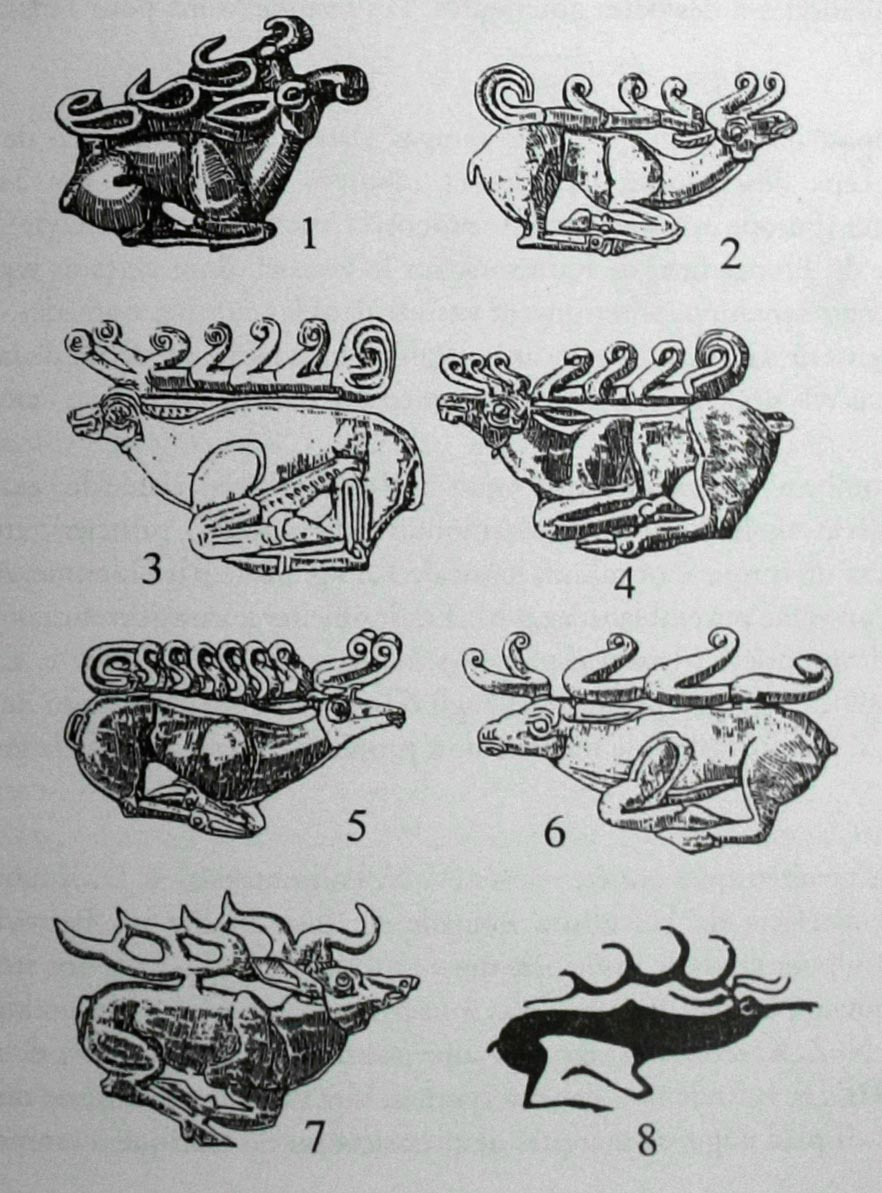
Running deer from: 1-2)The Ukraine,
3-5) Russia, 6) Iran, 7) Kazakhstan,
8) Mongolia. (Lebydynsky, 2011)

 Deer
    Early steppe nomads- both Iranian and Altaic- really like deer as art subjects. This wonderful figure from Lebedensky’s Tamga book illustrates the uniformity of just one deer motif. They sculpted, painted, and sewed them standing, lying down, being attacked by predators, with their legs turned 180 degrees (registering that might be hairy, though you could display it that way), and running. In Western (and SCA) heraldry, courant invokes the image of legs extended, but the steppe depiction is the moment in the stride where the legs are tucked under the body.

Griffins
    Griffins are of huge importance to Iranian steppe nomads. Unlike later Western griffins, it isn’t simply the back half of a lion glued onto the front half of an eagle with ears. You take something that looks like a lioness (or maneless male lion), add bird wings, a beak, pointy, feathery ears, and a fish-fin type crest running down the length of its neck. If you want to get really fancy, have it vulning (standing on top of and attacking) a deer or ibex. Depending on your culture, the deer’s legs may or may not be twisted 180 degrees from the front of the body.

 Camels
Phalera with two Bactrian camels.
Bronze, Filippovka, 4th cent. BC.
(The Golden Deer of Eurasia)
They have pompadour mullets!
    Camels were (and are) important to many Altaic nomads. A fairly common theme that you see in nomadic art is two Bactrian camels with fangs standing side-by-side and biting each others' back legs. I seriously doubt that particular pose could be registered, but the “combatant” pose was created with the intention to show animals attacking one another, so try registering that instead (the word may be changed to “respectant” during registration since they’re herbivorous). Alternatively, you could have them standing and facing one another (statant respectant). Then when you display it, shift it to the form more appropriate to your persona.

Monsters
    You don’t often see unique chimerical monsters in SCA heraldry, but they do exist and are completely registrable (there are currently 37 registered). You just have to blazon the different parts they’re made of. Some steppe nomads left behind depictions of chimerical monsters. The most common example it to start with either a deer or a horse. Say you have a deer- you can give it a bird beak. You may put stylized griffin heads on the ends of its antler tines. The blazon would read something like "a monster composed of the beak of an eagle and the body of a deer, with antler tines ending in gryphon heads". If you start with a horse instead, you do the same thing while adding deer antlers.
In steppe terms, this is a lion-headed, goat-horned gryphon (with front leg proportions more akin to a goat, but still ending in paws). Because of the difference between medieval gryphons and early steppe gryphons, this chimaera would be better blazoned as "a bird-winged monster composed of an ounce's head, paws, hindquarters, and tail, a goat's horns, ears, and forequarters, and a dragon's neck" if you want to register something like this in the SCA. It could be taken to be couchant (lying down) or sejant erect (sitting, but with front legs raise), but make it more obviously one or the other for registration purposes. It's wings are addorsed and inverted if you want to blazon that detail. Remember that steppe art involves squishing and stretching things to fit the space.
From a scabbard made by a Greek with Scythian designs and for a Scythian. Gold, PLACE, TIME. (From the Lands of the Scythians)
 What Not to Have
   Once you've come up with a steppe-themed charge, you might find that you want to put a little bit more on your device but don't want the rest of the obviously steppe options. Instead, you might find yourself flipping through the PicDic or medieval armorials for possible charges. What should you avoid if you want it to still make sense for a nomad? Big ships, for one- horse nomads have no reason to go sailing (unless you want to be one of those Iazyges who went to what's now England, or an Alan who crossed Gibraltar to raid with the Goths, but those were one-off trips). That's not to say they didn't fish in rivers or any of the seas in or near the steppes- you can occasionally find a zoomorphic fish- but big whales? No. Pelagic fish? No. Also avoid any objects which postdate your particular culture or that they never would have encountered. Maunches, for example- the angel-armed sleeves- are not from a time or place in which they could be encountered by a Saka. Farming implements (aside from some involved in animal husbandry) would also be uncharacteristic. If your persona didn't have a written language, books and quill pens wouldn't make much sense. Unless you have evidence that a steppe nomad encountered tales or depictions of New World fauna, it would be best to avoid them considering how temporally and geographically restricted knowledge of them was in SCA period. These are just a few examples. Basically, just do your homework and use your best judgement when picking charges not specific to steppe nomads. :)

One Final Note
   Keep in mind with all of these that if a steppe nomad motif looks much different from the Western standard, there is the risk of it not being registered if submitted as such. I’m not saying it couldn’t, but keep in mind that typical SCA heralds have to be able to blazon it consistently. Stylized zoomorphic art has been registered in the past, but so far as I know it isn't anymore, so definitely avoid that aspect when drawing for submission. When it comes time to display your armory, though, show everyone your steppe persona!


From the Lands of the Scythians: Ancient Treasures from the Museums of the USSR, 3000 BC-100BC, Metropolitan Museum of Art Bulletin, Vol 32, no. 5, 1975.

The Golden Deer of Eurasia: Scythian and Sarmatian Treasures from the Russian Steppes, The Metropolitan Museum of Art, 2000.

Brzezinski, R, and Mielczarek, M, 2002, Men-at-Arms: The Sarmatians 600BC-450AD, Osprey publishing.

Andrews, P, 1999, Felt Tents and Pavilions, Melisende UK Ltd.

Lebydynsky, I, 2011, Les Tamgas: Une "Héraldique" de la Steppe, éditions errance.