Showing posts with label horses. Show all posts

Thursday, August 21, 2014

Sarmatian-related Objects in the British Museum

  I was actually able to find some Sarmatian-related things in the British Museum! Yay! Many of them were artifacts from sedentary cultures that were either traded from or influenced by their steppe neighbors, be they Sarmatian or contemporaries of the Sarmatians.

  First up is something a sedentary culture picked up from either the Sarmatians or a contemporary steppe culture. They liked to sew gold plaques on their clothing. There were some in a case of Parthian items from the 1st century AD.
  There are tiny holes on the edges for the thread. Not pictured above these were some gold leaves mimicking early Greek head wreaths. The label notes that the wreath was probably placed on a corpse, so in this case the gold plaques may have been a funerary-specific thing.


 There were also a type of small, three-sided arrowhead which were apparently indicative of Central Asian steppe cultures before some sedentary ones decided they were awesome and started using them themselves. They were apparently quick and easy to make and good at piercing armor. They were fired out of recurved bows—also introduced form the steppes.
 These are from a soldier's cemetary (Deve Hüyük) from the mid-6th to 4th century BC in northern Syria, which was then part of the Achaemenid Empire.

  This horse bit is from the same site as the arrowheads. Nothing was said about whether the style was native Achaemenid or steppe-influenced, but I've included it here since it's contemporary and may be of interest to equestrians.
  I wouldn't advise actually using these on your horses, though. The label noted that the knobs on the snaffle, while allowing control with very small movements, would be uncomfortable for the horse.


  They also found items in at least one female grave there. Bronze mirrors were also ritually buried with priestesses in steppe nomad kurgans. It used to have a wooden handle. The bone tube used to have a lid and contained some sort of makeup. The other items are a cloak brooch and bracelets with stylized calf's head motifs.
  Anyone know what the burial practices of an Achaemenid garrison would have been?  Would they bury wives of soldiers there as well? Would they have had a religious leader there? Or did women sometimes fight in their culture like the Sarmatians? The labels didn't say if these were found alongside martial artifacts or not.

  Fast-forward in time to the Sassanian Empire—the last Iranian empire before the spread of Islam. They made seal stamps out of various minerals. People, animals (real and mythical), plants, and inanimate objects were all possible images on the seals. ...So were tamgas. :)
  The BM display only had the one tamga seal (no provenance given), but you can see quite a few more in a private Austrian collection on this website.


   And, finally, there was the Ribchester Hoard. The hoard itself is too early to belong to any of the Iazyges Sarmatians that were stationed there, but other, later Roman artifacts were displayed in the same case. And some of them looked to be lifted from the Sarmatians. One of the re-enactment groups I'll talk about soon discussed how Romans tended to absorb weapon and armor styles from the people they conquered.
  There were a number of weapons in this case—swords, daggers, etc...—and one of them is a ring pommel sword. Ring pommel swords were popular among Sarmatian from the 2nd century to the 2nd century AD (mentioned in the Osprey book on them). They were also used by other Central Asian peoples, though it doesn't seem like they were very popular until later according to the discussion on this forum. About the time the Iazyges were first drafted into the Roman army, ring pommel sword became popular amongst Romans.
  This sword is from the 2nd-3rd century AD, Pevensey, East Sussex. It was found with coins from Emporer Commodus' reign (176-192AD). It was buried in the ground intact. The wood and leather scabbard(?) (I think they may have meant to say grip there...) rotted away, but the tin-coated bronze pommel is intact.

  I'll talk more about the Ribchester Hoard and the Sarmatian ala there in an upcoming post on the Ribchester Roman Museum.





Friday, January 10, 2014

Ask the readers: Animals

One year ago today, we adopted a cat from the local shelter. Tali'Miller-Camp vas Iowa (yes, that is a Mass Effect reference) is a pet- an animal kept for pleasure. But unless your SCA persona is upper class and probably late period, the animals s/he could have kept are unlikely to have been purely pets- they would have had some sort of practical use.

What kind of animals did your persona (or their culture if not them, specifically) keep? What breed? Is it or breeds descended from it still around today? What were they used for?


Unlike my other "Ask the Readers", I can actually answer this one! Collectively, Sarmatians kept horses, cattle, sheep, and dogs.

Apologies for the lack of centering (it's at the top).
Turns out I don't have an image of this on my computer.
I'll replace it with a better version when I get home.

The sheep and cattle they kept for food, wool, and leather. Scythians did too and you can see an example of Scythians making a sheepskin shirt on a beautifully intricate torse made by the Greeks.


Mongolian horse and rider
Image source: http://www.studiomme.com

Their horses were their livelihood. They were meat, clothing, milk, wealth, transportation, and mounts all rolled into one. They would have been short and stocky compared to the horses we're accustomed to seeing in the West today- probably a lot like horses kept by modern steppe nomads.


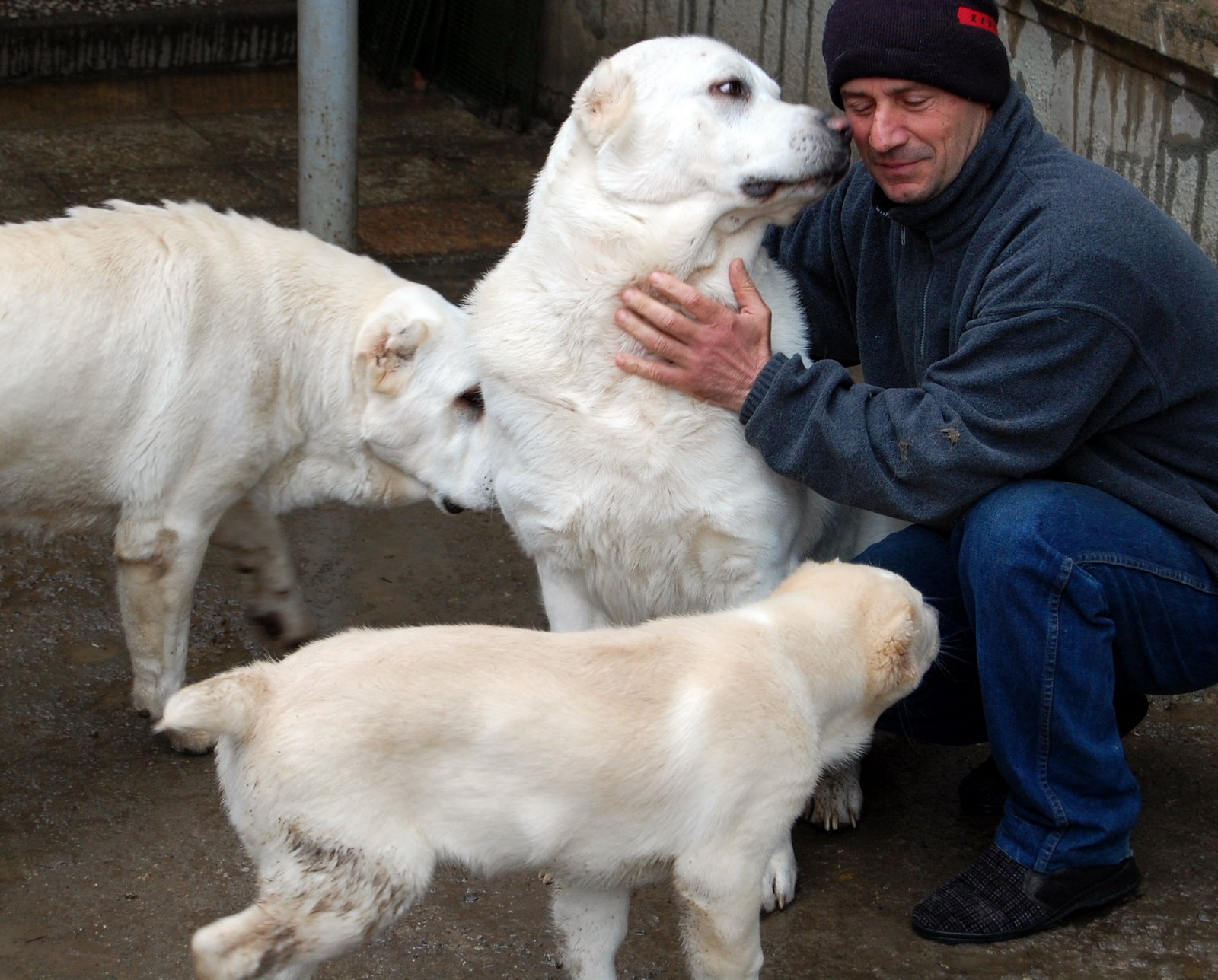
Kazbegi type Georgian Mountain Dog
Image source: http://kaukasus.blogspot.com

Their dogs were big molossers who served as livestock guardians and war dogs. The dogs of the Sarmatians sensu stricto were Sarmatian Mastiffs. The breed kept by the Alans was the Alaunt (which would have been partially descended from the Sarmatian Mastiff. The word 'Alaunt' later came to be used for a general phenotype, rather than a particular breed, in Europe. The original Alaunt probably looked similar to the Kazbegi type Georgian Mountain Dog, which is probably a descendant.

(References will be when I get home. Sorry!)

Tuesday, August 28, 2012

Steppe Nomad Symbolism for SCA Armory


   I’ve talked about tamgas being a heraldic tradition of steppe nomads before, but what if your particular culture and time didn’t have tamgas, didn’t use them as heraldry, or you just don't want one? There are still plenty of ways to make your Western-style armory reflect your steppe persona. Just think about symbolism that would have been important to your culture and put that on your device or badge. Mine their art for ideas as well as thinking about their modes of life.
    Below are some ideas. Can you think of any others? Add them in the comments!

Weapons
    Steppe nomads were not exactly a peaceful lot. They raided, they were mercenaries, they fought against empires that threatened them… They also got a lot of their sustenance from hunting. Bows (think Mongol-type bows, not longbows) and arrows were used both for hunting and in combat (Parthian shots ftw!). Some Sarmatian tribes, like the Iazyges, used long lances in combat. Swords and daggers were also prolific (swords in particular held strong symbolic significance for some, such as the Alans). When you emblazon them, just pick the type your persona would have had. Sarmatians were known for swords with little to no guard and ring pommels. They also had dirks which they carried in sheaths strapped to their thighs rather than hanging from their belts as Westerners would have done.
Ring pommels were popular between the 2nd cent. BC and 2nd cent. AD around the Black Sea and Hungarian Plain. They were usually 50-60 cm long, and sometimes had semi-precious stones set in the rings. These are from the Odessa Archeological Museum. (Brzezinski and Mielczarek, 2002)

Vestments
    What would your persona wear? What type of kaftan did their culture have? Were their boots distinctive? What about hats? What type of armor did they wear? Any torques or other commonly-worn accessories? All of these are possible charges.

People
    People are not common in armory- partially because most don’t care for them as charges and partially because they’re harder to draw/sew/embroider/etc… for most. If you do like them, though, you can have people standing around, people riding horses, people shooting bows, etc… Just give them the sort of racial features and proportions your nomads would have had, dress them up in their clothes, and make any other accoutrements persona-appropriate.
Models of dwellings from
Kirch, Crimea circa 600 BC.
(Andrews, 1999)

Wagons and Tents
    Steppe nomads did not simply sleep on the ground or in a bedroll; they had wagons and tents (which or what they look like depends on your persona). You could have a tent or wagon simply placed on your device, show them being drawn or carried by horses, cattle, or camels, or you could have multiples arranged to symbolize an encampment (heraldic options for this are semy, in orle, a semy on a bordure, or in a train (try “on a fess, x wagons/pack animal”).
  
Horses
    The single most important animal in a steppe nomad’s life is their horse. They are transportation, source of dairy, indicator of wealth and status, pack animals, mount during hunting or combat- everything. This makes them an extremely appropriate charge for a steppe nomad’s armory. 
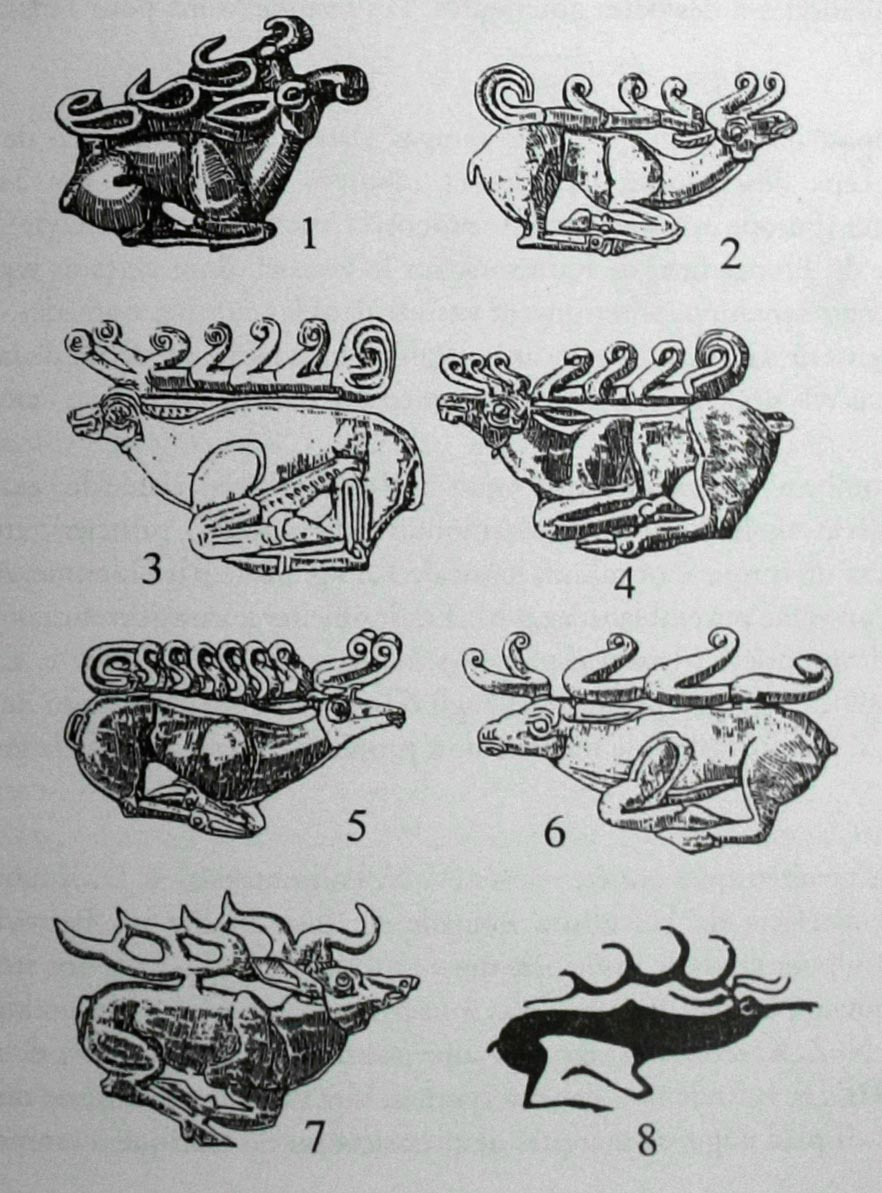
Running deer from: 1-2)The Ukraine,
3-5) Russia, 6) Iran, 7) Kazakhstan,
8) Mongolia. (Lebydynsky, 2011)

 Deer
    Early steppe nomads- both Iranian and Altaic- really like deer as art subjects. This wonderful figure from Lebedensky’s Tamga book illustrates the uniformity of just one deer motif. They sculpted, painted, and sewed them standing, lying down, being attacked by predators, with their legs turned 180 degrees (registering that might be hairy, though you could display it that way), and running. In Western (and SCA) heraldry, courant invokes the image of legs extended, but the steppe depiction is the moment in the stride where the legs are tucked under the body.

Griffins
    Griffins are of huge importance to Iranian steppe nomads. Unlike later Western griffins, it isn’t simply the back half of a lion glued onto the front half of an eagle with ears. You take something that looks like a lioness (or maneless male lion), add bird wings, a beak, pointy, feathery ears, and a fish-fin type crest running down the length of its neck. If you want to get really fancy, have it vulning (standing on top of and attacking) a deer or ibex. Depending on your culture, the deer’s legs may or may not be twisted 180 degrees from the front of the body.

 Camels
Phalera with two Bactrian camels.
Bronze, Filippovka, 4th cent. BC.
(The Golden Deer of Eurasia)
They have pompadour mullets!
    Camels were (and are) important to many Altaic nomads. A fairly common theme that you see in nomadic art is two Bactrian camels with fangs standing side-by-side and biting each others' back legs. I seriously doubt that particular pose could be registered, but the “combatant” pose was created with the intention to show animals attacking one another, so try registering that instead (the word may be changed to “respectant” during registration since they’re herbivorous). Alternatively, you could have them standing and facing one another (statant respectant). Then when you display it, shift it to the form more appropriate to your persona.

Monsters
    You don’t often see unique chimerical monsters in SCA heraldry, but they do exist and are completely registrable (there are currently 37 registered). You just have to blazon the different parts they’re made of. Some steppe nomads left behind depictions of chimerical monsters. The most common example it to start with either a deer or a horse. Say you have a deer- you can give it a bird beak. You may put stylized griffin heads on the ends of its antler tines. The blazon would read something like "a monster composed of the beak of an eagle and the body of a deer, with antler tines ending in gryphon heads". If you start with a horse instead, you do the same thing while adding deer antlers.
In steppe terms, this is a lion-headed, goat-horned gryphon (with front leg proportions more akin to a goat, but still ending in paws). Because of the difference between medieval gryphons and early steppe gryphons, this chimaera would be better blazoned as "a bird-winged monster composed of an ounce's head, paws, hindquarters, and tail, a goat's horns, ears, and forequarters, and a dragon's neck" if you want to register something like this in the SCA. It could be taken to be couchant (lying down) or sejant erect (sitting, but with front legs raise), but make it more obviously one or the other for registration purposes. It's wings are addorsed and inverted if you want to blazon that detail. Remember that steppe art involves squishing and stretching things to fit the space.
From a scabbard made by a Greek with Scythian designs and for a Scythian. Gold, PLACE, TIME. (From the Lands of the Scythians)
 What Not to Have
   Once you've come up with a steppe-themed charge, you might find that you want to put a little bit more on your device but don't want the rest of the obviously steppe options. Instead, you might find yourself flipping through the PicDic or medieval armorials for possible charges. What should you avoid if you want it to still make sense for a nomad? Big ships, for one- horse nomads have no reason to go sailing (unless you want to be one of those Iazyges who went to what's now England, or an Alan who crossed Gibraltar to raid with the Goths, but those were one-off trips). That's not to say they didn't fish in rivers or any of the seas in or near the steppes- you can occasionally find a zoomorphic fish- but big whales? No. Pelagic fish? No. Also avoid any objects which postdate your particular culture or that they never would have encountered. Maunches, for example- the angel-armed sleeves- are not from a time or place in which they could be encountered by a Saka. Farming implements (aside from some involved in animal husbandry) would also be uncharacteristic. If your persona didn't have a written language, books and quill pens wouldn't make much sense. Unless you have evidence that a steppe nomad encountered tales or depictions of New World fauna, it would be best to avoid them considering how temporally and geographically restricted knowledge of them was in SCA period. These are just a few examples. Basically, just do your homework and use your best judgement when picking charges not specific to steppe nomads. :)

One Final Note
   Keep in mind with all of these that if a steppe nomad motif looks much different from the Western standard, there is the risk of it not being registered if submitted as such. I’m not saying it couldn’t, but keep in mind that typical SCA heralds have to be able to blazon it consistently. Stylized zoomorphic art has been registered in the past, but so far as I know it isn't anymore, so definitely avoid that aspect when drawing for submission. When it comes time to display your armory, though, show everyone your steppe persona!


From the Lands of the Scythians: Ancient Treasures from the Museums of the USSR, 3000 BC-100BC, Metropolitan Museum of Art Bulletin, Vol 32, no. 5, 1975.

The Golden Deer of Eurasia: Scythian and Sarmatian Treasures from the Russian Steppes, The Metropolitan Museum of Art, 2000.

Brzezinski, R, and Mielczarek, M, 2002, Men-at-Arms: The Sarmatians 600BC-450AD, Osprey publishing.

Andrews, P, 1999, Felt Tents and Pavilions, Melisende UK Ltd.

Lebydynsky, I, 2011, Les Tamgas: Une "Héraldique" de la Steppe, éditions errance.