Showing posts with label jewelry. Show all posts

Saturday, July 26, 2014

Scythian and Scythian-related Objects in the British Museum

I was quite happy with the British Museum (BM). They had many steppe nomad and steppe nomad-related artifacts on display. And, because they're an archeology museum, their labels were much more informative than the Louvre's. Also, there's so much I want to talk about that I've decided to split my visit there into two posts--this one focused on the Scythians and the next on the Sarmatians.

The Oxus Treasure
Scythian feline on a ring biting its tail.
Similar to the pommels at the Met.
The Oxus Treasure is a collection of Achaemenid-period metalwork and coins found in modern-day Tajikistan just across the border with Afghanistan. Much of it was unfortunately cut or melted down for bullion by the merchants the finders originally sold it to, so museums only contain part of the find now. The art styles in the hoard are highly variable, so one hypothesis is that the hoard was temple tribute, with individual pieces being of various ages and originating from various cultures. The BM dates the metalwork to the 5th or 4th century BC. Some of them are the steppe nomad's Animal Style. Others simply demonstrate interactions with them.

Scythian bracelet with two
interlocking monsters.
Luristan Bronzes
The most adorable little Scythian monster ever!
Originally, it would have had stone inlays
and may have been on a hat or hair accessory.
This Achaemenid piece shows a
Persian hero killing steppe nomads.
I finally found out what those deer-ibex motifs in the Louvre are--they're from a group of artifacts called the Luristan Bronzes. They're from the Early Iron Age of west-central modern-day Iran. Some pieces are ornamentative, some ceremonial, and others had more practical purposes (e.g., the weapons). The BM had more on display, including some that looked like humans shaped to be rather, uh...phallic. I haven't included any pictures of this collection.

Caucasian artifacts
There was an entire section on the early first millennium BC Caucasus as the "gateway to the north" for Iran. Some of the artifacts in this section were of Scythian style from northwest Iran, while others were Caucasian (Koban culture). Below are gold fragments from late 8th century belts from Ziwiye in north-east Iran, which would have been sewn onto cloth or leather backings and are daggers from Iran and Georgia.

Scythian-style feline motifs with missing stone inlays
Look familiar? The label here gave more information on this
artifact than the one in the Met, some of it conflicting. I'm
not sure if they're two pieces of the sameartifact with the
Met either getting the less battered piece or restoring their's
more nicely, or if they're two separate artifacts made by the
same person. There are two different styles here.
The stags and ibexes are done in Scythian style. The motif
encasing them is more along the lines of Near Eastern art.
I do wonder about its identification as apiece of a belt...that
would have to be a pretty wide belt...even wider for the Met's.


10th-9th century BC Iran
The style is similar to some found in both northwest Iran and Georgia.
The handle was covered in wood held attached with small cooper
rivets. The edges have been sharpened, so it has actually been used
as a weapon.
14th-9th centuries BC, Georgia
These are types of Caucasian daggers.
The left is of a style often found with
other weapons (swords, axes, spearheads)
 in graves in Armenia and Georgia. The
right is younger and of the Koban culture.
 The style with animals facing each other
on the handle may have influenced later
Scythian handles.


Wednesday, July 9, 2014

Maybe Scythian Stuff in the Louvre?

Apologies for the wait. Between collections work, sightseeing, some professional service work, keeping up another blog to meet one of the requirements for one of my fellowships,and resting from doing all that, I'm only now getting time to write stuff up here. But more will follow shortly. :)

It turns out the Louvre doesn't actually have any Sarmatian stuff. I wish I'd saved the link that pulled Sarmatian stuff up on a search because I have no idea why it told me they did. They have one thing in the collections which references the Sarmatians (a Roman relief commemorating some of Hadrian's victories over them), but no actual stuff of their's according to a search through their online database. I went through the Iranian area (Iranian meaning cultures-and-empires-based-in-Iran, not all Iranian ethnicities) just to see what was there.

The database mentions an Achaemenid bracelet that might have been made by the Scythians. I found some artifacts on display that look familiar after having looked at a lot of pictures of Scythian metalwork. But there's no way to be sure they actually made it because the Louvre is an art museum and art museums do this thing where they hardly give you any information on the labels. Just name, material, date, donator, and date of aquisition.

---Dear art museums,
I know you want us to spend our time looking at the art pieces, but I would be able to appreciate them more if you'd give me a contextual framework in which to appreciate them. I know I could have rented an audio guide, but I highly doubt you consider the pieces I'm interested in important enough to tell me about them in there. And I know you sometimes have guided tours, but same thing there. So....more informative labels, please?
Sincerely,
Me---

So, given the lack of information (I only knew they were found within the boundaries of an Iranian empire because that's what the rooms' themes were.), there's no way for me to know if those pieces were: 1) made by the Scythians and traded to someone in an Iranian empire; 2) made by someone in an Iranian empire copying Scythian art style; or 3) representative of that Iranian empire's art style which happens to be similar to the Scythian's because they used to be the same people way, way back in the day. That being said, here are the artifacts I saw which might fall in one of the three categories above.

Colored relief of Assyrian griffins.
 Assyrian griffins look different from Scytho-Sarmatian griffins, but still quite fun. They have lion heads instead of eagle heads, horns instead of fin manes, and eagle back feet instead of lion back feet. But notice the colored blotches on their flanks? Look reminiscent of some Scythian style art you've seen before on this blog?

Bronze quiver plates (leather's rotted away) and arrows. 8th-7th centuries BC
The designs on the cases look nothing like Scythian cases (aside from griffins attacking a prey animal in the upper right being a familiar motif). But the cases themselves are the same type of design- bronze on leather with panels of scenes on them.

Bronze bracelets, 8th-7th centuries BC
Torses ending in animal heads were common in Scytho-Sarmatian jewelery, though these specific designs don't ring any bells for me.

Something made of bronze. That's all the label said.
 The label called these branches. They look vaguely reminiscent of the "Tree of Life" motif, but I don't know if it's an actual correlation or the human tendency to see patterns even when they aren't there.

Bronze plaque. Label says "Fin du Fer I"....End of the Iron Age?
There were several openwork plaques similar to the above. From far away they look like deer heads seen from the front. Close up, they're made of a pair of ibexes, sometimes with extra ibex or dragon heads popping out of strange places. They reminded me of Scythian art, though no particular pieces are coming to mind. And since I'm traveling, I don't have my books with me to search for them.

So that was the Louvre. Next up, the British Museum, where I had a bit more luck.

Tuesday, August 28, 2012

Steppe Nomad Symbolism for SCA Armory


   I’ve talked about tamgas being a heraldic tradition of steppe nomads before, but what if your particular culture and time didn’t have tamgas, didn’t use them as heraldry, or you just don't want one? There are still plenty of ways to make your Western-style armory reflect your steppe persona. Just think about symbolism that would have been important to your culture and put that on your device or badge. Mine their art for ideas as well as thinking about their modes of life.
    Below are some ideas. Can you think of any others? Add them in the comments!

Weapons
    Steppe nomads were not exactly a peaceful lot. They raided, they were mercenaries, they fought against empires that threatened them… They also got a lot of their sustenance from hunting. Bows (think Mongol-type bows, not longbows) and arrows were used both for hunting and in combat (Parthian shots ftw!). Some Sarmatian tribes, like the Iazyges, used long lances in combat. Swords and daggers were also prolific (swords in particular held strong symbolic significance for some, such as the Alans). When you emblazon them, just pick the type your persona would have had. Sarmatians were known for swords with little to no guard and ring pommels. They also had dirks which they carried in sheaths strapped to their thighs rather than hanging from their belts as Westerners would have done.
Ring pommels were popular between the 2nd cent. BC and 2nd cent. AD around the Black Sea and Hungarian Plain. They were usually 50-60 cm long, and sometimes had semi-precious stones set in the rings. These are from the Odessa Archeological Museum. (Brzezinski and Mielczarek, 2002)

Vestments
    What would your persona wear? What type of kaftan did their culture have? Were their boots distinctive? What about hats? What type of armor did they wear? Any torques or other commonly-worn accessories? All of these are possible charges.

People
    People are not common in armory- partially because most don’t care for them as charges and partially because they’re harder to draw/sew/embroider/etc… for most. If you do like them, though, you can have people standing around, people riding horses, people shooting bows, etc… Just give them the sort of racial features and proportions your nomads would have had, dress them up in their clothes, and make any other accoutrements persona-appropriate.
Models of dwellings from
Kirch, Crimea circa 600 BC.
(Andrews, 1999)

Wagons and Tents
    Steppe nomads did not simply sleep on the ground or in a bedroll; they had wagons and tents (which or what they look like depends on your persona). You could have a tent or wagon simply placed on your device, show them being drawn or carried by horses, cattle, or camels, or you could have multiples arranged to symbolize an encampment (heraldic options for this are semy, in orle, a semy on a bordure, or in a train (try “on a fess, x wagons/pack animal”).
  
Horses
    The single most important animal in a steppe nomad’s life is their horse. They are transportation, source of dairy, indicator of wealth and status, pack animals, mount during hunting or combat- everything. This makes them an extremely appropriate charge for a steppe nomad’s armory. 
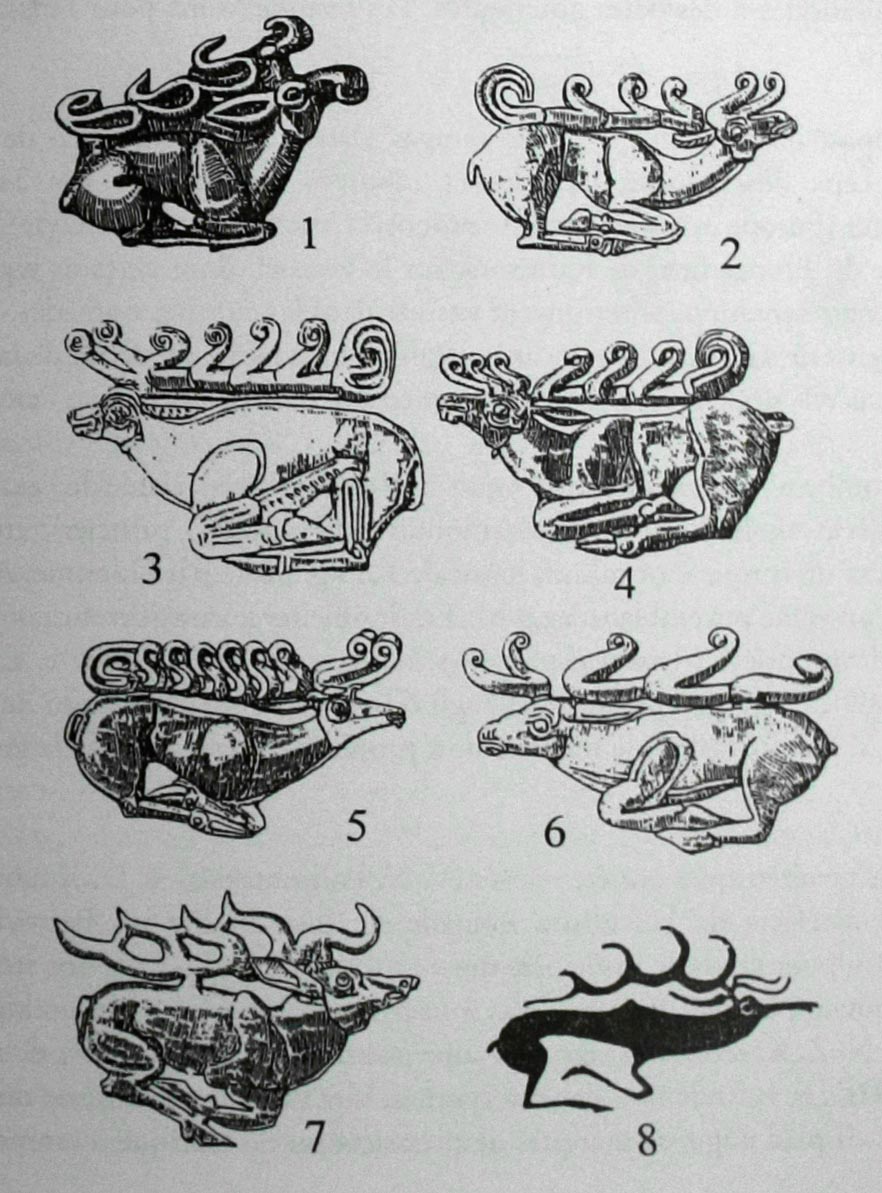
Running deer from: 1-2)The Ukraine,
3-5) Russia, 6) Iran, 7) Kazakhstan,
8) Mongolia. (Lebydynsky, 2011)

 Deer
    Early steppe nomads- both Iranian and Altaic- really like deer as art subjects. This wonderful figure from Lebedensky’s Tamga book illustrates the uniformity of just one deer motif. They sculpted, painted, and sewed them standing, lying down, being attacked by predators, with their legs turned 180 degrees (registering that might be hairy, though you could display it that way), and running. In Western (and SCA) heraldry, courant invokes the image of legs extended, but the steppe depiction is the moment in the stride where the legs are tucked under the body.

Griffins
    Griffins are of huge importance to Iranian steppe nomads. Unlike later Western griffins, it isn’t simply the back half of a lion glued onto the front half of an eagle with ears. You take something that looks like a lioness (or maneless male lion), add bird wings, a beak, pointy, feathery ears, and a fish-fin type crest running down the length of its neck. If you want to get really fancy, have it vulning (standing on top of and attacking) a deer or ibex. Depending on your culture, the deer’s legs may or may not be twisted 180 degrees from the front of the body.

 Camels
Phalera with two Bactrian camels.
Bronze, Filippovka, 4th cent. BC.
(The Golden Deer of Eurasia)
They have pompadour mullets!
    Camels were (and are) important to many Altaic nomads. A fairly common theme that you see in nomadic art is two Bactrian camels with fangs standing side-by-side and biting each others' back legs. I seriously doubt that particular pose could be registered, but the “combatant” pose was created with the intention to show animals attacking one another, so try registering that instead (the word may be changed to “respectant” during registration since they’re herbivorous). Alternatively, you could have them standing and facing one another (statant respectant). Then when you display it, shift it to the form more appropriate to your persona.

Monsters
    You don’t often see unique chimerical monsters in SCA heraldry, but they do exist and are completely registrable (there are currently 37 registered). You just have to blazon the different parts they’re made of. Some steppe nomads left behind depictions of chimerical monsters. The most common example it to start with either a deer or a horse. Say you have a deer- you can give it a bird beak. You may put stylized griffin heads on the ends of its antler tines. The blazon would read something like "a monster composed of the beak of an eagle and the body of a deer, with antler tines ending in gryphon heads". If you start with a horse instead, you do the same thing while adding deer antlers.
In steppe terms, this is a lion-headed, goat-horned gryphon (with front leg proportions more akin to a goat, but still ending in paws). Because of the difference between medieval gryphons and early steppe gryphons, this chimaera would be better blazoned as "a bird-winged monster composed of an ounce's head, paws, hindquarters, and tail, a goat's horns, ears, and forequarters, and a dragon's neck" if you want to register something like this in the SCA. It could be taken to be couchant (lying down) or sejant erect (sitting, but with front legs raise), but make it more obviously one or the other for registration purposes. It's wings are addorsed and inverted if you want to blazon that detail. Remember that steppe art involves squishing and stretching things to fit the space.
From a scabbard made by a Greek with Scythian designs and for a Scythian. Gold, PLACE, TIME. (From the Lands of the Scythians)
 What Not to Have
   Once you've come up with a steppe-themed charge, you might find that you want to put a little bit more on your device but don't want the rest of the obviously steppe options. Instead, you might find yourself flipping through the PicDic or medieval armorials for possible charges. What should you avoid if you want it to still make sense for a nomad? Big ships, for one- horse nomads have no reason to go sailing (unless you want to be one of those Iazyges who went to what's now England, or an Alan who crossed Gibraltar to raid with the Goths, but those were one-off trips). That's not to say they didn't fish in rivers or any of the seas in or near the steppes- you can occasionally find a zoomorphic fish- but big whales? No. Pelagic fish? No. Also avoid any objects which postdate your particular culture or that they never would have encountered. Maunches, for example- the angel-armed sleeves- are not from a time or place in which they could be encountered by a Saka. Farming implements (aside from some involved in animal husbandry) would also be uncharacteristic. If your persona didn't have a written language, books and quill pens wouldn't make much sense. Unless you have evidence that a steppe nomad encountered tales or depictions of New World fauna, it would be best to avoid them considering how temporally and geographically restricted knowledge of them was in SCA period. These are just a few examples. Basically, just do your homework and use your best judgement when picking charges not specific to steppe nomads. :)

One Final Note
   Keep in mind with all of these that if a steppe nomad motif looks much different from the Western standard, there is the risk of it not being registered if submitted as such. I’m not saying it couldn’t, but keep in mind that typical SCA heralds have to be able to blazon it consistently. Stylized zoomorphic art has been registered in the past, but so far as I know it isn't anymore, so definitely avoid that aspect when drawing for submission. When it comes time to display your armory, though, show everyone your steppe persona!


From the Lands of the Scythians: Ancient Treasures from the Museums of the USSR, 3000 BC-100BC, Metropolitan Museum of Art Bulletin, Vol 32, no. 5, 1975.

The Golden Deer of Eurasia: Scythian and Sarmatian Treasures from the Russian Steppes, The Metropolitan Museum of Art, 2000.

Brzezinski, R, and Mielczarek, M, 2002, Men-at-Arms: The Sarmatians 600BC-450AD, Osprey publishing.

Andrews, P, 1999, Felt Tents and Pavilions, Melisende UK Ltd.

Lebydynsky, I, 2011, Les Tamgas: Une "Héraldique" de la Steppe, éditions errance.

Saturday, August 4, 2012

Make Your Own Scythian Gryphon

There are two metal sheets, but I'd already used one when
I took this picture.
   After walking around the Met, I went to their annex, the Cloister. If you're heading to New York, definitely make a trip there (you get same day entrance when you go to the Met). It's parts of several abbeys and recreations of those styles all combined into one absolutely gorgeous building. There are various exhibits (including the famous unicorn tapestries!), labelled gardens of European plants used in the Middle Ages, and guided tours (such as one for all the really cool carved doors they have). It's off the beaten path, not crowded, and very peaceful.
   I also discovered this in the gift store. It's a kit for making your own Scythian gryphon like the ones actually displayed at the Met! The box is even made so that you can display your "masterpiece" by hanging it on a wall complete with a descriptive card. A lot of the Iranian steppe artifacts at the Met were made via a chasing and repoussé technique (info from the booklet) and that's what this one sort of recreates. It's a little kid-ified version, so it's by no means true-to-life, though it's a nice introduction to it for the beginner. There are several other techniques "recreated" in this series, so I definitely recommend children's ministers take a look at it. Probably not for the very young ones, but perhaps ages 10 and up?
Edgework plus wing and eye details
   Rather than gold sheets, you get two gilded sheets of some sort of silver-colored malleable metal (tin?). The sheets one would actually use to recreate steppe gold jewelry would be a much thicker (in addition to being actual gold sheets). These are far too flimsy to be sewn to clothing like Iranian steppe nomads did. The size of the gryphon (~4 in) is much larger than the originals it's based on (~1 in). Given how soft and thin the sheets are, hammering is overkill, so all you do is push and rub with the plastic tools given. The surface used to do the repoussé is just a thin sheet of foam because that's also all that's needed.
   You start by taping a sheet to the mold. From the top, use the wide, flat tool on the right (a square end and a circular end) to mark the edges of the gryphon and major body parts (I just did the wings). Then you switch to the tool in the center of the picture above to make the details show up. There's a spherical end and another like a sphere cut in half (for the smaller areas and the sharper edges). You also use the tool on the left (a point and a wedge on either end) to define the corners and get into the crevices. This is the "chasing" part, where the background is being forced away from you.
   Then you take the tape off and turn the sheet over on top of the foam. Use the round end of the middle tool to push out the large areas (wings, thigh, shoulder, neck...) and the half-round end for the smaller areas. This is the "repoussé" part, where the image is being forced away from you.
After "chasing" with the second and third
tools. See the inadvertent rips?
Because the sheet is flimsy, some parts will inevitably get pushed back away from where you had them, and some edges will become less defined. At this point, you flip back and forth between "chasing" and "repoussé" until you're happy with the way your gryphon looks.
   The instruction booklet tells you to stop here and display your "masterpiece" in the front pocket. But since the Scythian gryphons were standalone plaques for clothing, not images on sheets, I decided to go ahead and remove the background which was not part of the gryphon. Mostly I could just rub the pointy tool back and forth along the edge until it ripped (sometimes this happens on accident, as you can see in the picture to the left). I had a few little snags hanging on and ended up taking scissors to them or folding them under, depending on where they were, and whether their size and shape was messing with the gryphon itself (that happened a lot around the toes).
   Someone got their Laurel for goldworking at Lilies. I might have to look him up at an event and see if I can get his input on using actual chasing and repoussé to make Sarmatian plaques for my clothing...
After applying "repoussé"
After ripping/cutting out the gryphon and dealing with the edges
Ta-da! My "masterpiece" displayed! So cute and corny...

Wednesday, July 25, 2012

Steppe Nomads at the Met

I was recently in NYC for mundane research. Given that three of my books surveying Sarmatian and co. goldwork were published by the Metropolitan Museum of Art, it was on my list of things to do when I'm not working in the collections of the natural history museum.
I wasn't expecting a lot to be displayed- they aren't exactly popular with the general public- and there wasn't. Iranian steppe nomads are confined to a corner in a small gallery devoted to Near East Asian art. This includes other groups such as the people of the Caucasus, Sassanian Persians, and Mesopotamians. I was actually surprised at how little work was being displayed from "the cradle of civilization". The one thing that I was disappointed about, even with my low expectations, is that none of the golden deer were displayed. I think the Golden Deer of Eurasia was written as a companion to a special exhibition (how I wish I could have seen it!), but I was hoping at least one of the many they have would still be viewable by the general public. Oh well. I still highly recommend going if you're in town. The museum has a dearth of other things displayed. I took pictures of Renaissance string instruments for a friend, saw Henry VIII's last set of field armor (how sad that his "grossly overweight" is "normal" for much of the US today...), and a really awesome ceramic dish. It was made at the end of period using actual animals to make casts. Check out their annex, The Cloisters, as well!

Below are pictures of what they did have in the Caucasian peoples (sensu stricto) and Iranian nomads corner.
Disc with running dogs surrounding a mountain goat
Bronze
Caucasus region, 1st-3rd centuries AD

Clasp with an eagle and its prey
Gold with turquoise inlays
Iran? Parthian, 1st cent BC-1st cent AD

Roundel with horned animal, lions, and griffins
Gilded silver inlaid with stones, iron backing
Central Asia, Sarmatian, 3rd-2nd century BC


Roundels with griffin heads
Gilded silver with stone inlays
Western Asia, late 1st millennium BC

Axe head
Silver and iron
Western Asia, Scythians, 6th-5th century BC

Dress ornaments
Gold
Northern Black Sea region (Maikop?)
Scythian, 5th century BC

Fragment of a plaque
Gold
Northwestern Iran, possibly Ziwiye, 7th century BC

Teeny tiny ibex figure (an inch long at most)
Same info as above plaque fragment

Finial and pommel with coiled animal forms
Gold and gold with turquoise inlays
Western Asia, possible Black Sea area
Scythian, 6th century BC

Belt buckle, felines attacking ibexes
Gold
Mongolia or southern Siberia, Xiongnu period, 3rd-2nd century BC

In addition to the relevant corner, I also found these gems in the Chinese exhibits (which are extensive!). Look familiar to anyone?
Belt buckles
Bronze
North China, 3rd-2nd century BC
This shape of belt buckle is also present in the form of several Saka (i.e., Asian Scythians) artifacts figured in the Golden Deer book, including the one I used to make the bottom right scene in my '8 of 8' scroll.

Belt plaque
Gilded silver
North China, 3rd century BC
Another belt buckle plaque, this time rectangular. There's that Sarmatian theme of twisting the hindquarters around 180 degrees. It also has the Iranian nomad modifications of taking a horse (it has one hoof per foot), giving it a bird beak, deer antlers, drawing the antlers in that very stylized way, and terminating the tines in griffin heads to boot. The griffin heads aren't quite as noticeable as they typically are, but if you've seen it before you can easily recognize it as such.

There are multiple records of Iranian steppe nomads getting a hold of Chinese artifacts and vice-versa (trade-and-raid routes and all that). There's also the pan-steppe themes that extend all the way east into Mongolia, which borders China. Mallory and Mair discuss the introduction and adoption of Scythian-style art in China. Lebedensky (the same guy who wrote the tamga book) mentions in another book that some Scythians may have migrated into China (must get a hold of all his books!) I didn't notice anything steppe-related in the Greek or Roman rooms (though I could have missed something; they are rather extensive), so I was extremely excited to find these steppe-type artifacts in the Chinese area. There were a few more relevant artifacts in the China section, but these were the best examples of steppe-type art there.

The Golden Deer of Eurasia: Scythian and Sarmatian Treasures from the Russian Steppes, The Metropolitan Museum of Art, 2000.
Iaroslav Lebedynsky, Les Saces, p.73
Mallory and Mair, 2000, The Tarim Mummies: Ancient China and the Mystery of the Earliest Peoples from the West