TRUE
Just not directly. And who knows from whence it ultimately came.
When people talk about "origins" or "causes", many don't distinguish between direct, ultimate, or steps along the way. Sarmatians are only one of many candidates for the ultimate origin...saying they're a step along the way is the more conservative (and, IMO, more likely) assumption.
 |
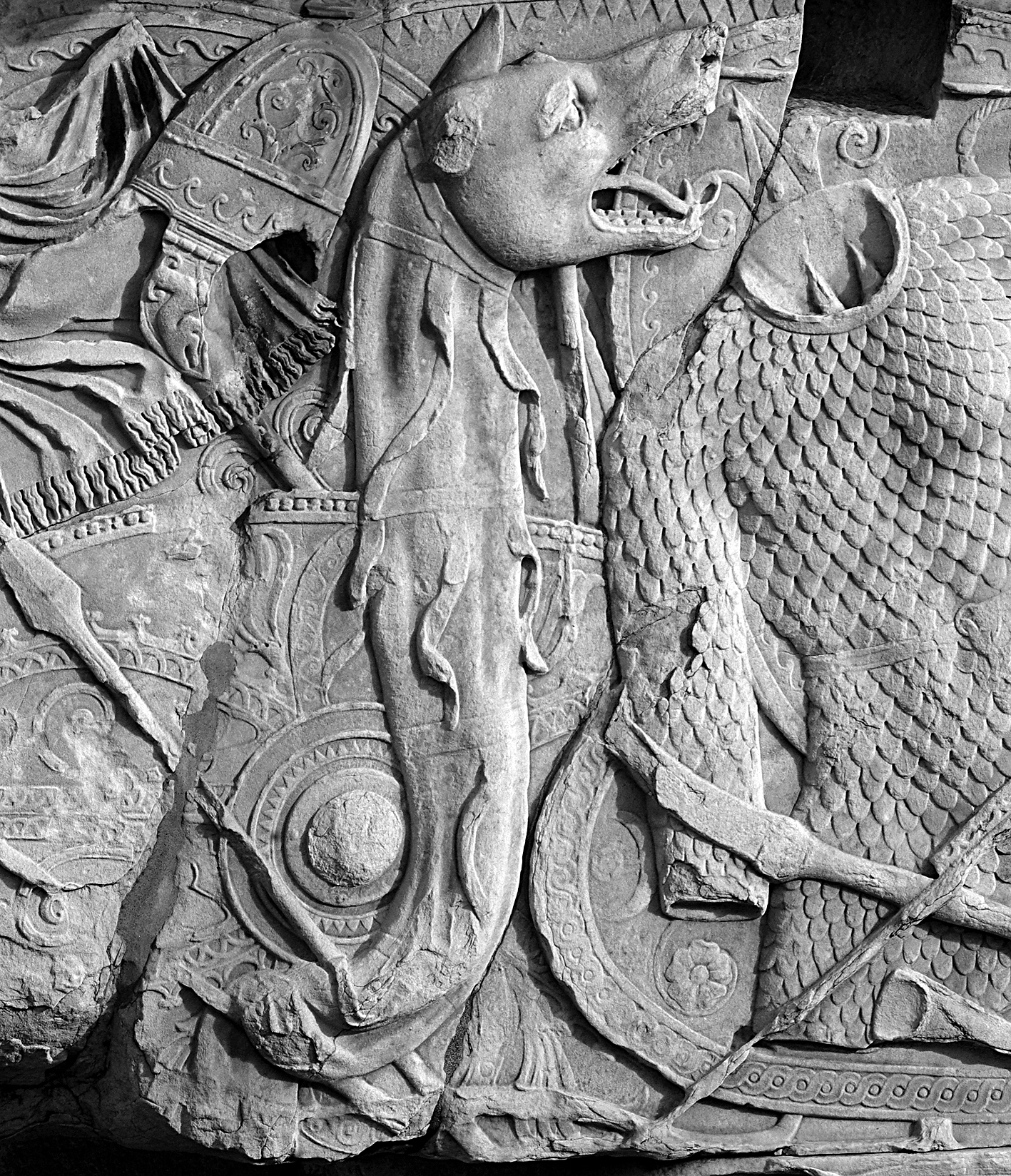
A Dacian draco on Trajan's Column- note the wolf
head and the complicated construction with
multiple rings and streamers on the tube. |
For the
direct origin of Roman draco standards, look to the Dacians. By the end of the 1st century AD, the
Romans associated the dracos with the Dacians they had recently defeated in the
Dacian Wars. Which means they probably got it directly from them (though they also knew Scythians [he likely meant the Sarmatians] had them, as
Arrian wrote about dracos making a fearful sound).
Draco origins are discussed by Mihailescu‐Bîrliba (2009) in his
analysis of a funerary monument in Chester. This happens to be the
picture on the background of this blog. He makes a very convincing
argument for a Dacian direct origin as well as for the monument actually depicting a Dacian, not a Sarmatian, as was
previously thought. Which means I have to find a new background
picture... *grumble*
The
ultimate origin of draco standards is a point of contention among scholars. Dacian, Scythian, Thracian, Sarmatian, Parthian, Persian, and even ancient Indo-Iranian have all been proposed. There are two issues to be considered when looking for the ultimate origin.
1) Where do we first see or read about them?
2) What was their original use?
On first appearances:
We have to be careful with first appearances. First appearance dates (FADs) are statistically highly unlikely to be the first
existence date. This is acknowledged in paleontology by differentiating between FADs and what we call "ghost lineages". A ghost lineage is a stretch of time during which, based on phylogenetic hypothesis, a clade or species had to of existed, but we have no physical evidence of it.
Unfortunately, sorting out the history of cultural artifacts is so much more complicated than evolutionary trees that can be sussed out based on morphological and molecular evidence. So no such thing as a ghost lineage for dracos, but we still need to acknowledge that the first time we see evidence of one is not necessarily evidence of the
first one. If there's a large enough stretch of time between FADs in different cultures (the size of "large enough" TBD by scholars more knowledgeable than I), then we can say, "Yes, this culture probably had it before that one." But this far back in time and with so many illiterate cultures involved, what's a few decades to anyone? Considering how widespread dracos were in the ancient world, unless we know that one group encountered it in another before adopting it (e.g., Romans and Dacians), I don't think it prudent to consider first appearance to be synonymous with [almost] first existence.
 |
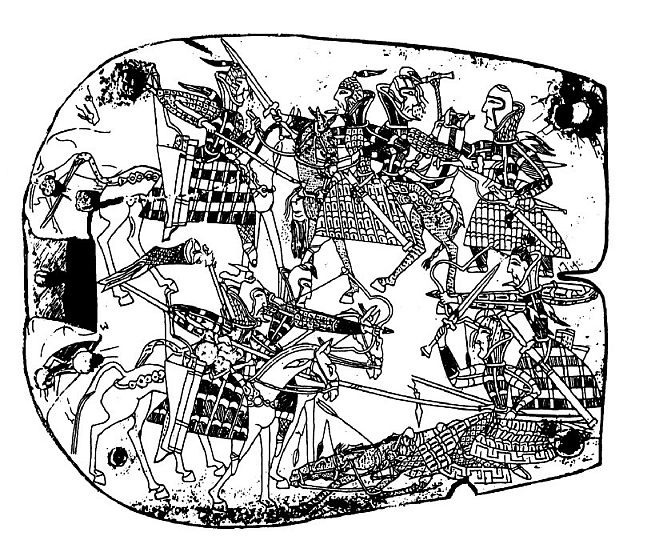
Orlat battle plaque from Sogdiana/Uzbekistan-
note the tube of fabric on a stick at center left. |
So far as I know, there is no evidence of an animal head on a pole with fabric streaming behind it showing up in one culture well before another (please, please correct me if you know better than I). There is a depiction of a headless one held by horse archers in Sogdiana (modern Uzbekistan) which
might (with a very heavy emphasis on the "might") be from the last centuries BC. It might also be from the 4th or 5th century AD. I don't feel comfortable using it as evidence of an early depiction until the professionals have reached a consensus.
I've seen an argument that the Dacians had them as far back as the Bronze Age
based on bracelets- you can find zoomorphic bracelets in their
area which have wolf heads (the Dacians used wolf heads, not the dragons
the Romans used) on either end. But assuming that's a depiction of a draco 1)
ignores the fact that other people across Eurasia also had zoomorphic
bracelets with animal heads, and 2) requires a pseudoscientific practice- seeing what you
want to see instead of being objective about it.
It's zoomorphic art. It
has nothing to do with dracos except to reflect the animals preferably depicted by each culture. Just because the head is on the end of a long
thing doesn't mean the bracelet shaft represents the fabric tube. The end is just
the intuitive place to put an embellishment on a bracelet that isn't shaped like a full circle.
On original use:
Wind sock, religious purposes, group symbology (ethnic or military unit), and intimidation in war are all possible uses of a draco standard (though I'm personally less inclined to consider the religious use a possibility [lack of evidence and the whole copout thing I've talked about before]). When looking for an ultimate origin, it doesn't matter what it was used for along the way (so Roman use is irrelevant). What matters is the original use because it might narrow down the possibilities for its origin. The Romans remarked on them making frightful sounds, so it definitely
intimidated them, but that doesn't mean that was the original intended
use. If it were originally a war standard, it probably came from a culture which fought battles fairly regularly and most likely against other cultures that later adopted it. If it were originally a wind sock, the culture inventing it would had to have used archers in battle and they would likely need to be standing still for at least part of the battle. Wind socks will pick up forward movement which would then need to be compensated for, making them more difficult to use (or impossible if the horse were moving fast enough).
I personally find the wind sock argument to be the most convincing. The arguments against it are: 1) wind socks are only useful to archers when the sock is stationary, 2) the enemy would get more use out of them, 3) wind socks are modern inventions, and 4) considering the different types of heads, why wouldn't group symbolism be the more likely original use?
Counterpoint 1: Yes, being stationary is important. This point assumes that horse archers always fought while moving. We know the Scythians started their battles with stationary volleys. Unless we have known battle tactics for all cultures which might be the ultimate originators, we can't use this as a reason to nix the wind sock theory compeltely. (As a side note, Sarmatians did not use this tactic to my knowledge, which is why I don't think they were the ultimate originators of dracos, considering I favor the wind sock theory.) I've heard that forward movement can be corrected for when it comes to wind indicators, but I have no experience in this and don't know how easy/hard it would be or to what degree it can be corrected.
Counterpoint 2: Yes, holding a wind sock would tell enemy archers how to adjust for wind near the group with the draco. However, flags and banners also show wind speed and direction and that didn't stop plenty of cultures from using them as standards regardless of whether or not the enemy could also use them as wind indicators. I'm not an archer, but it does make sense to me that an arrow would be more affected by wind the farther away it is from its shooting point given the loss of speed. There was an archery instructor online arguing in favor of the wind sock theory, though, so I'm left to assume that wind still influences the shot shortly after the arrow leaves the bow. Are any of you reading this archers who can add to this argument?
Counterpoint 3: The term, sure. But the device? Draco standards are tubes of fabric on a pole braced by something so they stay open on the pole end. That's what a windsock is. It's true that we don't have evidence of it being used as a wind indicator by archers (though we have evidence of archers holding them). But quite frankly, all discussion of what draco standards were originally used for is heavily doused in speculation regardless of which camp you fall in. I personally find it hard to believe that no archer in pre-modern history ever thought to use a piece of fabric on a stick to tell wind direction in battle. There just wouldn't be time to repeat the test over and over using sparse test shots, pieces of grass, or a wet finger. If the wind changed in the middle of battle, you risk wasting arrows if you don't have a constant indicator. And since we use windsocks at airports instead of flags, I have to assume that the windsock design is more accurate than a simple flag as a wind indicator.
Counterpoint 4: Why not just the heads, if that were the case? The fact that their back ends are all colorful, open tubes makes it more likely that the head type was changed after the fact to reflect personal/cultural preference.
In short, I can't come up with a good reason for going to the trouble and expense of making a tube of fabric and bracing it open with something hard when a flat piece of fabric (i.e., a flag or banner) would do just as well for a military standard/rallying point or group symbology. As for the intimidation effect- I think it more likely that its additional use as this was a happy accident. Even the Highland Bagpipes, whose purpose was to intimidate the enemy and rile up the side using it, didn't come out of a vacuum- other types of bagpipes were around before that and co-opted for this use.
As for religious or nationalistic use... Let's use the Dacians as an example. They thought wolves were pretty much the most awesome things ever, which is why their dracos have wolf heads. ...But why would someone think "Hey, let's make a depiction of a wolf!" and come up with a wolf head on the end of a fabric tube instead of just painting a wolf on a flag? Jumping straight to a draco is just
not parsimonious in the slightest. You have to carve the wood, attach the metal on top of it, sew the fabric into a tube, and attach it to the head. It's so much easier to just paint a wolf on a piece of fabric. So regardless of who invented them or what feelings about religion or nationality dracos may or may not have invoked, I just don't buy the idea of "originally religious/nationalistic" in the slightest.
If you think about geography, Dacians having them first doesn't make sense. Put a drop of dye in water and what happens? It spreads out in all directions. The Dacians are at one side of the area where draco standards are found and they weren't only interacting in one direction. Given that we don't have an instance of one culture having them well before another, it makes more sense to me that draco standards would either come from somewhere near the center of their known range, then spread out in all directions
or a common ancestral culture had them and we just don't see the early evidence. Like I've said before, absence of evidence is not evidence of absence. It should be approached cautiously, but should still be considered.
tl:dr: Romans got draco standards directly from the Dacians. We don't know who they ultimately came from, but Sarmatians had them before Romans. This blogger thinks that the Sarmatians were not the ultimate origin and that the Dacians got them from farther east. The Sarmatians and Dacians interacted, so that's one possibility for how the Dacians got them.
And as a side note- this marks my halfway point to completing my A&S 50: Persona challenge!
Mihailescu‐Bîrliba, L., 2009, A funerary sculptured monument of Chester and its representation, Studia Antiqua et Archeologica XV.
Mode, M., 2006, Heroic fights and dying heroes- The Orlat battle plaque and the roots of Sogdian art, Eran ud Aneran- Studies presented to Moris Il'ic Marsak on the occasion of his 70th birthday, Libreria Editrice Cafoscarina, Venice, Italy, 718 pp.
Rostovtzeff, M., 1922, Iranians and Greeks in South Russia, Clarendon Press, Oxford, UK, 260 pp.