Showing posts with label gold. Show all posts

Friday, June 5, 2015

Solid Gold....Bong? -_-*

Well that's one aspect of steppe nomad culture I will not be recreating. The news outlets have been calling it a bong, but they were cups used to drink a brewed opium drink while cannabis was burned nearby.
That is some awesome repousée work, though.
http://www.ibtimes.co.uk/solid-gold-scythian-bongs-cannabis-opium-discovered-russia-1503725

Saturday, August 4, 2012

Make Your Own Scythian Gryphon

There are two metal sheets, but I'd already used one when
I took this picture.
   After walking around the Met, I went to their annex, the Cloister. If you're heading to New York, definitely make a trip there (you get same day entrance when you go to the Met). It's parts of several abbeys and recreations of those styles all combined into one absolutely gorgeous building. There are various exhibits (including the famous unicorn tapestries!), labelled gardens of European plants used in the Middle Ages, and guided tours (such as one for all the really cool carved doors they have). It's off the beaten path, not crowded, and very peaceful.
   I also discovered this in the gift store. It's a kit for making your own Scythian gryphon like the ones actually displayed at the Met! The box is even made so that you can display your "masterpiece" by hanging it on a wall complete with a descriptive card. A lot of the Iranian steppe artifacts at the Met were made via a chasing and repoussé technique (info from the booklet) and that's what this one sort of recreates. It's a little kid-ified version, so it's by no means true-to-life, though it's a nice introduction to it for the beginner. There are several other techniques "recreated" in this series, so I definitely recommend children's ministers take a look at it. Probably not for the very young ones, but perhaps ages 10 and up?
Edgework plus wing and eye details
   Rather than gold sheets, you get two gilded sheets of some sort of silver-colored malleable metal (tin?). The sheets one would actually use to recreate steppe gold jewelry would be a much thicker (in addition to being actual gold sheets). These are far too flimsy to be sewn to clothing like Iranian steppe nomads did. The size of the gryphon (~4 in) is much larger than the originals it's based on (~1 in). Given how soft and thin the sheets are, hammering is overkill, so all you do is push and rub with the plastic tools given. The surface used to do the repoussé is just a thin sheet of foam because that's also all that's needed.
   You start by taping a sheet to the mold. From the top, use the wide, flat tool on the right (a square end and a circular end) to mark the edges of the gryphon and major body parts (I just did the wings). Then you switch to the tool in the center of the picture above to make the details show up. There's a spherical end and another like a sphere cut in half (for the smaller areas and the sharper edges). You also use the tool on the left (a point and a wedge on either end) to define the corners and get into the crevices. This is the "chasing" part, where the background is being forced away from you.
   Then you take the tape off and turn the sheet over on top of the foam. Use the round end of the middle tool to push out the large areas (wings, thigh, shoulder, neck...) and the half-round end for the smaller areas. This is the "repoussé" part, where the image is being forced away from you.
After "chasing" with the second and third
tools. See the inadvertent rips?
Because the sheet is flimsy, some parts will inevitably get pushed back away from where you had them, and some edges will become less defined. At this point, you flip back and forth between "chasing" and "repoussé" until you're happy with the way your gryphon looks.
   The instruction booklet tells you to stop here and display your "masterpiece" in the front pocket. But since the Scythian gryphons were standalone plaques for clothing, not images on sheets, I decided to go ahead and remove the background which was not part of the gryphon. Mostly I could just rub the pointy tool back and forth along the edge until it ripped (sometimes this happens on accident, as you can see in the picture to the left). I had a few little snags hanging on and ended up taking scissors to them or folding them under, depending on where they were, and whether their size and shape was messing with the gryphon itself (that happened a lot around the toes).
   Someone got their Laurel for goldworking at Lilies. I might have to look him up at an event and see if I can get his input on using actual chasing and repoussé to make Sarmatian plaques for my clothing...
After applying "repoussé"
After ripping/cutting out the gryphon and dealing with the edges
Ta-da! My "masterpiece" displayed! So cute and corny...

Wednesday, July 25, 2012

Steppe Nomads at the Met

I was recently in NYC for mundane research. Given that three of my books surveying Sarmatian and co. goldwork were published by the Metropolitan Museum of Art, it was on my list of things to do when I'm not working in the collections of the natural history museum.
I wasn't expecting a lot to be displayed- they aren't exactly popular with the general public- and there wasn't. Iranian steppe nomads are confined to a corner in a small gallery devoted to Near East Asian art. This includes other groups such as the people of the Caucasus, Sassanian Persians, and Mesopotamians. I was actually surprised at how little work was being displayed from "the cradle of civilization". The one thing that I was disappointed about, even with my low expectations, is that none of the golden deer were displayed. I think the Golden Deer of Eurasia was written as a companion to a special exhibition (how I wish I could have seen it!), but I was hoping at least one of the many they have would still be viewable by the general public. Oh well. I still highly recommend going if you're in town. The museum has a dearth of other things displayed. I took pictures of Renaissance string instruments for a friend, saw Henry VIII's last set of field armor (how sad that his "grossly overweight" is "normal" for much of the US today...), and a really awesome ceramic dish. It was made at the end of period using actual animals to make casts. Check out their annex, The Cloisters, as well!

Below are pictures of what they did have in the Caucasian peoples (sensu stricto) and Iranian nomads corner.
Disc with running dogs surrounding a mountain goat
Bronze
Caucasus region, 1st-3rd centuries AD

Clasp with an eagle and its prey
Gold with turquoise inlays
Iran? Parthian, 1st cent BC-1st cent AD

Roundel with horned animal, lions, and griffins
Gilded silver inlaid with stones, iron backing
Central Asia, Sarmatian, 3rd-2nd century BC


Roundels with griffin heads
Gilded silver with stone inlays
Western Asia, late 1st millennium BC

Axe head
Silver and iron
Western Asia, Scythians, 6th-5th century BC

Dress ornaments
Gold
Northern Black Sea region (Maikop?)
Scythian, 5th century BC

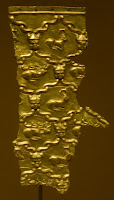
Fragment of a plaque
Gold
Northwestern Iran, possibly Ziwiye, 7th century BC

Teeny tiny ibex figure (an inch long at most)
Same info as above plaque fragment

Finial and pommel with coiled animal forms
Gold and gold with turquoise inlays
Western Asia, possible Black Sea area
Scythian, 6th century BC

Belt buckle, felines attacking ibexes
Gold
Mongolia or southern Siberia, Xiongnu period, 3rd-2nd century BC

In addition to the relevant corner, I also found these gems in the Chinese exhibits (which are extensive!). Look familiar to anyone?
Belt buckles
Bronze
North China, 3rd-2nd century BC
This shape of belt buckle is also present in the form of several Saka (i.e., Asian Scythians) artifacts figured in the Golden Deer book, including the one I used to make the bottom right scene in my '8 of 8' scroll.

Belt plaque
Gilded silver
North China, 3rd century BC
Another belt buckle plaque, this time rectangular. There's that Sarmatian theme of twisting the hindquarters around 180 degrees. It also has the Iranian nomad modifications of taking a horse (it has one hoof per foot), giving it a bird beak, deer antlers, drawing the antlers in that very stylized way, and terminating the tines in griffin heads to boot. The griffin heads aren't quite as noticeable as they typically are, but if you've seen it before you can easily recognize it as such.

There are multiple records of Iranian steppe nomads getting a hold of Chinese artifacts and vice-versa (trade-and-raid routes and all that). There's also the pan-steppe themes that extend all the way east into Mongolia, which borders China. Mallory and Mair discuss the introduction and adoption of Scythian-style art in China. Lebedensky (the same guy who wrote the tamga book) mentions in another book that some Scythians may have migrated into China (must get a hold of all his books!) I didn't notice anything steppe-related in the Greek or Roman rooms (though I could have missed something; they are rather extensive), so I was extremely excited to find these steppe-type artifacts in the Chinese area. There were a few more relevant artifacts in the China section, but these were the best examples of steppe-type art there.

The Golden Deer of Eurasia: Scythian and Sarmatian Treasures from the Russian Steppes, The Metropolitan Museum of Art, 2000.
Iaroslav Lebedynsky, Les Saces, p.73
Mallory and Mair, 2000, The Tarim Mummies: Ancient China and the Mystery of the Earliest Peoples from the West