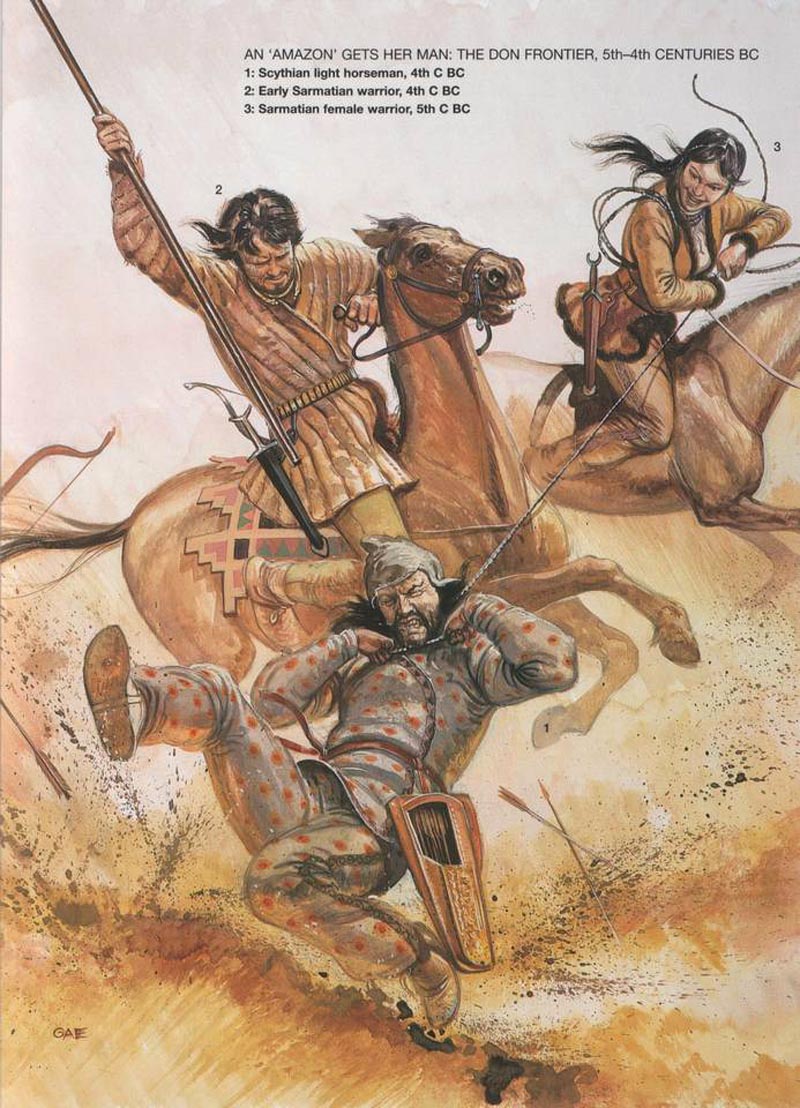
Sarmatians are usually pictured with a type of jacket called a kurta over their tunics. Kurtas are a type of kaftan, which are worn in various forms by Asian peoples such as Mongols and Indians. Picture a T-tunic in which the front is made of two triangular flaps which cross one over the other and you'll have the general appearance of a kurta (for Sarmatians, it seems the right flap goes on top). The Sarmatians cut them off at mid-thigh and they could have slits up the sides. This kept them from bunching up and pulling or whatnot while riding a horse. Some sort of trim could be included.
|
| The man on the horse is wearing a quilted kurta. The one being attacked is a Scythian. I'm not sure what the woman's jacket was based on. |
 |
| Wrist straps |
The ends of the sleeves could be longer than the wrist (though they weren't all this way). The reason for this was to create a hand flap which functioned as a sort of glove when the temperature was cold. If you don't want the glove, you pull the end back over your wrist. There's an image of Scythian men with this same modification and they have straps hanging down which would have been sewn to the inside of the sleeve. I'm guessing the straps were used to tie the hand flap closed. In the image, they had the flaps folded back over their wrists and let the ties hang. It looks like the ties end in a big triangular shape.
 |
| A pot made by Greeks. They seemed to have made a lot of things depicting the Scythians for the Scythians |
|
The fronts of these Scythian jackets look a little different from Sarmatian kurtas, though- this particular style has two slits in front- one over the mid thigh and one over the inner-thigh. I haven't seen this in any Sarmatian kurtas.
 |
| Scythian kurta with multiple slits |
 |
| A polka-dotted Scythian |
Sarmatian kurtas could be made out of leather (deer is common) or cotton (which can be quilted). They could also be lined in fur (squirrel seems to be common). Cotton might seem out of time for those of you who have Western personas, but it was around and used for clothing in the East long before it showed up in the West. They could be decorated with floral or geometric designs. Little gold plaques which would have been sewn on are commonly found in kurgans. Fabric paint is another option which is known to have been used by Scythians (One known paint pattern- polka dots. C'est amusant.). There's a leather saddle with felt appliques preserved, so it seems like a logical inference to say leather kurtas could too, but I haven't seen any examples illustrating this. You have the option to include it if you lean heavily towards the "creative" side of the SCA, but unless I find evidence of it, I don't really feel comfortable including them on mine. For the most part, though, Sarmatian kurtas seem relatively unadorned in comparison with Scythian ones.
Most of the documentation you find will be in images of the Sarmatians created by other people. We actually did get very lucky, though, in that a child's kurta was preserved in a Siberian kurgan, which is now housed in the State Hermitage Museum in St. Petersburg, Russian.
 |
Child's Fur Coat
Fur; l. 35 cm
Tashtyk Culture. 3rd - 4th century
Oglakhty Burial VI, Grave No. 4 (Excavations of Prof. L.R. Kyzlasov), South Siberia, Khakassia Republic, left bank of the River Yenisei, near Mount Oglakhty, Russia
Source of Entry: Archaeological Expedition to Khakassia of the Moscow State University. 1969 |
I just made my first kurta in time to wear at the St. Denys' Day event. I wanted to go the leather route, but unless I had gotten lucky and found enough for sale at an event, my cheapest option was to invoke the unwritten "Ten Foot Rule" (if it looks genuine from ten feet, it's acceptable [unless on enchanted grounds]). Which means that this financially-limited student used tan moleskin from Joanne's Fabrics to imitate deer leather.
I did some things wrongly because my measurements turned out to be wrong- the jacket doesn't go past my hips, for one- but given that I'm a novice seamstress making my first kurta, I wasn't expecting perfection (another reason I used cheaper fabric). From a lot of the depictions, it seems like they didn't have inserts (gores and gussets), but I didn't trust my patterning skills (or lack thereof) to make one without gussets in which I my arms would still have full mobility, so I included them. But then I more closely examined the child's coat above, and it looks to have gores that go all the way from hem to armpit sewn next to roughly rectangular front pieces. The shape modifications around the arm-body seam look similar to those in the above depiction of Scythian men. I'll try this solution in my next run and see how that goes.
Because I used woven fabric instead of leather, I had to hem all ends that weren't cut on the bias, though the child's coat didn't have them except maybe on the ends of the sleeves (one side looks like it was hemmed but the other doesn't; not entirely sure what's going on there). Other options I chose were: side slits, no hand flaps, and no decorations
Below are results of the pattern I actually used. Once I make another, I'll do a second post about the modified pattern.
Don't make your own with this pattern, it's only here for future reference so you can see the differences from it and from a standard T-tunic build. There are so many things wrong with it...
 |
| Finished product |
 |
| Waaaaay too short |
*--Unless otherwise specified, pictures of artifacts all come from "From the Lands of the Scythians"
From The Land of the Scythians: Ancient Treasures from the Museums of the U.S.S.R., 3000 B.C. - 100 B.C. (Metropolitan Museum of Art Bulletin, Volume XXXII, Number 5, 1975)
Brzezinski, R., and Mielczarek, M., 2002, Men-at-Arms: The Sarmatians 600BC-450AD, Osprey publishing.
Sulimirski, T., 1970, The Sarmatians, vol. 73 of Ancient Peoples and Places, Praeger Publishers, Inc.