Showing posts with label sewing. Show all posts

Wednesday, March 20, 2013

Thoughts on kurta patterns

  Over the past half a year, I've intermittently been rethinking my original ideas about kurta patterns. Some of it is based on a class I attended, some of it on looking further at pictures of the child's kurta and other depictions of kurtas, and some of it from a recent comment on a past post.

Pattern pieces and their shape
  I had originally thought the front flaps would be trapezoids whose bottom width is from hip to hip, but when you look at the child's coat- it's bottom is only a little wider than the top. Laid out so that the opening is vertical down the center, the outside edges pretty much go straight down. The extra bits on the side are gores.

  Jadi Fatima showed her class at KWARCS a Mongol pattern she'd recreated that used gores and gussets like that on the side. The two gores on the armpit were trapezoids as opposed to the triangles anyone who's ever made a generic T-tunic using a period pattern is used to. There were two additional long trapezoids running from below the armpit to the hem.  It looks like the child's kurta eschews the gussets and just has two gores running down the side.

  Scott, the commenter I previously mentioned, makes his kurtas with triangular gores. He described his pattern as follows:
  My kurta uses these long triangular gussets that function as armpit gussets as well. I have found this to be the easiest and most practical way to go about it. I basically use a 3,3,5 pattern, that is rectangular body panels 3 units wide and 5 units long, sleeves 3 units long and 2 units in circumferance at the widest point. Then I can simply alter the width of the triangular gusset and taper of the sleeve to achieve a good fit. For instance, mine is 1m long, with 60cm wide body panels, 60 cm sleeves that are cut 40 cm wide tapering to 25 cm. The triangular gusset starts about 15cm down the sleeve and is 50 cm wide at the bottom hem and is made up of all the scraps, 3 pieces in one and five in the other. If you just leave the front panel whole instead of splitting it, you have a Byzantine style tunic like the one found in that cave in Turkey, or you can make a narrower side gusset, split the front panel and you have a kaftan pattern.

Keeping kurtas closed
  I had thought that the hem should lie horizontally when the kurta is flattened on the ground, but the child's kurta is opened in such a way that it's pointed in front instead. I have a really hard time keeping my crappy attempt at a kurta closed and was considering adding some sort of button to the inside for practicality's sake.

  That still left me wondering how Sarmatians and others would have kept theirs' closed, because I've never seen any sort of internal fastener. That doesn't mean they don't exist- All the pictures of seen of Sarmatians wearing kurtas have them crossed in only one direction (and Sulimirski mentions this), so maybe they had some sort of fastener on the inside and we just don't have one preserved today [that I know of].

  The one Gamble made for me actually stays closed on its own because the fake silk brocade on the inside creates enough friction that it doesn't budge much. The moleskin on the mine has a slick inside surface that wants to move. I'm sure leather would create friction more like the brocade does. Quilted cotton, too. So maybe fasteners just wouldn't have been needed?

Open vs. closed
  The kurtas of the Scythians on the Greek-made jug and jewelry are barely crossing and have a vertical slit down the center. Someone sent me a link to a Scythian A&S entry in another kingdom (Northshield or Midrealm, I don't remember which), which also demonstrated the vertical opening down the center. I really wish I could find that link, because they created an entire outfit and it was gorgeous. After flipping back and forth through depictions of kurtas with vertical openings (I'm going to call this "open") and those with flaps crossing the front of the body (I'm calling this "closed"), something Jadi had said years ago at Dragon*Con  (and repeated at KWARCS) struck me- what if it's the same pattern, just worn differently by the Scythians than by the Sarmatians?

  She had been trying to figure out a pattern for an open kaftan. I don't remember if it was Persian or Mongol. She just couldn't get the neckline right. She'd already made a closed kaftan from the same culture and was standing in front of the mirror one day while the kaftan was unbelted and hanging open and realized she was wearing the open kaftan. It was the same exact garment.

  This kaftan had fasteners in the same place as you see on Mongol kaftans and some extra attachments on the inside edge of the underflap. Going horseback riding? Cross the flaps and fasten the overflap at the armpit to keep the wind off your front. Walking around town on a hot day? Attach the outer flap to the inside buttons so that there's a vertical slit down the middle.

  Under the assumption that Iranian steppe nomads didn't have fasteners, one could either cross or not cross it before putting on the belt depending on which culture you're emulating. If they did have fasteners, it could be a similar setup to the Persian kaftan.

Wednesday, November 14, 2012

Knowne Worlde Academy of Rapier and Clothing Symposium

  The annual SCA-wide fencing and clothing event was this past weekend (as was Calontir's Crown Tourney- congrats to Their new Excellencies Donngal and Catalina!).

  Unfortunate circumstances led to me missing all the morning classes I wanted to go to on subjects such as body mechanics and single rapier fundamentals, so the only fencing class I went to was the rapier and dagger master class. I got some good tips out of it for future reference, but I don't own a dagger yet and the room was waaaay too crowded, so I didn't get to actually try anything.

  The clothing class, however, was extremely beneficial. It turns out I took a class from the same teacher at Dragon*Con two years ago. She taught back-to-back classes on making patterns for Central Asian kaftans (caftans with her spelling; it doesn't really matter). She also gave us background info (hurray!) on why kaftans were constructed the way they were. Having two layers in front with a wrap kaftan I knew about- it combats the cold wind blowing straight at you when you're riding a horse. She also talked about the vestiges of those original purposes which were retained in later period sedentary cultures. One thing she pointed out (which she also talked about in the D*Con class) was how she'd spent a long time trying to figure out the neckline in a Persian (I think) kaftan, only to realize that it was the same pattern used by Turkic nomads, just the two sides attached down the center instead of wrapped.
  She had this brilliant method of teaching us a basic Turkic nomad kaftan pattern. She passed out pieces of fabric for us to cut the pieces for miniature kaftans out of. The fabric was black and white checked, which meant you could designate each small square as being a certain number of inches. It works brilliantly! I need to find some of that now.
One of the things she pointed out that had been bothering me when trying to draft patterns was shoulders. I couldn't figure out how to get the shoulder seams to lay flat against me. Turns out they aren't supposed to (at least not before later period kaftans). Shoulder seams should be straight and the pooching in front is supposed to be there.
Her name is Jadi Fatima. She primarily researches Ottoman, Mongolian, and Persian culture, textiles, and dance. She does brilliant work and I highly encourage visiting her website.

There was a ball Saturday night, for which my ride and I were the only musicians. Christian is a music Laurel (he mostly played recorder with a little guitar) and I played the drum. ...That was the second time I've picked up a bodhran. I think I did okay. o_o As he described the situation, all the musicians were from Calontir and we definitely stayed in tune the entire time.

Wednesday, November 7, 2012

My Anniversary Present!

The hiatus is over now. :)
I've been waiting to post this one for quite a while. I initially held off because it was my husband's entry in Queen's Prize and I wanted to wait to post it until it was over. Then the mundane busy-ness happened.
My husband (who has started going by Gamble in the SCA) is awesome. I was traveling for five weeks prior to our first anniversary and he spent that time secretly plotting and planning my present. I came home to this:

  He looked through the Sarmatian books I'd left behind and referenced a bath robe and jacket I have to make the pattern and figure out the measurements. The extra triangular sections on the front are there because the initial cut didn't wrap around as far as he wanted.
  We don't have a sewing machine, so he hand-sewed the entire thing. He's almost as new to sewing as me (and much better!) and wanted to play around with reversibility, so it's reversible. He used some of the fabric gifted to my by Juturna to imitate deerskin leather and found some polyester imitation silk at the local fabric store. He made it reversible for the heck of it and it is awesome.
   I'll take some measurements and update this post later so everyone has a tried and true kurta  pattern to work with.

Thursday, June 7, 2012

Possible kurta pattern

At the request of a reader, here's a possible pattern for a kurta. I don't have time to test it before leaving for Lilies, so if anyone tries this, let me know any problems or ah-ha moments you have. It's based on the child's kurta in the Hermitage Museum I posted previously.

I would recommend not actually cutting the triangles out of the sleeves (just sew along where the seam should go) until you've tested whether you have full range of motion with your arms. It's entirely possible that it could have a more complex shape than a straight line.

This post will be updated after I make one.


Friday, October 14, 2011

Kurtas

  Sarmatians are usually pictured with a type of jacket called a kurta over their tunics. Kurtas are a type of kaftan, which are worn in various forms by Asian peoples such as Mongols and Indians. Picture a T-tunic in which the front is made of two triangular flaps which cross one over the other and you'll have the general appearance of a kurta (for Sarmatians, it seems the right flap goes on top). The Sarmatians cut them off at mid-thigh and they could have slits up the sides. This kept them from bunching up and pulling or whatnot while riding a horse. Some sort of trim could be included.
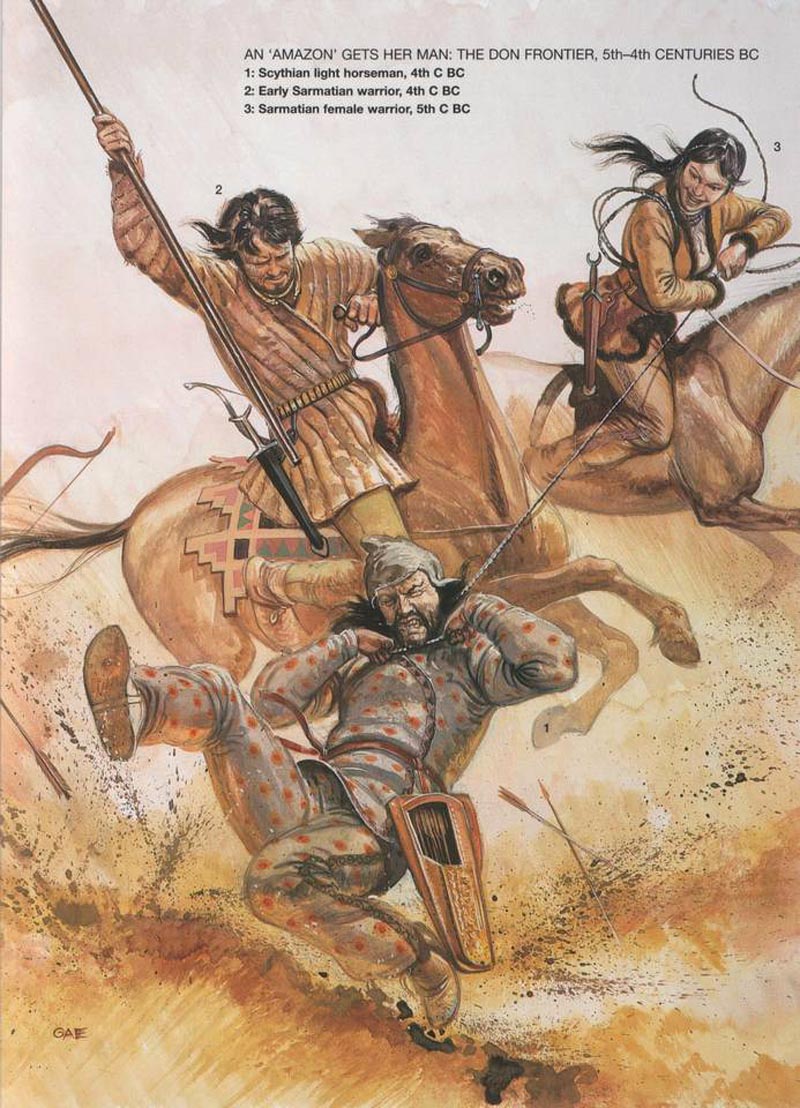
The man on the horse is wearing a quilted kurta. The one being attacked is a Scythian. I'm not sure what the woman's jacket was based on.
Wrist straps
  The ends of the sleeves could be longer than the wrist (though they weren't all this way). The reason for this was to create a hand flap which functioned as a sort of glove when the temperature was cold. If you don't want the glove, you pull the end back over your wrist. There's an image of Scythian men with this same modification and they have straps hanging down which would have been sewn to the inside of the sleeve. I'm guessing the straps were used to tie the hand flap closed. In the image, they had the flaps folded back over their wrists and let the ties hang. It looks like the ties end in a big triangular shape.
A pot made by Greeks. They seemed to have made a lot of things depicting the Scythians for the Scythians
  The fronts of these Scythian jackets look a little different from Sarmatian kurtas, though- this particular style has two slits in front- one over the mid thigh and one over the inner-thigh. I haven't seen this in any Sarmatian kurtas.
Scythian kurta with multiple slits
A polka-dotted Scythian
  Sarmatian kurtas could be made out of leather (deer is common) or cotton (which can be quilted). They could also be lined in fur (squirrel seems to be common). Cotton might seem out of time for those of you who have Western personas, but it was around and used for clothing in the East long before it showed up in the West. They could be decorated with floral or geometric designs. Little gold plaques which would have been sewn on are commonly found in kurgans. Fabric paint is another option which is known to have been used by Scythians (One known paint pattern- polka dots. C'est amusant.). There's a leather saddle with felt appliques preserved, so it seems like a logical inference to say leather kurtas could too, but I haven't seen any examples illustrating this. You have the option to include it if you lean heavily towards the "creative" side of the SCA, but unless I find evidence of it, I don't really feel comfortable including them on mine. For the most part, though, Sarmatian kurtas seem relatively unadorned in comparison with Scythian ones.
  Most of the documentation you find will be in images of the Sarmatians created by other people. We actually did get very lucky, though, in that a child's kurta was preserved in a Siberian kurgan, which is now housed in the State Hermitage Museum in St. Petersburg, Russian.
Child's Fur Coat
Fur; l. 35 cm
Tashtyk Culture. 3rd - 4th century
Oglakhty Burial VI, Grave No. 4 (Excavations of Prof. L.R. Kyzlasov), South Siberia, Khakassia Republic, left bank of the River Yenisei, near Mount Oglakhty, Russia
Source of Entry:   Archaeological Expedition to Khakassia of the Moscow State University. 1969

  I just made my first kurta in time to wear at the St. Denys' Day event. I wanted to go the leather route, but unless I had gotten lucky and found enough for sale at an event, my cheapest option was to invoke the unwritten "Ten Foot Rule" (if it looks genuine from ten feet, it's acceptable [unless on enchanted grounds]). Which means that this financially-limited student used tan moleskin from Joanne's Fabrics to imitate deer leather.
  I did some things wrongly because my measurements turned out to be wrong- the jacket doesn't go past my hips, for one- but given that I'm a novice seamstress making my first kurta, I wasn't expecting perfection (another reason I used cheaper fabric). From a lot of the depictions, it seems like they didn't have inserts (gores and gussets), but I didn't trust my patterning skills (or lack thereof) to make one without gussets in which I my arms would still have full mobility, so I included them. But then I more closely examined the child's coat above, and it looks to have gores that go all the way from hem to armpit sewn next to roughly rectangular front pieces. The shape modifications around the arm-body seam look similar to those in the above depiction of Scythian men. I'll try this solution in my next run and see how that goes.
  Because I used woven fabric instead of leather, I had to hem all ends that weren't cut on the bias, though the child's coat didn't have them except maybe on the ends of the sleeves (one side looks like it was hemmed but the other doesn't; not entirely sure what's going on there). Other options I chose were: side slits, no hand flaps, and no decorations
  Below are results of the pattern I actually used. Once I make another, I'll do a second post about the modified pattern. Don't make your own with this pattern, it's only here for future reference so you can see the differences from it and from a standard T-tunic build. There are so many things wrong with it...


Finished product

Waaaaay too short

*--Unless otherwise specified, pictures of artifacts all come from "From the Lands of the Scythians"

From The Land of the Scythians: Ancient Treasures from the Museums of the U.S.S.R., 3000 B.C. - 100 B.C. (Metropolitan Museum of Art Bulletin, Volume XXXII, Number 5, 1975)
Brzezinski, R., and Mielczarek, M., 2002, Men-at-Arms: The Sarmatians 600BC-450AD, Osprey publishing.

Sulimirski, T., 1970,  The Sarmatians, vol. 73 of Ancient Peoples and Places, Praeger Publishers, Inc.

Monday, June 6, 2011

Phrygian caps

A couple days ago, I made my first piece of Sarmatian garb- a Phrygian cap. While the name may be unfamiliar, you've all seen them worn by the members of a certain village of blue people.
The association was ever so lovingly pointed out by my fiancé and his best friend. I don't care if it looks silly; it amuses me and I like it. So there. :P
Phrygian caps have been around a long time and worn by many different peoples. The Phrygians in Anatolia are the namesake of the cap, but it spread to other cultures as well. The Greeks associated it with barbarism- which, in the original sense, means "not Greek" and implies an Eastern influence. Among the Romans, it became a symbol of liberty because freed slaves wore it. This association led to its use by French revolutionaries. Their caps were red and bore rosettes. It has since seen use in American and Latin American symbolism for the same reason, including on the seal of my home state.
Basically, it's a tall cap with an asymmetric, rounded apex, usually made in a material soft enough that it flops over. The apex is very blunt. The pointiest I've seen it is on a bust of Queen Dynamis of Bosporus.
According to Salisbury (2001), the cap is actually her royal headdress. The apex is pointier and curvier than most caps you can find pictured. The stars are something I haven't seen elsewhere. 
It also has a trim. The trim is optional- not all caps had it. Both are options for a Sarmatian persona, as illustrated by Köhler (1871).
Köhler's Sarmatians had floppy hats as opposed to Dynamis', which stands up straight. The Dacians on Trajan's column had Phrygian caps which stood up straighter. Given that Sarmatians were raiders and some were also allied with the Dacians during the Dacian wars, it's not a stretch to assume that Sarmatians could have worn hats that stand up too. By the same token, one could also choose to have the back of the hat extend down to cover the neck like the Scythian pictured in Brezinski and Mielczarek (2002). Ear flaps are another modification that was worn, as seen in a hat from Duro-Europas in what is now Lebanon, though I haven't found a record of them among Sarmatians or their contacts. I could just be missing it, so keep it in mind. A pattern for that hat can be found here.
Whether it's floppy or stands up is probably in part due to the fabric and in part to the cut. Wider fabric up top means the hat is less able to stand on its own (since it isn't given shape by your head that high up). If your hat is thicker leather, felt, or felt-lined, it will be stiffer than if it's only made out of linen, wool, or thinner leather.
Köhler indicated that both male and female Sarmatians wore Phrygian caps. Some classical authors say they would go bare-headed (in Brezinski and Mielczarek [2002]), so if you would feel silly wearing a Smurf hat, your outfit would still be complete without.

I had some cheap felt lying around and decided to try making my hat out of it. It's more suitable for the version that stands up. I also chose to make the kind that doesn't extend over the neck or ears. I cut it bigger than it needed to be so I'd have room to play around, then pinned it in various ways until it held the shape I wanted. Because of the shape and size of my fabric, I had to make it in two pieces (normally it would be in one piece). I stitched the edges together with blanket stitching like the Duro-Europas hat. The apex is more concave than I intended, but I'm otherwise happy with how it turned out. Now that I know what shape and size works for my head, I'll make another later on with nicer fabric and put trim on it. I'll make it taller and less concave in the front as well. I'll probably make a floppy one at some point, too.
You can use the third picture below as a base for your own. The dimensions are 11.5 x 8.5 in.


Brezinski and Mielczarek (2002), Men-at-Arms: The Sarmatians 600BC-450AD, Osprey publishing.
Harris, J, 1981, The Red Cap of Liberty: A Study of Dress Worn by French Revolutionary Partisans 1789-94, Eighteenth-Century Studies 14.3, p. 283-312.
Köhler, 1871, Die Trachten der Völker in Bild und Schnitt.
Salisbury, JE, 2001, Women in the Ancient World.