Showing posts with label zoomorphic art. Show all posts

Tuesday, August 26, 2014

Saka "Golden Woman" Reconstructions

Two years ago, a new, undisturbed find of a wealthy Saka woman from the 4th to 5th centuries BC in western Kazakhstan made the news. Finding an unlooted kurgan is always great news. So many of them were looted in both distant and recent history (in modern cases, many looters melt the gold down, which means all cultural information is lost). A week ago, images of many of the artifacts in her grave, along with reconstructions of some things (like her clothes and her comb) were published here. Take a look through them! It's pretty awesome.
  The claim that her symbols represent a belief in Zoroastrianism confused me. Maybe something was lost in translation, but worshiping a sky/sun god is kind of an ancestral Indo-European thing (discussed in The Horse, The Wheel, and Language), so it should by no means be indicative of Zoroastrianism over other religions in that category.
  Side note 1: The tall hat would have been made of felt over a wooden frame. I don't know more details than that; it's something that was briefly noted in Warrior Women by Davis-Kimball.
  Side note 2: The "Golden Man" is also a woman. But because the archeologists in charge of reporting her operated in a highly patriarchal paradigm, they failed to report it, even though some of them suspected it. It ruffled their feathers that she was buried with a warrior's accoutrements. Davis-Kimball also recounts how she independently figured it out and the reception of her findings in her book.
  One thing I should note before anyone rushes off to recreate her outfit: just because someone is buried in something, doesn't mean they would have worn it in life. It could be funerary clothing. Someone noted on this facebook page that a hat like that is impractical, so why would someone living on the steppes wear it? Couldn't it get blown away by the wind? All I have to offer to counter that is that there are depictions of steppe women wearing tall hats while alive in their goldwork. See this post for one example. However, it's still possible that they were specifically for ceremonial purposes, rather than for everyday use.

Anthony, D.W., 2007, The Horse, The Wheel, and Language: How Bronze-Age Riders from the Eurasian Steppes Shaped the Modern World, Princeton University Press, pp. 553.
Davis-Kimball, J., and Behan, M., 2002, Warrior Women: An Archaeologist's Search for History's Hidden Heroines, Warner Books, pp. 268. 

Saturday, July 26, 2014

Scythian and Scythian-related Objects in the British Museum

I was quite happy with the British Museum (BM). They had many steppe nomad and steppe nomad-related artifacts on display. And, because they're an archeology museum, their labels were much more informative than the Louvre's. Also, there's so much I want to talk about that I've decided to split my visit there into two posts--this one focused on the Scythians and the next on the Sarmatians.

The Oxus Treasure
Scythian feline on a ring biting its tail.
Similar to the pommels at the Met.
The Oxus Treasure is a collection of Achaemenid-period metalwork and coins found in modern-day Tajikistan just across the border with Afghanistan. Much of it was unfortunately cut or melted down for bullion by the merchants the finders originally sold it to, so museums only contain part of the find now. The art styles in the hoard are highly variable, so one hypothesis is that the hoard was temple tribute, with individual pieces being of various ages and originating from various cultures. The BM dates the metalwork to the 5th or 4th century BC. Some of them are the steppe nomad's Animal Style. Others simply demonstrate interactions with them.

Scythian bracelet with two
interlocking monsters.
Luristan Bronzes
The most adorable little Scythian monster ever!
Originally, it would have had stone inlays
and may have been on a hat or hair accessory.
This Achaemenid piece shows a
Persian hero killing steppe nomads.
I finally found out what those deer-ibex motifs in the Louvre are--they're from a group of artifacts called the Luristan Bronzes. They're from the Early Iron Age of west-central modern-day Iran. Some pieces are ornamentative, some ceremonial, and others had more practical purposes (e.g., the weapons). The BM had more on display, including some that looked like humans shaped to be rather, uh...phallic. I haven't included any pictures of this collection.

Caucasian artifacts
There was an entire section on the early first millennium BC Caucasus as the "gateway to the north" for Iran. Some of the artifacts in this section were of Scythian style from northwest Iran, while others were Caucasian (Koban culture). Below are gold fragments from late 8th century belts from Ziwiye in north-east Iran, which would have been sewn onto cloth or leather backings and are daggers from Iran and Georgia.

Scythian-style feline motifs with missing stone inlays
Look familiar? The label here gave more information on this
artifact than the one in the Met, some of it conflicting. I'm
not sure if they're two pieces of the sameartifact with the
Met either getting the less battered piece or restoring their's
more nicely, or if they're two separate artifacts made by the
same person. There are two different styles here.
The stags and ibexes are done in Scythian style. The motif
encasing them is more along the lines of Near Eastern art.
I do wonder about its identification as apiece of a belt...that
would have to be a pretty wide belt...even wider for the Met's.


10th-9th century BC Iran
The style is similar to some found in both northwest Iran and Georgia.
The handle was covered in wood held attached with small cooper
rivets. The edges have been sharpened, so it has actually been used
as a weapon.
14th-9th centuries BC, Georgia
These are types of Caucasian daggers.
The left is of a style often found with
other weapons (swords, axes, spearheads)
 in graves in Armenia and Georgia. The
right is younger and of the Koban culture.
 The style with animals facing each other
on the handle may have influenced later
Scythian handles.


Wednesday, July 9, 2014

Maybe Scythian Stuff in the Louvre?

Apologies for the wait. Between collections work, sightseeing, some professional service work, keeping up another blog to meet one of the requirements for one of my fellowships,and resting from doing all that, I'm only now getting time to write stuff up here. But more will follow shortly. :)

It turns out the Louvre doesn't actually have any Sarmatian stuff. I wish I'd saved the link that pulled Sarmatian stuff up on a search because I have no idea why it told me they did. They have one thing in the collections which references the Sarmatians (a Roman relief commemorating some of Hadrian's victories over them), but no actual stuff of their's according to a search through their online database. I went through the Iranian area (Iranian meaning cultures-and-empires-based-in-Iran, not all Iranian ethnicities) just to see what was there.

The database mentions an Achaemenid bracelet that might have been made by the Scythians. I found some artifacts on display that look familiar after having looked at a lot of pictures of Scythian metalwork. But there's no way to be sure they actually made it because the Louvre is an art museum and art museums do this thing where they hardly give you any information on the labels. Just name, material, date, donator, and date of aquisition.

---Dear art museums,
I know you want us to spend our time looking at the art pieces, but I would be able to appreciate them more if you'd give me a contextual framework in which to appreciate them. I know I could have rented an audio guide, but I highly doubt you consider the pieces I'm interested in important enough to tell me about them in there. And I know you sometimes have guided tours, but same thing there. So....more informative labels, please?
Sincerely,
Me---

So, given the lack of information (I only knew they were found within the boundaries of an Iranian empire because that's what the rooms' themes were.), there's no way for me to know if those pieces were: 1) made by the Scythians and traded to someone in an Iranian empire; 2) made by someone in an Iranian empire copying Scythian art style; or 3) representative of that Iranian empire's art style which happens to be similar to the Scythian's because they used to be the same people way, way back in the day. That being said, here are the artifacts I saw which might fall in one of the three categories above.

Colored relief of Assyrian griffins.
 Assyrian griffins look different from Scytho-Sarmatian griffins, but still quite fun. They have lion heads instead of eagle heads, horns instead of fin manes, and eagle back feet instead of lion back feet. But notice the colored blotches on their flanks? Look reminiscent of some Scythian style art you've seen before on this blog?

Bronze quiver plates (leather's rotted away) and arrows. 8th-7th centuries BC
The designs on the cases look nothing like Scythian cases (aside from griffins attacking a prey animal in the upper right being a familiar motif). But the cases themselves are the same type of design- bronze on leather with panels of scenes on them.

Bronze bracelets, 8th-7th centuries BC
Torses ending in animal heads were common in Scytho-Sarmatian jewelery, though these specific designs don't ring any bells for me.

Something made of bronze. That's all the label said.
 The label called these branches. They look vaguely reminiscent of the "Tree of Life" motif, but I don't know if it's an actual correlation or the human tendency to see patterns even when they aren't there.

Bronze plaque. Label says "Fin du Fer I"....End of the Iron Age?
There were several openwork plaques similar to the above. From far away they look like deer heads seen from the front. Close up, they're made of a pair of ibexes, sometimes with extra ibex or dragon heads popping out of strange places. They reminded me of Scythian art, though no particular pieces are coming to mind. And since I'm traveling, I don't have my books with me to search for them.

So that was the Louvre. Next up, the British Museum, where I had a bit more luck.

Monday, April 15, 2013

2013 Two Truths And a Lie #2

TRUE

  Just not directly. And who knows from whence it ultimately came.
  When people talk about "origins" or "causes", many don't distinguish between direct, ultimate, or steps along the way. Sarmatians are only one of many candidates for the ultimate origin...saying they're a step along the way is the more conservative (and, IMO, more likely) assumption.
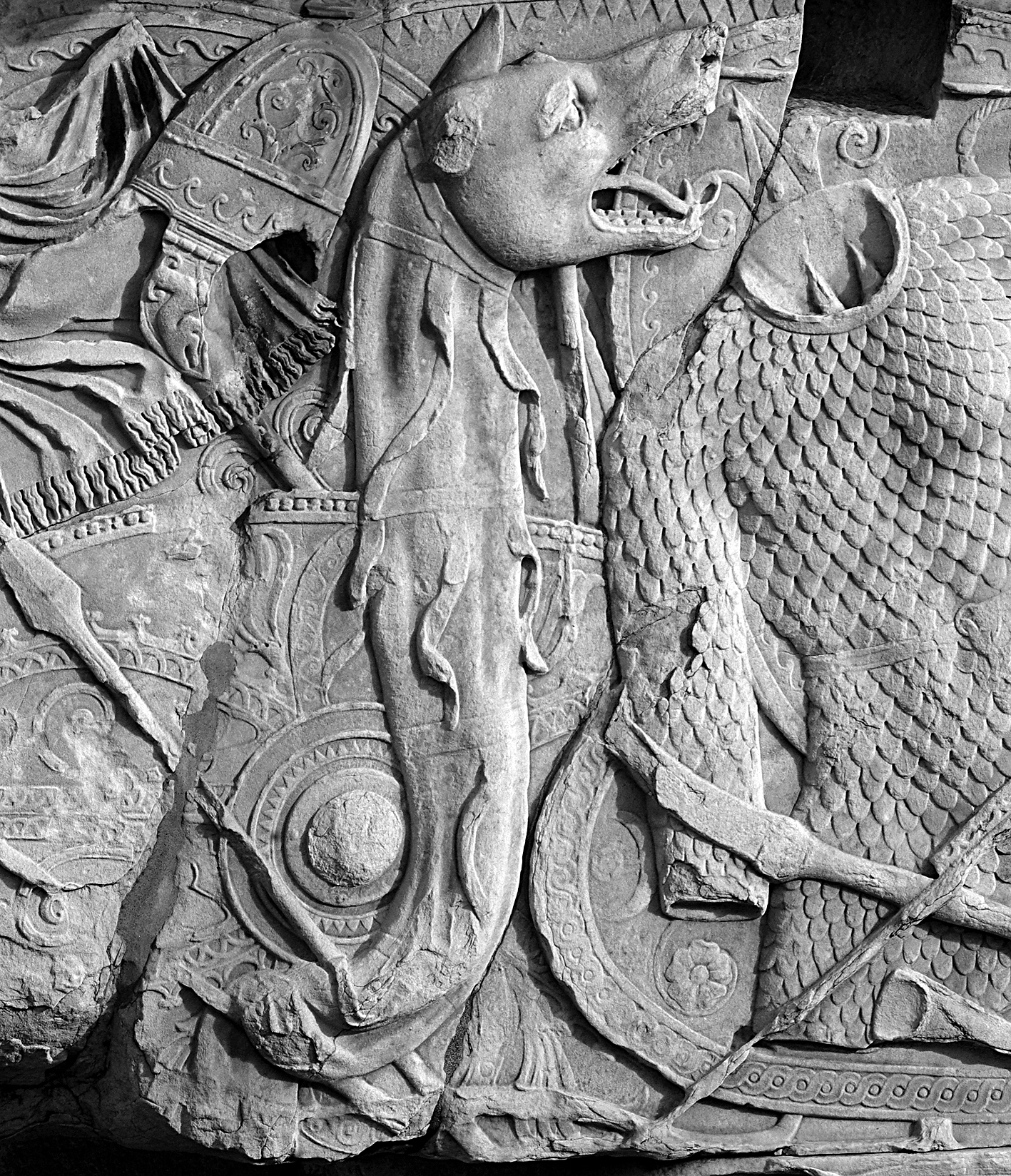
A Dacian draco on Trajan's Column- note the wolf
head and the complicated construction with
multiple rings and streamers on the tube.

  For the direct origin of Roman draco standards, look to the Dacians. By the end of the 1st century AD, the Romans associated the dracos with the Dacians they had recently defeated in the Dacian Wars. Which means they probably got it directly from them (though they also knew Scythians [he likely meant the Sarmatians] had them, as Arrian wrote about dracos making a fearful sound).
  Draco origins are discussed by Mihailescu‐Bîrliba (2009) in his analysis of a funerary monument in Chester. This happens to be the picture on the background of this blog. He makes a very convincing argument for a Dacian direct origin as well as for the monument actually depicting a Dacian, not a Sarmatian, as was previously thought. Which means I have to find a new background picture... *grumble*

  The ultimate origin of draco standards is a point of contention among scholars. Dacian, Scythian, Thracian, Sarmatian, Parthian, Persian, and even ancient Indo-Iranian have all been proposed. There are two issues to be considered when looking for the ultimate origin.
1) Where do we first see or read about them?
2) What was their original use?


On first appearances:
  We have to be careful with first appearances. First appearance dates (FADs) are statistically highly unlikely to be the first existence date. This is acknowledged in paleontology by differentiating between FADs and what we call "ghost lineages". A ghost lineage is a stretch of time during which, based on phylogenetic hypothesis, a clade or species had to of existed, but we have no physical evidence of it.
  Unfortunately, sorting out the history of cultural artifacts is so much more complicated than evolutionary trees that can be sussed out based on morphological and molecular evidence. So no such thing as a ghost lineage for dracos, but we still need to acknowledge that the first time we see evidence of one is not necessarily evidence of the first one. If there's a large enough stretch of time between FADs in different cultures (the size of "large enough" TBD by scholars more knowledgeable than I), then we can say, "Yes, this culture probably had it before that one." But this far back in time and with so many illiterate cultures involved, what's a few decades to anyone? Considering how widespread dracos were in the ancient world, unless we know that one group encountered it in another before adopting it (e.g., Romans and Dacians), I don't think it prudent to consider first appearance to be synonymous with [almost] first existence.
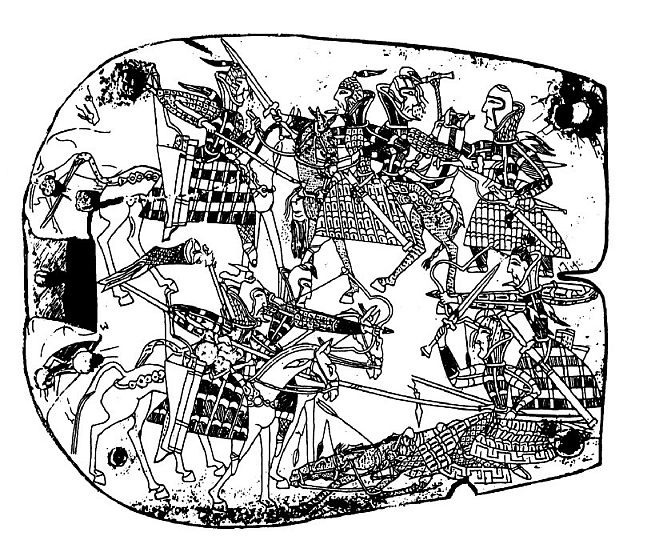
Orlat battle plaque from Sogdiana/Uzbekistan-
note the tube of fabric on a stick at center left.

  So far as I know, there is no evidence of an animal head on a pole with fabric streaming behind it showing up in one culture well before another (please, please correct me if you know better than I). There is a depiction of a headless one held by horse archers in Sogdiana (modern Uzbekistan) which might (with a very heavy emphasis on the "might") be from the last centuries BC. It might also be from the 4th or 5th century AD. I don't feel comfortable using it as evidence of an early depiction until the professionals have reached a consensus.

    I've seen an argument that the Dacians had them as far back as the Bronze Age based on bracelets- you can find zoomorphic bracelets in their area which have wolf heads (the Dacians used wolf heads, not the dragons the Romans used) on either end. But assuming that's a depiction of a draco 1) ignores the fact that other people across Eurasia also had zoomorphic bracelets with animal heads, and 2) requires a pseudoscientific practice- seeing what you want to see instead of being objective about it.
  It's zoomorphic art. It has nothing to do with dracos except to reflect the animals preferably depicted by each culture. Just because the head is on the end of a long thing doesn't mean the bracelet shaft represents the fabric tube. The end is just the intuitive place to put an embellishment on a bracelet that isn't shaped like a full circle.


On original use:
  Wind sock, religious purposes, group symbology (ethnic or military unit), and intimidation in war are all possible uses of a draco standard (though I'm personally less inclined to consider the religious use a possibility [lack of evidence and the whole copout thing I've talked about before]). When looking for an ultimate origin, it doesn't matter what it was used for along the way (so Roman use is irrelevant). What matters is the original use because it might narrow down the possibilities for its origin. The Romans remarked on them making frightful sounds, so it definitely intimidated them, but that doesn't mean that was the original intended use. If it were originally a war standard, it probably came from a culture which fought battles fairly regularly and most likely against other cultures that later adopted it. If it were originally a wind sock, the culture inventing it would had to have used archers in battle and they would likely need to be standing still for at least part of the battle. Wind socks will pick up forward movement which would then need to be compensated for, making them more difficult to use (or impossible if the horse were moving fast enough).

  I personally find the wind sock argument to be the most convincing. The arguments against it are: 1) wind socks are only useful to archers when the sock is stationary, 2) the enemy would get more use out of them, 3) wind socks are modern inventions, and 4) considering the different types of heads, why wouldn't group symbolism be the more likely original use?

  Counterpoint 1: Yes, being stationary is important. This point assumes that horse archers always fought while moving. We know the Scythians started their battles with stationary volleys. Unless we have known battle tactics for all cultures which might be the ultimate originators, we can't use this as a reason to nix the wind sock theory compeltely. (As a side note, Sarmatians did not use this tactic to my knowledge, which is why I don't think they were the ultimate originators of dracos, considering I favor the wind sock theory.) I've heard that forward movement can be corrected for when it comes to wind indicators, but I have no experience in this and don't know how easy/hard it would be or to what degree it can be corrected.

  Counterpoint 2: Yes, holding a wind sock would tell enemy archers how to adjust for wind near the group with the draco. However, flags and banners also show wind speed and direction and that didn't stop plenty of cultures from using them as standards regardless of whether or not the enemy could also use them as wind indicators. I'm not an archer, but it does make sense to me that an arrow would be more affected by wind the farther away it is from its shooting point given the loss of speed. There was an archery instructor online arguing in favor of the wind sock theory, though, so I'm left to assume that wind still influences the shot shortly after the arrow leaves the bow. Are any of you reading this archers who can add to this argument?

  Counterpoint 3: The term, sure. But the device? Draco standards are tubes of fabric on a pole braced by something so they stay open on the pole end. That's what a windsock is. It's true that we don't have evidence of it being used as a wind indicator by archers (though we have evidence of archers holding them). But quite frankly, all discussion of what draco standards were originally used for is heavily doused in speculation regardless of which camp you fall in. I personally find it hard to believe that no archer in pre-modern history ever thought to use a piece of fabric on a stick to tell wind direction in battle. There just wouldn't be time to repeat the test over and over using sparse test shots, pieces of grass, or a wet finger. If the wind changed in the middle of battle, you risk wasting arrows if you don't have a constant indicator. And since we use windsocks at airports instead of flags, I have to assume that the windsock design is more accurate than a simple flag as a wind indicator.

  Counterpoint 4: Why not just the heads, if that were the case? The fact that their back ends are all colorful, open tubes makes it more likely that the head type was changed after the fact to reflect personal/cultural preference.

  In short, I can't come up with a good reason for going to the trouble and expense of making a tube of fabric and bracing it open with something hard when a flat piece of fabric (i.e., a flag or banner) would do just as well for a military standard/rallying point or group symbology. As for the intimidation effect- I think it more likely that its additional use as this was a happy accident. Even the Highland Bagpipes, whose purpose was to intimidate the enemy and rile up the side using it, didn't come out of a vacuum- other types of bagpipes were around before that and co-opted for this use.
  As for religious or nationalistic use... Let's use the Dacians as an example. They thought wolves were pretty much the most awesome things ever, which is why their dracos have wolf heads. ...But why would someone think "Hey, let's make a depiction of a wolf!" and come up with a wolf head on the end of a fabric tube instead of just painting a wolf on a flag? Jumping straight to a draco is just not parsimonious in the slightest. You have to carve the wood, attach the metal on top of it, sew the fabric into a tube, and attach it to the head. It's so much easier to just paint a wolf on a piece of fabric. So regardless of who invented them or what feelings about religion or nationality dracos may or may not have invoked, I just don't buy the idea of "originally religious/nationalistic" in the slightest.

  If you think about geography, Dacians having them first doesn't make sense. Put a drop of dye in water and what happens? It spreads out in all directions. The Dacians are at one side of the area where draco standards are found and they weren't only interacting in one direction. Given that we don't have an instance of one culture having them well before another, it makes more sense to me that draco standards would either come from somewhere near the center of their known range, then spread out in all directions or a common ancestral culture had them and we just don't see the early evidence. Like I've said before, absence of evidence is not evidence of absence. It should be approached cautiously, but should still be considered.


tl:dr: Romans got draco standards directly from the Dacians. We don't know who they ultimately came from, but Sarmatians had them before Romans. This blogger thinks that the Sarmatians were not the ultimate origin and that the Dacians got them from farther east. The Sarmatians and Dacians interacted, so that's one possibility for how the Dacians got them.

And as a side note- this marks my halfway point to completing my A&S 50: Persona challenge!

Mihailescu‐Bîrliba, L., 2009, A funerary sculptured monument of Chester and its representation, Studia Antiqua et Archeologica XV.

Mode, M., 2006, Heroic fights and dying heroes- The Orlat battle plaque and the roots of Sogdian art, Eran ud Aneran- Studies presented to Moris Il'ic Marsak on the occasion of his 70th birthday, Libreria Editrice Cafoscarina, Venice, Italy, 718 pp.

Rostovtzeff, M., 1922, Iranians and Greeks in South Russia, Clarendon Press, Oxford, UK, 260 pp.

Saturday, August 4, 2012

Make Your Own Scythian Gryphon

There are two metal sheets, but I'd already used one when
I took this picture.
   After walking around the Met, I went to their annex, the Cloister. If you're heading to New York, definitely make a trip there (you get same day entrance when you go to the Met). It's parts of several abbeys and recreations of those styles all combined into one absolutely gorgeous building. There are various exhibits (including the famous unicorn tapestries!), labelled gardens of European plants used in the Middle Ages, and guided tours (such as one for all the really cool carved doors they have). It's off the beaten path, not crowded, and very peaceful.
   I also discovered this in the gift store. It's a kit for making your own Scythian gryphon like the ones actually displayed at the Met! The box is even made so that you can display your "masterpiece" by hanging it on a wall complete with a descriptive card. A lot of the Iranian steppe artifacts at the Met were made via a chasing and repoussé technique (info from the booklet) and that's what this one sort of recreates. It's a little kid-ified version, so it's by no means true-to-life, though it's a nice introduction to it for the beginner. There are several other techniques "recreated" in this series, so I definitely recommend children's ministers take a look at it. Probably not for the very young ones, but perhaps ages 10 and up?
Edgework plus wing and eye details
   Rather than gold sheets, you get two gilded sheets of some sort of silver-colored malleable metal (tin?). The sheets one would actually use to recreate steppe gold jewelry would be a much thicker (in addition to being actual gold sheets). These are far too flimsy to be sewn to clothing like Iranian steppe nomads did. The size of the gryphon (~4 in) is much larger than the originals it's based on (~1 in). Given how soft and thin the sheets are, hammering is overkill, so all you do is push and rub with the plastic tools given. The surface used to do the repoussé is just a thin sheet of foam because that's also all that's needed.
   You start by taping a sheet to the mold. From the top, use the wide, flat tool on the right (a square end and a circular end) to mark the edges of the gryphon and major body parts (I just did the wings). Then you switch to the tool in the center of the picture above to make the details show up. There's a spherical end and another like a sphere cut in half (for the smaller areas and the sharper edges). You also use the tool on the left (a point and a wedge on either end) to define the corners and get into the crevices. This is the "chasing" part, where the background is being forced away from you.
   Then you take the tape off and turn the sheet over on top of the foam. Use the round end of the middle tool to push out the large areas (wings, thigh, shoulder, neck...) and the half-round end for the smaller areas. This is the "repoussé" part, where the image is being forced away from you.
After "chasing" with the second and third
tools. See the inadvertent rips?
Because the sheet is flimsy, some parts will inevitably get pushed back away from where you had them, and some edges will become less defined. At this point, you flip back and forth between "chasing" and "repoussé" until you're happy with the way your gryphon looks.
   The instruction booklet tells you to stop here and display your "masterpiece" in the front pocket. But since the Scythian gryphons were standalone plaques for clothing, not images on sheets, I decided to go ahead and remove the background which was not part of the gryphon. Mostly I could just rub the pointy tool back and forth along the edge until it ripped (sometimes this happens on accident, as you can see in the picture to the left). I had a few little snags hanging on and ended up taking scissors to them or folding them under, depending on where they were, and whether their size and shape was messing with the gryphon itself (that happened a lot around the toes).
   Someone got their Laurel for goldworking at Lilies. I might have to look him up at an event and see if I can get his input on using actual chasing and repoussé to make Sarmatian plaques for my clothing...
After applying "repoussé"
After ripping/cutting out the gryphon and dealing with the edges
Ta-da! My "masterpiece" displayed! So cute and corny...

Wednesday, July 25, 2012

Steppe Nomads at the Met

I was recently in NYC for mundane research. Given that three of my books surveying Sarmatian and co. goldwork were published by the Metropolitan Museum of Art, it was on my list of things to do when I'm not working in the collections of the natural history museum.
I wasn't expecting a lot to be displayed- they aren't exactly popular with the general public- and there wasn't. Iranian steppe nomads are confined to a corner in a small gallery devoted to Near East Asian art. This includes other groups such as the people of the Caucasus, Sassanian Persians, and Mesopotamians. I was actually surprised at how little work was being displayed from "the cradle of civilization". The one thing that I was disappointed about, even with my low expectations, is that none of the golden deer were displayed. I think the Golden Deer of Eurasia was written as a companion to a special exhibition (how I wish I could have seen it!), but I was hoping at least one of the many they have would still be viewable by the general public. Oh well. I still highly recommend going if you're in town. The museum has a dearth of other things displayed. I took pictures of Renaissance string instruments for a friend, saw Henry VIII's last set of field armor (how sad that his "grossly overweight" is "normal" for much of the US today...), and a really awesome ceramic dish. It was made at the end of period using actual animals to make casts. Check out their annex, The Cloisters, as well!

Below are pictures of what they did have in the Caucasian peoples (sensu stricto) and Iranian nomads corner.
Disc with running dogs surrounding a mountain goat
Bronze
Caucasus region, 1st-3rd centuries AD

Clasp with an eagle and its prey
Gold with turquoise inlays
Iran? Parthian, 1st cent BC-1st cent AD

Roundel with horned animal, lions, and griffins
Gilded silver inlaid with stones, iron backing
Central Asia, Sarmatian, 3rd-2nd century BC


Roundels with griffin heads
Gilded silver with stone inlays
Western Asia, late 1st millennium BC

Axe head
Silver and iron
Western Asia, Scythians, 6th-5th century BC

Dress ornaments
Gold
Northern Black Sea region (Maikop?)
Scythian, 5th century BC

Fragment of a plaque
Gold
Northwestern Iran, possibly Ziwiye, 7th century BC

Teeny tiny ibex figure (an inch long at most)
Same info as above plaque fragment

Finial and pommel with coiled animal forms
Gold and gold with turquoise inlays
Western Asia, possible Black Sea area
Scythian, 6th century BC

Belt buckle, felines attacking ibexes
Gold
Mongolia or southern Siberia, Xiongnu period, 3rd-2nd century BC

In addition to the relevant corner, I also found these gems in the Chinese exhibits (which are extensive!). Look familiar to anyone?
Belt buckles
Bronze
North China, 3rd-2nd century BC
This shape of belt buckle is also present in the form of several Saka (i.e., Asian Scythians) artifacts figured in the Golden Deer book, including the one I used to make the bottom right scene in my '8 of 8' scroll.

Belt plaque
Gilded silver
North China, 3rd century BC
Another belt buckle plaque, this time rectangular. There's that Sarmatian theme of twisting the hindquarters around 180 degrees. It also has the Iranian nomad modifications of taking a horse (it has one hoof per foot), giving it a bird beak, deer antlers, drawing the antlers in that very stylized way, and terminating the tines in griffin heads to boot. The griffin heads aren't quite as noticeable as they typically are, but if you've seen it before you can easily recognize it as such.

There are multiple records of Iranian steppe nomads getting a hold of Chinese artifacts and vice-versa (trade-and-raid routes and all that). There's also the pan-steppe themes that extend all the way east into Mongolia, which borders China. Mallory and Mair discuss the introduction and adoption of Scythian-style art in China. Lebedensky (the same guy who wrote the tamga book) mentions in another book that some Scythians may have migrated into China (must get a hold of all his books!) I didn't notice anything steppe-related in the Greek or Roman rooms (though I could have missed something; they are rather extensive), so I was extremely excited to find these steppe-type artifacts in the Chinese area. There were a few more relevant artifacts in the China section, but these were the best examples of steppe-type art there.

The Golden Deer of Eurasia: Scythian and Sarmatian Treasures from the Russian Steppes, The Metropolitan Museum of Art, 2000.
Iaroslav Lebedynsky, Les Saces, p.73
Mallory and Mair, 2000, The Tarim Mummies: Ancient China and the Mystery of the Earliest Peoples from the West

Monday, June 18, 2012

Notes From Lilies


Lilies was so much fun! I learned a lot about many different subjects, including how to do a handful of crafts, and met a bunch of fun and nice people in the process. I weaved a seamless bag which I need to felt now. My husband made a leather jack and did really well with the tooling. He is much better at basket-weaving than I. I also learned that Yoda speaks Latin in English. My husband (now going by the name he'll be submitting, Gamble) and I are going to buy a couple rapiers to practice Calontir Steel cut and thrust on our own. I really, really need to find a place where I can practice thrown weapons 'cause it is tons of fun. Especially spears. We also saw Their Royal Majesties and Highnesses from five kingdoms do the wave in court.
I drew two device submissions for heraldic consultants. One of the pre-prints I had painted previously was given to a new Boga-Fyrd. I was the only entrant in the borders competition, but was assured I didn't win by default. I drew up another zoomorphic border. I'm kicking myself for forgetting to take a picture before handing it off... I did two deer with their hind limbs flipped above their backs and long antlers filling up the extra space- one on the top left corner, the other on the bottom right with antlers extending vertically up/down the sides of the sheet (scroll is in landscape format), and horizontally to the center of the page. At the center, they turn vertically toward the center of the sheet for just an inch or so to hold onto a blank circle for an order badge at top and a blank escutcheon for personal arms at the bottom. Their Majesties' scribe suggested painting around the colors instead of over them since she's seen paint not stick to gold gesso before. I picked up an illumination how-to book which described a masking method that might make that easier to do. I'm excited to try it out next time.

I finished skimming through the giant French tamga book in time for my class at Lilies. I had one student who's currently exploring Mongol stuff and we had a lot of fun talking shop. It would probably be a copyright violation to post translations of the book online, but I will e-mail relevant passages to anyone who asks as well as discussing each chapter on here once I'm finished translating each one.
Ashina Turk on the left, modern Mongol on the right
On a related note, to the reader who asked for a raven tamga- There actually was a tamga in the book which means "crow/raven" (the French word used, corbeau, does not differentiate between the two). It seems that tamgas didn't have specific names or meanings (other than identifying the one who uses it) in the beginning, but later on some were given names. Modern tamgas in Mongolia are still used this way, including the raven tamga. This tamga first showed up in a source cited as "The Book of Tang". It was compiled from earlier sources in the tenth century and in it are illustrated the tamgas representing various nomadic tribes within the then-borders of China. A Turkic clan called the Ashina used a tamga basically identical to the modern Mongol raven tamga.


The dumpling class was an even bigger success. I had seven people show up and they all seemed to really enjoy themselves. I ended up giving out a couple copies of the recipe beyond the class as well. I almost entered them in the "Cooked On Site" competition, but given that I forgot to re-look up and write down the scant documentation I'd found beforehand, I decided to wait until next year.
If you have the opportunity to go next year, I highly recommend it. So much fun!

Tuesday, June 5, 2012

Zoomorphic Art as Illumination Take Two


I entered this scroll in the "8 of anything" A&S contest at Melon Wars about a month ago. My take on the theme is that there are eight sets of eight things on the scroll. It's intended to be a game for the viewer to try and figure out what they are. I'll give people some time to guess then put the answers in the comments if any are missed.


   I've continued to work on Sarmatian zoomorphic art as an illumination style. One thing I didn't mention in my first post about zoomorphic art as illumination is that when Sarmatians put animals on objects, they made them fit the predetermined space. Proportions don't matter so much as removing as much white space as you possibly can. That means elongated or shortened bodies and limbs are commonplace. And if the animal is a deer- expect its antlers to be ridiculously long with oodles of tines and fill every inch of white space they possibly can.

  The animals in the border are all from or based on artifacts pictured in my trusty Golden Deer book. As before, I used jewel tones to color the internal linework and whitespace in reference to the jewels that would sometimes be placed in the eyes, nostrils, etc... All of them are animals which have been depicted in Iranian steppe nomad art- mostly Sarmatian.


   The images inside the animal border are depictions of steppe nomad life, with one exception. The picture of someone picking melons I included for the Melon Wars event. I doubt Sarmatians actually harvested melons. I'm not sure they would have even been found that far north. The image in the bottom right corner is itself an actual artifact. The deer in the bottom left image are based on Scythian artifacts.

   I was working under a very tight time limit and didn't actually finish painting until an hour before the competition ended, so I had to rush and skip step 8, hence the rough look of it. I might go back and fix that later, but I have other more imminent things to work on for Lilies.


   The calligraphic hand is Rustic Roman. Since Sarmatians didn't have a written language, I picked one that was contemporaneous with them. I think it works well with zoomorphic art. It was invented in the first century AD. Like other early Roman fonts, there are no lowercase letters. Early Roman hands didn't have spaces between words either, but that makes it a pain to read, so I included them. Brown ink might have worked better with my illumination, but I already had black and didn't need to spend more money than I already had on the Micron brush pens for the jewel tone linework (which work fantastically, by the way; definitely worth the investment if you do illumination styles that can use them).

The Golden Deer of Eurasia: Scythian and Sarmatian Treasures from the Russian Steppes, The Metropolitan Museum of Art, 2000.

Monday, June 4, 2012

Creating a Scroll

This isn't a post about how to design a scroll in a period style, or how to design a scroll for an award- you can find those here, here, and here- it's about how to go from a blank page to a finished piece. The start of a project can be very intimidating. What it should be, though, is invigorating. It's a chance to try something out. If you mess up, that's okay, because you tried and that's better than doing nothing. You can try to fix it or you can start over, up to you.

Here are the steps once you've come up with the concept and a layout:
1) Lightly pencil in blobs that will one day be the locations of your illuminations. Realize that these might change, so plan on fluidity- particularly if your scroll will have multiple modules interacting with one another. (This picture is from my test scroll, hence the different levels of progression in different parts. I forgot to take picture of this stage from the actual scroll.)
2) Are you doing calligraphy? Do your entire calligraphy sequence a couple of times on scrap paper to get an idea of how much space it's going to take up. This should all be done in one sitting because your hand can be slightly different depending on your mood, energy, etc...- especially if you haven't been doing it for years and years. Experiment with width, height, and spacing until you're happy with how it will fit in with the illumination. Pick a hand that works with your illumination style.
3) Pencil in guidelines for the calligraphy and possibly box in the space it needs to be contained in. Now do the calligraphy. This should be done in the same sitting as the practice runs. Always do calligraphy first because it doesn't take anywhere near as long to re-do as illumination does. This means that if something goes wrong which can't be rectified, you waste much less time starting over. Pick the right color for the calligraphy- black is the default, but some styles (like Italian White Vine) call for brown calligraphy.
 4) Now start sketching the actual shapes and details for your illumination. You might think about doing general shapes first, then details if your scroll is very modular (i.e., has multiple parts). Like doing calligraphy first, this is to waste less time re-doing stuff if you change your mind, mess up, or find your style changing as you work.

5) Got everything all penciled in to your liking? Here's where the process becomes less linear. I like to ink my lineart first. My husband suggested I should paint, then ink, but I like having more visible lines to paint between. So this step is optional- ink over your pencil lines then erase them. Doing all one line weight is very simple but also very boring. Do major delineations in a thicker weight (a .08 micron is good), then smaller and smaller details in smaller weights (.05, .03, .02, .01, and .005 microns are all options).
 6) Here's another step that's optional- do your leafwork, be it gold, silver, or something else. This is particularly important if you're using metal leaf because it will stick to gouache, and you don't want you painted portions covered up by gold leaf.I used gouache, so in this case I didn't need to do metalwork first, though I typically do anyways.
7) Once you have your shapes drawn (be they in pencil or pen), lay down the base colors of paint.
8) Now do shading, highlights, and whitework. It might seem like you don't need it at first, but if you try any of the above, you'll probably think your illumination looks much better for it.
9) Draw ink lines over where the pencil was/is (erase pencil if still there). Do this step even if you already did optional step #5 because unless you are an absolutely amazing painter, there will probably be bits and pieces of your lineart covered at least partially by paint. You don't necessarily have to re-ink the entire thing- just fix what needs to be fixed.
Ta-da! You just made an illuminated manuscript from start to finish. That wasn't so bad, was it? :)


About the piece


The Golden Deer of Eurasia: Scythian and Sarmatian Treasures from the Russian Steppes, The Metropolitan Museum of Art, 2000.

Monday, April 16, 2012

Truth or a lie #2

TRUE


This find is detailed in the book "The Golden Deer of Eurasia". Deer were a common motif in Sarmatian art. These particular statues have wooden cores covered in gold leaf that was hammered on and attached by tiny bronze nails. While they were all made based on some set template, the degree of craftsmanship present varies wildly. Some of them were undoubtedly made by artisans who knew exactly what they were doing. Others were made by people who probably hadn't tried anything like this before. Some show influences from other cultures that those Sarmatians would have been interacting with at the time- meaning that, whoever this leader was, he was important or beloved enough that foreigners took part in paying tribute to him. Below are select pictures from the book. I'd like to try my hand at making one of these someday. Maybe I can get Bob to join me so we have a range of skills from his sculpting experience and my lack thereof. :)