Here's a paper that's hot off the press (it came out in Nature Communications yesterday). The tl;dr is that Eurasian steppe nomads were highly mobile in the Iron Age to the point that there was a lot of genetic exchange between East and West.
Showing posts with label saka. Show all posts
Showing posts with label saka. Show all posts
Saturday, March 4, 2017


Thursday, August 20, 2015
New Grave Find and Iranian Nomad Social Media Group
A new group of Sarmatian kurgans has been found with at least 29 graves! They opened one up and found a double burial of what they are assuming to be a married couple.
And since my dissertation struggles have meant I've avoided spending time doing SCA stuff, Holly Herda over at Sarmatian in the USA was kind enough to set up that Iranian nomad social media group I talked about a while back. I got an equal number of votes for Facebook and Google Groups. Since there's already a good and relevant group on Facebook, Mongols and Russians and Scythians, Oh my!, we went with Google. She found out that Google is planning to phase out Google Groups, unfortunately, so SCA Iranian Steppe Nomads is a Google+ community.
And since my dissertation struggles have meant I've avoided spending time doing SCA stuff, Holly Herda over at Sarmatian in the USA was kind enough to set up that Iranian nomad social media group I talked about a while back. I got an equal number of votes for Facebook and Google Groups. Since there's already a good and relevant group on Facebook, Mongols and Russians and Scythians, Oh my!, we went with Google. She found out that Google is planning to phase out Google Groups, unfortunately, so SCA Iranian Steppe Nomads is a Google+ community.
Thursday, January 29, 2015
The Face of a Saka
Quick linkshare- The Pazyryk mummy with the awesome tattoos has had her face reconstructed.
http://www.ryot.org/frozen-mummy-tattoos-princess-ukok-siberia-taxidermy-reproduction/919290
http://www.ryot.org/frozen-mummy-tattoos-princess-ukok-siberia-taxidermy-reproduction/919290
Tuesday, September 16, 2014
New Book to Buy
If you haven't already, pre-order this book! Battle pathologies on female skeletons!
http://www.c-span.org/video/?321162-11/book-discussion-amazons
http://www.c-span.org/video/?321162-11/book-discussion-amazons
Saturday, September 6, 2014
Of Ancient Norse, Egalitarian Societies, and Burial Practices
Some of you may have seen an internet article like this one going around recently for a study that was actually published three years ago. But if your local library doesn't have the access to go behind the paywall of the original article, you might also find yourself being mislead. Here's a more accurate write-up of it close to the time of publication, and here's a write-up explaining where the newer misleading ones went wrong. I recommend reading through the comments of the last one; some of them are quite informative.
I first got wind of this study through one of the newer studies. I had a brain fail and didn't check the primary reference (shame on me!) before commenting on a friend's post that I wasn't surprised. The Norse did give us Valkyries and shieldmaidens, after all. And I'd heard from SCAdians with Norse personas that women in those cultures had much more freedom than more stereotypical medieval European societies. But then I saw the post explaining the errors and I was also not surprised. The game of Internet Telephone and bad science journalism strike again...
One of the comments reminded me of something that I've never explicitly stated (and I apologize for not doing so before)—when you hear or read about egalitarian societies of the past (or today)—it doesn't necessarily mean they're egalitarian because they believe in equality. It might be because they don't really have a choice.
<tangent>To bring in another of my bio/paleo analogies, terrestrial vertebrates can be bipeds or quadrupeds, but the description doesn't end there. They can be obligate or facultative bipeds or quadrupeds. There's a difference between an organism being bipedal because it has to be vs. bipedal because it wants to be. Raccoons, for example, are quadrupeds normally, but I've seen them pick up food in their front paws and run away on their hind legs. It was more useful for them to be bipedal at that point in time because they could carry more food that way.
</tangent>
In her book, Davis-Kimball recounts some time spent with a modern nomad group. Their chief was a woman. She asked the men what they thought about having a female leader. They looked at her like she was an idiot and told her she was their chief because she was the most qualified to be their chief. End of story.
If you're like me, you probably have a pretty privileged life. Living inside a decent building. Your access to the internet is good enough that you can afford to spend time on it reading my blog instead of doing necessary things like checking if your boss has e-mailed you recently. You can likely go to a nearby grocery store to buy your food. Maybe you even have the fallback of living with your parents if your job doesn't pan out.
But if you live a nomadic life on the steppes, or you're looking for new farmland across the sea, the future quality of your life is much less certain. You can't afford to tell half the population "No, stay home. We'll take care of everything here" or "You can't fight or be a leader because we want you to sew things and cook, even if you aren't terribly good at it". What an individual does is dictated by necessity as much as by their skill. If a male Viking spends all day raiding a nearby village, he's not going to be able to stay home and tend the fields. If your group needs a leader, you pick the best because you may not fare well in the winter if you don't. The way "civilized" society has been set up, we have more leeway with the mistakes we make. Crops didn't do well this year? That's okay. We've got plenty from last year in the freezer.
But having all that leeway means the powerful also have more wiggle room to let their personal preferences creep in. And in Western society, that means assuming males are more competent than females in many jobs and deserve more pay. Now before you counter that the pay gap is false, I've read the same 70% statistic as you and, like you, disregarded it because the study that number came from failed to account for various factors that would cause it to look more serious than it should. I didn't see any reason to believe the pay gap diatribe until I read this horrifying study. It's in an open access journal, so you have no excuse not to read it.
But if you're in a rush, here's the take-home message (before you go read the full thing later): Give people (male or female; it's so ingrained in our culture that it doesn't matter!) the resume of an applicant for a STEM field position. If the gender of the name is masculine, they are more likely to hire that person, offer them a higher salary, give them more career mentoring, and consider them more competent.
The thing that makes this study so convincing is that the only thing that changed on the resume was the gender of the name. Everything else on the resume—the achievements that actually tell you how good a candidate a person is—was the. Exact. Same. And there have been plenty of other studies showing similar biases (which is why female authors often abbreviate their names).
...So back to my original point—when you read about female warriors of the past, or female leaders of modern nomadic tribes, don't assume it means that society believes/d everyone is created equal. It might just be because they had/ve no choice but to act that way.
Remember the post on the Nart Sagas I linked to? Where there's a prophecy that "one day men and women will live peacefully as equals"? At first glance, it sounds all warm and squishy because it means they accept that it's possible for people to be equal regardless of gender. But also remember that wife kidnapping was a thing there. And forcing an unrelated woman to treat you like a son by doing something that, in our society, is sexual harassment was an accepted practice.
Early Sarmatian (or maybe just Sauromatian, I forget if it stopped with them) graves with weapons may have been 20% female, but that practice died off. By the time you get to Late Sarmatians, there are no more female warriors defending their tribes against the Huns or raiding nearby Roman settlements. And as for that 20% number, again, things aren't necessarily what they seem. Just because someone is buried with an object doesn't always mean they regularly used that object in life. Ancient Egyptians were buried with a book; that doesn't mean they were all librarians.
Like the Book of the Dead, the steppe nomad practice of burying weapons with people could be a ceremonial or religious thing (from what I've read, they did practice a sort of sword worship). Maybe that noblewoman was buried with a sword because her tribe felt that people of note should be buried with a symbol of power. Or maybe their mythology had dead souls paying their way to the afterlife with a sword, like the coins for Charos (note: I completely made that one up; I have no reason to actually believe that). Who knows? One could come up with any number of theories, both substantiated and unsubstantiated. The same goes for the occasional steppe nomad man buried with both weapons and mirrors (normally associated with female graves)—doesn't necessarily mean he was something like a Two-Spirit, which Davis-Kimball suggested. The assumption that grave goods are solely representative of use in life is rife with errors and where Davis-Kimball's book falls flat.
On the other hand, it doesn't mean that every case of being buried with weapons was like that. It is common practice, after all, to bury people with things they were attached to in life. Just remember that's it's not going to be a 1:1 correlation. If you want to be sure about a particular find, look for data like whether a particular sword was worn from use and whether the skeleton shows skeletal pathologies consistent with being a warrior.
I first got wind of this study through one of the newer studies. I had a brain fail and didn't check the primary reference (shame on me!) before commenting on a friend's post that I wasn't surprised. The Norse did give us Valkyries and shieldmaidens, after all. And I'd heard from SCAdians with Norse personas that women in those cultures had much more freedom than more stereotypical medieval European societies. But then I saw the post explaining the errors and I was also not surprised. The game of Internet Telephone and bad science journalism strike again...
One of the comments reminded me of something that I've never explicitly stated (and I apologize for not doing so before)—when you hear or read about egalitarian societies of the past (or today)—it doesn't necessarily mean they're egalitarian because they believe in equality. It might be because they don't really have a choice.
<tangent>To bring in another of my bio/paleo analogies, terrestrial vertebrates can be bipeds or quadrupeds, but the description doesn't end there. They can be obligate or facultative bipeds or quadrupeds. There's a difference between an organism being bipedal because it has to be vs. bipedal because it wants to be. Raccoons, for example, are quadrupeds normally, but I've seen them pick up food in their front paws and run away on their hind legs. It was more useful for them to be bipedal at that point in time because they could carry more food that way.
</tangent>
In her book, Davis-Kimball recounts some time spent with a modern nomad group. Their chief was a woman. She asked the men what they thought about having a female leader. They looked at her like she was an idiot and told her she was their chief because she was the most qualified to be their chief. End of story.
If you're like me, you probably have a pretty privileged life. Living inside a decent building. Your access to the internet is good enough that you can afford to spend time on it reading my blog instead of doing necessary things like checking if your boss has e-mailed you recently. You can likely go to a nearby grocery store to buy your food. Maybe you even have the fallback of living with your parents if your job doesn't pan out.
But if you live a nomadic life on the steppes, or you're looking for new farmland across the sea, the future quality of your life is much less certain. You can't afford to tell half the population "No, stay home. We'll take care of everything here" or "You can't fight or be a leader because we want you to sew things and cook, even if you aren't terribly good at it". What an individual does is dictated by necessity as much as by their skill. If a male Viking spends all day raiding a nearby village, he's not going to be able to stay home and tend the fields. If your group needs a leader, you pick the best because you may not fare well in the winter if you don't. The way "civilized" society has been set up, we have more leeway with the mistakes we make. Crops didn't do well this year? That's okay. We've got plenty from last year in the freezer.
But having all that leeway means the powerful also have more wiggle room to let their personal preferences creep in. And in Western society, that means assuming males are more competent than females in many jobs and deserve more pay. Now before you counter that the pay gap is false, I've read the same 70% statistic as you and, like you, disregarded it because the study that number came from failed to account for various factors that would cause it to look more serious than it should. I didn't see any reason to believe the pay gap diatribe until I read this horrifying study. It's in an open access journal, so you have no excuse not to read it.
But if you're in a rush, here's the take-home message (before you go read the full thing later): Give people (male or female; it's so ingrained in our culture that it doesn't matter!) the resume of an applicant for a STEM field position. If the gender of the name is masculine, they are more likely to hire that person, offer them a higher salary, give them more career mentoring, and consider them more competent.
The thing that makes this study so convincing is that the only thing that changed on the resume was the gender of the name. Everything else on the resume—the achievements that actually tell you how good a candidate a person is—was the. Exact. Same. And there have been plenty of other studies showing similar biases (which is why female authors often abbreviate their names).
...So back to my original point—when you read about female warriors of the past, or female leaders of modern nomadic tribes, don't assume it means that society believes/d everyone is created equal. It might just be because they had/ve no choice but to act that way.
Remember the post on the Nart Sagas I linked to? Where there's a prophecy that "one day men and women will live peacefully as equals"? At first glance, it sounds all warm and squishy because it means they accept that it's possible for people to be equal regardless of gender. But also remember that wife kidnapping was a thing there. And forcing an unrelated woman to treat you like a son by doing something that, in our society, is sexual harassment was an accepted practice.
Early Sarmatian (or maybe just Sauromatian, I forget if it stopped with them) graves with weapons may have been 20% female, but that practice died off. By the time you get to Late Sarmatians, there are no more female warriors defending their tribes against the Huns or raiding nearby Roman settlements. And as for that 20% number, again, things aren't necessarily what they seem. Just because someone is buried with an object doesn't always mean they regularly used that object in life. Ancient Egyptians were buried with a book; that doesn't mean they were all librarians.
Like the Book of the Dead, the steppe nomad practice of burying weapons with people could be a ceremonial or religious thing (from what I've read, they did practice a sort of sword worship). Maybe that noblewoman was buried with a sword because her tribe felt that people of note should be buried with a symbol of power. Or maybe their mythology had dead souls paying their way to the afterlife with a sword, like the coins for Charos (note: I completely made that one up; I have no reason to actually believe that). Who knows? One could come up with any number of theories, both substantiated and unsubstantiated. The same goes for the occasional steppe nomad man buried with both weapons and mirrors (normally associated with female graves)—doesn't necessarily mean he was something like a Two-Spirit, which Davis-Kimball suggested. The assumption that grave goods are solely representative of use in life is rife with errors and where Davis-Kimball's book falls flat.
On the other hand, it doesn't mean that every case of being buried with weapons was like that. It is common practice, after all, to bury people with things they were attached to in life. Just remember that's it's not going to be a 1:1 correlation. If you want to be sure about a particular find, look for data like whether a particular sword was worn from use and whether the skeleton shows skeletal pathologies consistent with being a warrior.
Tuesday, August 26, 2014
Saka "Golden Woman" Reconstructions
Two years ago, a new, undisturbed find of a wealthy Saka woman from the 4th to 5th centuries BC in western Kazakhstan made the news. Finding an unlooted kurgan is always great news. So many of them were
looted in both distant and recent history (in modern cases, many looters
melt the gold down, which means all cultural information is lost). A week ago, images of many of the artifacts in her grave, along with reconstructions of some things (like her clothes and her comb) were published here. Take a look through them! It's pretty awesome.
The claim that her symbols represent a belief in Zoroastrianism confused me. Maybe something was lost in translation, but worshiping a sky/sun god is kind of an ancestral Indo-European thing (discussed in The Horse, The Wheel, and Language), so it should by no means be indicative of Zoroastrianism over other religions in that category.
Side note 1: The tall hat would have been made of felt over a wooden frame. I don't know more details than that; it's something that was briefly noted in Warrior Women by Davis-Kimball.
Side note 2: The "Golden Man" is also a woman. But because the archeologists in charge of reporting her operated in a highly patriarchal paradigm, they failed to report it, even though some of them suspected it. It ruffled their feathers that she was buried with a warrior's accoutrements. Davis-Kimball also recounts how she independently figured it out and the reception of her findings in her book.
One thing I should note before anyone rushes off to recreate her outfit: just because someone is buried in something, doesn't mean they would have worn it in life. It could be funerary clothing. Someone noted on this facebook page that a hat like that is impractical, so why would someone living on the steppes wear it? Couldn't it get blown away by the wind? All I have to offer to counter that is that there are depictions of steppe women wearing tall hats while alive in their goldwork. See this post for one example. However, it's still possible that they were specifically for ceremonial purposes, rather than for everyday use.
The claim that her symbols represent a belief in Zoroastrianism confused me. Maybe something was lost in translation, but worshiping a sky/sun god is kind of an ancestral Indo-European thing (discussed in The Horse, The Wheel, and Language), so it should by no means be indicative of Zoroastrianism over other religions in that category.
Side note 1: The tall hat would have been made of felt over a wooden frame. I don't know more details than that; it's something that was briefly noted in Warrior Women by Davis-Kimball.
Side note 2: The "Golden Man" is also a woman. But because the archeologists in charge of reporting her operated in a highly patriarchal paradigm, they failed to report it, even though some of them suspected it. It ruffled their feathers that she was buried with a warrior's accoutrements. Davis-Kimball also recounts how she independently figured it out and the reception of her findings in her book.
One thing I should note before anyone rushes off to recreate her outfit: just because someone is buried in something, doesn't mean they would have worn it in life. It could be funerary clothing. Someone noted on this facebook page that a hat like that is impractical, so why would someone living on the steppes wear it? Couldn't it get blown away by the wind? All I have to offer to counter that is that there are depictions of steppe women wearing tall hats while alive in their goldwork. See this post for one example. However, it's still possible that they were specifically for ceremonial purposes, rather than for everyday use.
- Anthony, D.W., 2007, The Horse, The Wheel, and Language: How Bronze-Age Riders from the Eurasian Steppes Shaped the Modern World, Princeton University Press, pp. 553.
Davis-Kimball, J., and Behan, M., 2002, Warrior Women: An Archaeologist's Search for History's Hidden Heroines, Warner Books, pp. 268.
Wednesday, March 20, 2013
Thoughts on kurta patterns
Over the past half a year, I've intermittently been rethinking my original ideas about kurta patterns. Some of it is based on a class I attended, some of it on looking further at pictures of the child's kurta and other depictions of kurtas, and some of it from a recent comment on a past post.
Pattern pieces and their shape
I had originally thought the front flaps would be trapezoids whose bottom width is from hip to hip, but when you look at the child's coat- it's bottom is only a little wider than the top. Laid out so that the opening is vertical down the center, the outside edges pretty much go straight down. The extra bits on the side are gores.
Jadi Fatima showed her class at KWARCS a Mongol pattern she'd recreated that used gores and gussets like that on the side. The two gores on the armpit were trapezoids as opposed to the triangles anyone who's ever made a generic T-tunic using a period pattern is used to. There were two additional long trapezoids running from below the armpit to the hem. It looks like the child's kurta eschews the gussets and just has two gores running down the side.
Scott, the commenter I previously mentioned, makes his kurtas with triangular gores. He described his pattern as follows:
Keeping kurtas closed
I had thought that the hem should lie horizontally when the kurta is flattened on the ground, but the child's kurta is opened in such a way that it's pointed in front instead. I have a really hard time keeping my crappy attempt at a kurta closed and was considering adding some sort of button to the inside for practicality's sake.
That still left me wondering how Sarmatians and others would have kept theirs' closed, because I've never seen any sort of internal fastener. That doesn't mean they don't exist- All the pictures of seen of Sarmatians wearing kurtas have them crossed in only one direction (and Sulimirski mentions this), so maybe they had some sort of fastener on the inside and we just don't have one preserved today [that I know of].
The one Gamble made for me actually stays closed on its own because the fake silk brocade on the inside creates enough friction that it doesn't budge much. The moleskin on the mine has a slick inside surface that wants to move. I'm sure leather would create friction more like the brocade does. Quilted cotton, too. So maybe fasteners just wouldn't have been needed?
Open vs. closed
The kurtas of the Scythians on the Greek-made jug and jewelry are barely crossing and have a vertical slit down the center. Someone sent me a link to a Scythian A&S entry in another kingdom (Northshield or Midrealm, I don't remember which), which also demonstrated the vertical opening down the center. I really wish I could find that link, because they created an entire outfit and it was gorgeous. After flipping back and forth through depictions of kurtas with vertical openings (I'm going to call this "open") and those with flaps crossing the front of the body (I'm calling this "closed"), something Jadi had said years ago at Dragon*Con (and repeated at KWARCS) struck me- what if it's the same pattern, just worn differently by the Scythians than by the Sarmatians?
She had been trying to figure out a pattern for an open kaftan. I don't remember if it was Persian or Mongol. She just couldn't get the neckline right. She'd already made a closed kaftan from the same culture and was standing in front of the mirror one day while the kaftan was unbelted and hanging open and realized she was wearing the open kaftan. It was the same exact garment.
This kaftan had fasteners in the same place as you see on Mongol kaftans and some extra attachments on the inside edge of the underflap. Going horseback riding? Cross the flaps and fasten the overflap at the armpit to keep the wind off your front. Walking around town on a hot day? Attach the outer flap to the inside buttons so that there's a vertical slit down the middle.
Under the assumption that Iranian steppe nomads didn't have fasteners, one could either cross or not cross it before putting on the belt depending on which culture you're emulating. If they did have fasteners, it could be a similar setup to the Persian kaftan.

Pattern pieces and their shape
I had originally thought the front flaps would be trapezoids whose bottom width is from hip to hip, but when you look at the child's coat- it's bottom is only a little wider than the top. Laid out so that the opening is vertical down the center, the outside edges pretty much go straight down. The extra bits on the side are gores.
Jadi Fatima showed her class at KWARCS a Mongol pattern she'd recreated that used gores and gussets like that on the side. The two gores on the armpit were trapezoids as opposed to the triangles anyone who's ever made a generic T-tunic using a period pattern is used to. There were two additional long trapezoids running from below the armpit to the hem. It looks like the child's kurta eschews the gussets and just has two gores running down the side.
Scott, the commenter I previously mentioned, makes his kurtas with triangular gores. He described his pattern as follows:
My kurta uses these long triangular gussets that function as armpit gussets as well. I have found this to be the easiest and most practical way to go about it. I basically use a 3,3,5 pattern, that is rectangular body panels 3 units wide and 5 units long, sleeves 3 units long and 2 units in circumferance at the widest point. Then I can simply alter the width of the triangular gusset and taper of the sleeve to achieve a good fit. For instance, mine is 1m long, with 60cm wide body panels, 60 cm sleeves that are cut 40 cm wide tapering to 25 cm. The triangular gusset starts about 15cm down the sleeve and is 50 cm wide at the bottom hem and is made up of all the scraps, 3 pieces in one and five in the other. If you just leave the front panel whole instead of splitting it, you have a Byzantine style tunic like the one found in that cave in Turkey, or you can make a narrower side gusset, split the front panel and you have a kaftan pattern.
Keeping kurtas closed
I had thought that the hem should lie horizontally when the kurta is flattened on the ground, but the child's kurta is opened in such a way that it's pointed in front instead. I have a really hard time keeping my crappy attempt at a kurta closed and was considering adding some sort of button to the inside for practicality's sake.
That still left me wondering how Sarmatians and others would have kept theirs' closed, because I've never seen any sort of internal fastener. That doesn't mean they don't exist- All the pictures of seen of Sarmatians wearing kurtas have them crossed in only one direction (and Sulimirski mentions this), so maybe they had some sort of fastener on the inside and we just don't have one preserved today [that I know of].
The one Gamble made for me actually stays closed on its own because the fake silk brocade on the inside creates enough friction that it doesn't budge much. The moleskin on the mine has a slick inside surface that wants to move. I'm sure leather would create friction more like the brocade does. Quilted cotton, too. So maybe fasteners just wouldn't have been needed?
Open vs. closed
The kurtas of the Scythians on the Greek-made jug and jewelry are barely crossing and have a vertical slit down the center. Someone sent me a link to a Scythian A&S entry in another kingdom (Northshield or Midrealm, I don't remember which), which also demonstrated the vertical opening down the center. I really wish I could find that link, because they created an entire outfit and it was gorgeous. After flipping back and forth through depictions of kurtas with vertical openings (I'm going to call this "open") and those with flaps crossing the front of the body (I'm calling this "closed"), something Jadi had said years ago at Dragon*Con (and repeated at KWARCS) struck me- what if it's the same pattern, just worn differently by the Scythians than by the Sarmatians?

She had been trying to figure out a pattern for an open kaftan. I don't remember if it was Persian or Mongol. She just couldn't get the neckline right. She'd already made a closed kaftan from the same culture and was standing in front of the mirror one day while the kaftan was unbelted and hanging open and realized she was wearing the open kaftan. It was the same exact garment.
This kaftan had fasteners in the same place as you see on Mongol kaftans and some extra attachments on the inside edge of the underflap. Going horseback riding? Cross the flaps and fasten the overflap at the armpit to keep the wind off your front. Walking around town on a hot day? Attach the outer flap to the inside buttons so that there's a vertical slit down the middle.

Under the assumption that Iranian steppe nomads didn't have fasteners, one could either cross or not cross it before putting on the belt depending on which culture you're emulating. If they did have fasteners, it could be a similar setup to the Persian kaftan.
Sunday, December 23, 2012
Literature Review: The New Penguin Atlas of---

This review is actually for two books in a series which both contain information on the Sarmatians and later Alans- The New Penguin Atlas of Ancient History and The New Penguin Atlas of Medieval History by Colin McEvedy. The sheer amount of work that must have gone into compiling all of the information contained therein is staggering. And the concise way in which it's presented is brilliant. The commentary is pretty hilarious at times, too. If you're a map or history buff, no matter what culture you care about, if it was in Europe or the parts of Asia and Africa near it at some point in history (and even pre-history) before the end of 1483, you'll enjoy this book. Best of all, the author is candid about the instances where he makes assumptions that are not well-established. I cannot recommend it enough.
Each book consists of a collection of maps showing the large-scale evolution of such cultural features as language, writing forms, migration, borders, and population size with a running commentary on the side. Most history books will pick a time and place and talk about it in detail (such as the Italian Renaissance or Tudor England) and they're great for diving into narrow subjects. The purpose of this book is to see the big picture, so it doesn't provide the fine level of detail you can get elsewhere, but is equally as valuable for a different reason. It puts things into perspective. Instead of jumping from Greece to Rome in your history book, you actually get a vague idea of whats going on with the "barbaric" Germanic tribes at the same time (using that word in its original sense). You see the kingdoms of France and Armenia showing up at about the same time on opposite ends of the map. It really helps to remind one that things do not exist in isolation.
There was enough information about the Sarmato-Alans in the two books that it warrants an entire other post. Be expecting a Christmas present from me. :)
McEvedy, C., 2002, The New Penguin Atlas of Ancient History, 2nd ed., Penguin Books.
McEvedy, C., 1992, The New Penguin Atlas of Medieval History, Penguin Books.
Sunday, November 18, 2012
Literature Review: Gonzales-Ruiz et al., 2012
I can't believe I've only done one lit review so far... Time to fix that with a discussion of a fun paper (Gonzalez-Ruiz et al., 2012) that was brought to my attention recently on the haplotypes of people buried in Pazyryk graves (The Pazyryk culture is the one that gave us the dozens of golden deer statues I discussed previously. Ethinically, they were "Eastern Scythians", a.k.a. Saka.). The best part is that it's in PLOS ONE, which is a completely open source peer-reviewed journal. No paying $30+ for an article when you don't have a university library to use. :) I won't go into detail since you can read the entire thing for yourself with a click of a button, but here are the main points. If you aren't a geneticist, don't worry about the methods; there's a lot of jargon involved. Try reading the introduction, then skipping to the discussion.
Haplotypes are particular sequences of DNA which are very useful in biogeographic studies of humans. They evolve at just the right rate to tell us about the worldwide expansion of our species throughout, then out of, Africa when considering particular combinations of haplotypes (haplogroups). The haplotypes used for these type of studies have pervaded the populations they evolved in. Some of them were carried to new regions when a population migrated or when adjacent groups sequentially interbreed, thus transporting the haplotype that way even if the original population didn't move much.
Central Asia and the adjacent steppes are at a crossroads between "Europe" and "Asia" insofar as the ethnicities living there are concerned (despite the name of the region itself). There are high number of diverse ethnicities living there- some seem more European and some seem more Asian. The purpose of this paper was to add more information to our understanding of the ancient genetic flow in the region.
The authors extracted DNA from skeletal material in Iron Age Pazyryk burials and compared it to other DNA from both Bronze Age and Iron Age burials in Central Asia. What they found is that during the Bronze Age- after humans had initially expanded into the Far East- the Altai mountains were acting as a barrier. East was east, west was west, and there's no evidence for any genetic flow between them. At some point in the Iron Age, things changed. The haplogroups go from being East Eurasian (i.e. Turkic nomads) on the east side of the mountains and West Eurasian (i.e., Iranian nomads) on the west side of the mountains to about half and half on both sides.
Today, steppe nomads are Turkic. The few remaining ethnicities in the same larger language group as the Iranian steppe nomads are sedentary now. They were driven off the steppes and diminished in prominence by the westward-expanding Turkic nomads within history. What this study shows is that during prehistory, it was the Iranian nomads who did the expanding (toward the East). They initially stopped at the Altaic mountains, then the groups living in that area started expanding outwards-or rather, their genes did. There were no new West Eurasian haplotypes showing up, just the local ones increasing in geographic range. This study adds another line of evidence for our understanding of the ancient biogeography of steppe nomads (on top of cultural and linguistic data), and give us some hard boundaries (both spatial and temporal).
Haplotypes are particular sequences of DNA which are very useful in biogeographic studies of humans. They evolve at just the right rate to tell us about the worldwide expansion of our species throughout, then out of, Africa when considering particular combinations of haplotypes (haplogroups). The haplotypes used for these type of studies have pervaded the populations they evolved in. Some of them were carried to new regions when a population migrated or when adjacent groups sequentially interbreed, thus transporting the haplotype that way even if the original population didn't move much.
Central Asia and the adjacent steppes are at a crossroads between "Europe" and "Asia" insofar as the ethnicities living there are concerned (despite the name of the region itself). There are high number of diverse ethnicities living there- some seem more European and some seem more Asian. The purpose of this paper was to add more information to our understanding of the ancient genetic flow in the region.
The authors extracted DNA from skeletal material in Iron Age Pazyryk burials and compared it to other DNA from both Bronze Age and Iron Age burials in Central Asia. What they found is that during the Bronze Age- after humans had initially expanded into the Far East- the Altai mountains were acting as a barrier. East was east, west was west, and there's no evidence for any genetic flow between them. At some point in the Iron Age, things changed. The haplogroups go from being East Eurasian (i.e. Turkic nomads) on the east side of the mountains and West Eurasian (i.e., Iranian nomads) on the west side of the mountains to about half and half on both sides.
Today, steppe nomads are Turkic. The few remaining ethnicities in the same larger language group as the Iranian steppe nomads are sedentary now. They were driven off the steppes and diminished in prominence by the westward-expanding Turkic nomads within history. What this study shows is that during prehistory, it was the Iranian nomads who did the expanding (toward the East). They initially stopped at the Altaic mountains, then the groups living in that area started expanding outwards-or rather, their genes did. There were no new West Eurasian haplotypes showing up, just the local ones increasing in geographic range. This study adds another line of evidence for our understanding of the ancient biogeography of steppe nomads (on top of cultural and linguistic data), and give us some hard boundaries (both spatial and temporal).
Tuesday, August 28, 2012
Steppe Nomad Symbolism for SCA Armory
I’ve talked about tamgas being a heraldic tradition of steppe nomads before, but what if your particular culture and time didn’t have tamgas, didn’t use them as heraldry, or you just don't want one? There are still plenty of ways to make your Western-style armory reflect your steppe persona. Just think about symbolism that would have been important to your culture and put that on your device or badge. Mine their art for ideas as well as thinking about their modes of life.
Below are some ideas. Can you think of any others? Add them in the comments!
Below are some ideas. Can you think of any others? Add them in the comments!
Weapons
Steppe nomads were not exactly a peaceful lot. They raided, they were mercenaries, they fought against empires that threatened them… They also got a lot of their sustenance from hunting. Bows (think Mongol-type bows, not longbows) and arrows were used both for hunting and in combat (Parthian shots ftw!). Some Sarmatian tribes, like the Iazyges, used long lances in combat. Swords and daggers were also prolific (swords in particular held strong symbolic significance for some, such as the Alans). When you emblazon them, just pick the type your persona would have had. Sarmatians were known for swords with little to no guard and ring pommels. They also had dirks which they carried in sheaths strapped to their thighs rather than hanging from their belts as Westerners would have done.
Vestments
What would your persona wear? What type of kaftan did their culture have? Were their boots distinctive? What about hats? What type of armor did they wear? Any torques or other commonly-worn accessories? All of these are possible charges.
People
People are not common in armory- partially because most don’t care for them as charges and partially because they’re harder to draw/sew/embroider/etc… for most. If you do like them, though, you can have people standing around, people riding horses, people shooting bows, etc… Just give them the sort of racial features and proportions your nomads would have had, dress them up in their clothes, and make any other accoutrements persona-appropriate.
Wagons and Tents
Steppe nomads did not simply sleep on the ground or in a bedroll; they had wagons and tents (which or what they look like depends on your persona). You could have a tent or wagon simply placed on your device, show them being drawn or carried by horses, cattle, or camels, or you could have multiples arranged to symbolize an encampment (heraldic options for this are semy, in orle, a semy on a bordure, or in a train (try “on a fess, x wagons/pack animal”).
Horses
The single most important animal in a steppe nomad’s life is their horse. They are transportation, source of dairy, indicator of wealth and status, pack animals, mount during hunting or combat- everything. This makes them an extremely appropriate charge for a steppe nomad’s armory.
Steppe nomads were not exactly a peaceful lot. They raided, they were mercenaries, they fought against empires that threatened them… They also got a lot of their sustenance from hunting. Bows (think Mongol-type bows, not longbows) and arrows were used both for hunting and in combat (Parthian shots ftw!). Some Sarmatian tribes, like the Iazyges, used long lances in combat. Swords and daggers were also prolific (swords in particular held strong symbolic significance for some, such as the Alans). When you emblazon them, just pick the type your persona would have had. Sarmatians were known for swords with little to no guard and ring pommels. They also had dirks which they carried in sheaths strapped to their thighs rather than hanging from their belts as Westerners would have done.
 |
| Ring pommels were popular between the 2nd cent. BC and 2nd cent. AD around the Black Sea and Hungarian Plain. They were usually 50-60 cm long, and sometimes had semi-precious stones set in the rings. These are from the Odessa Archeological Museum. (Brzezinski and Mielczarek, 2002) |
Vestments
What would your persona wear? What type of kaftan did their culture have? Were their boots distinctive? What about hats? What type of armor did they wear? Any torques or other commonly-worn accessories? All of these are possible charges.
People
People are not common in armory- partially because most don’t care for them as charges and partially because they’re harder to draw/sew/embroider/etc… for most. If you do like them, though, you can have people standing around, people riding horses, people shooting bows, etc… Just give them the sort of racial features and proportions your nomads would have had, dress them up in their clothes, and make any other accoutrements persona-appropriate.
 |
| Models of dwellings from Kirch, Crimea circa 600 BC. (Andrews, 1999) |
Wagons and Tents
Steppe nomads did not simply sleep on the ground or in a bedroll; they had wagons and tents (which or what they look like depends on your persona). You could have a tent or wagon simply placed on your device, show them being drawn or carried by horses, cattle, or camels, or you could have multiples arranged to symbolize an encampment (heraldic options for this are semy, in orle, a semy on a bordure, or in a train (try “on a fess, x wagons/pack animal”).
Horses
The single most important animal in a steppe nomad’s life is their horse. They are transportation, source of dairy, indicator of wealth and status, pack animals, mount during hunting or combat- everything. This makes them an extremely appropriate charge for a steppe nomad’s armory.
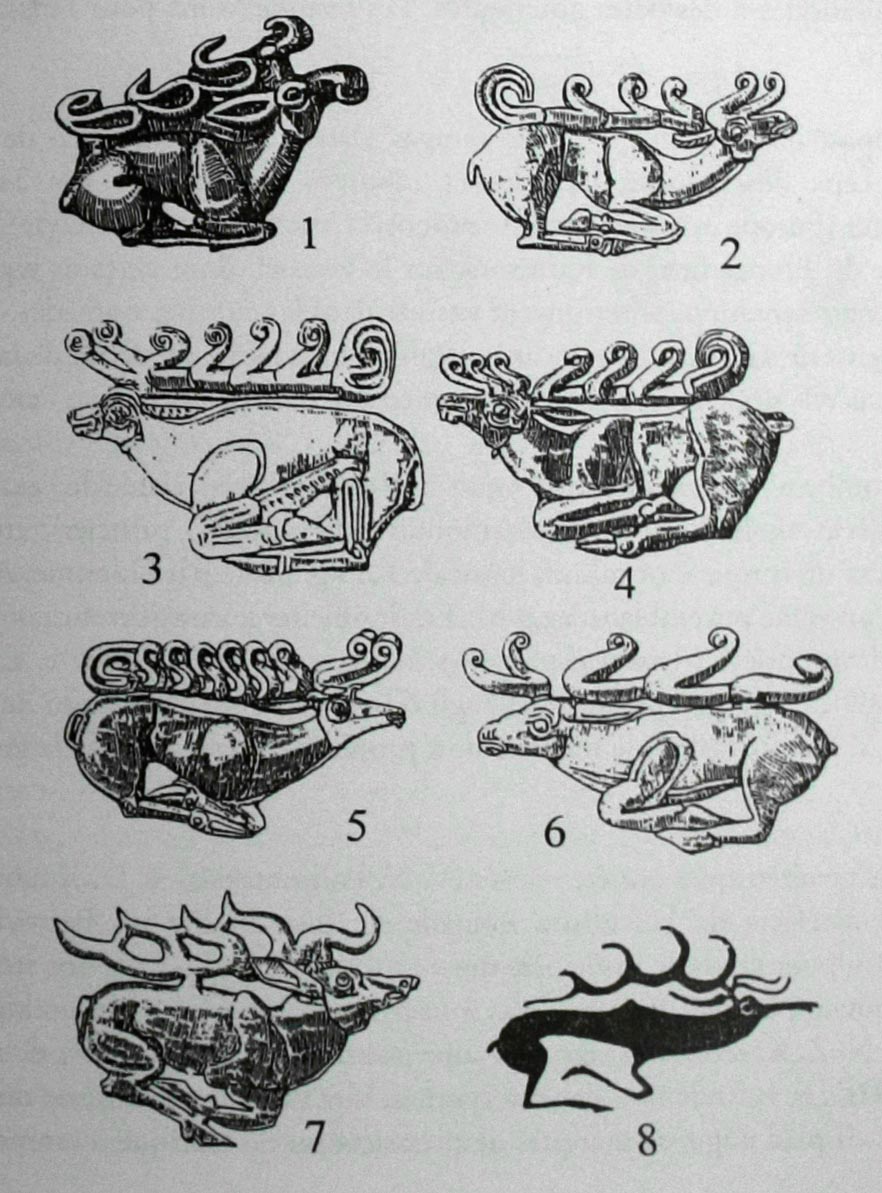 |
| Running deer from: 1-2)The Ukraine, 3-5) Russia, 6) Iran, 7) Kazakhstan, 8) Mongolia. (Lebydynsky, 2011) |
Deer
Early steppe nomads- both Iranian and Altaic- really like deer as art subjects. This wonderful figure from Lebedensky’s Tamga book illustrates the uniformity of just one deer motif. They sculpted, painted, and sewed them standing, lying down, being attacked by predators, with their legs turned 180 degrees (registering that might be hairy, though you could display it that way), and running. In Western (and SCA) heraldry, courant invokes the image of legs extended, but the steppe depiction is the moment in the stride where the legs are tucked under the body.
Griffins
Griffins are of huge importance to Iranian steppe nomads. Unlike later Western griffins, it isn’t simply the back half of a lion glued onto the front half of an eagle with ears. You take something that looks like a lioness (or maneless male lion), add bird wings, a beak, pointy, feathery ears, and a fish-fin type crest running down the length of its neck. If you want to get really fancy, have it vulning (standing on top of and attacking) a deer or ibex. Depending on your culture, the deer’s legs may or may not be twisted 180 degrees from the front of the body.
Camels
Camels were (and are) important to many Altaic nomads. A fairly common theme that you see in nomadic art is two Bactrian camels with fangs standing side-by-side and biting each others' back legs. I seriously doubt that particular pose could be registered, but the “combatant” pose was created with the intention to show animals attacking one another, so try registering that instead (the word may be changed to “respectant” during registration since they’re herbivorous). Alternatively, you could have them standing and facing one another (statant respectant). Then when you display it, shift it to the form more appropriate to your persona.
Monsters
You don’t often see unique chimerical monsters in SCA heraldry, but they do exist and are completely registrable (there are currently 37 registered). You just have to blazon the different parts they’re made of. Some steppe nomads left behind depictions of chimerical monsters. The most common example it to start with either a deer or a horse. Say you have a deer- you can give it a bird beak. You may put stylized griffin heads on the ends of its antler tines. The blazon would read something like "a monster composed of the beak of an eagle and the body of a deer, with antler tines ending in gryphon heads". If you start with a horse instead, you do the same thing while adding deer antlers.
What Not to Have
Once you've come up with a steppe-themed charge, you might find that you want to put a little bit more on your device but don't want the rest of the obviously steppe options. Instead, you might find yourself flipping through the PicDic or medieval armorials for possible charges. What should you avoid if you want it to still make sense for a nomad? Big ships, for one- horse nomads have no reason to go sailing (unless you want to be one of those Iazyges who went to what's now England, or an Alan who crossed Gibraltar to raid with the Goths, but those were one-off trips). That's not to say they didn't fish in rivers or any of the seas in or near the steppes- you can occasionally find a zoomorphic fish- but big whales? No. Pelagic fish? No. Also avoid any objects which postdate your particular culture or that they never would have encountered. Maunches, for example- the angel-armed sleeves- are not from a time or place in which they could be encountered by a Saka. Farming implements (aside from some involved in animal husbandry) would also be uncharacteristic. If your persona didn't have a written language, books and quill pens wouldn't make much sense. Unless you have evidence that a steppe nomad encountered tales or depictions of New World fauna, it would be best to avoid them considering how temporally and geographically restricted knowledge of them was in SCA period. These are just a few examples. Basically, just do your homework and use your best judgement when picking charges not specific to steppe nomads. :)Early steppe nomads- both Iranian and Altaic- really like deer as art subjects. This wonderful figure from Lebedensky’s Tamga book illustrates the uniformity of just one deer motif. They sculpted, painted, and sewed them standing, lying down, being attacked by predators, with their legs turned 180 degrees (registering that might be hairy, though you could display it that way), and running. In Western (and SCA) heraldry, courant invokes the image of legs extended, but the steppe depiction is the moment in the stride where the legs are tucked under the body.
Griffins
Griffins are of huge importance to Iranian steppe nomads. Unlike later Western griffins, it isn’t simply the back half of a lion glued onto the front half of an eagle with ears. You take something that looks like a lioness (or maneless male lion), add bird wings, a beak, pointy, feathery ears, and a fish-fin type crest running down the length of its neck. If you want to get really fancy, have it vulning (standing on top of and attacking) a deer or ibex. Depending on your culture, the deer’s legs may or may not be twisted 180 degrees from the front of the body.
Camels
 |
| Phalera with two Bactrian camels. Bronze, Filippovka, 4th cent. BC. (The Golden Deer of Eurasia) They have pompadour mullets! |
Monsters
You don’t often see unique chimerical monsters in SCA heraldry, but they do exist and are completely registrable (there are currently 37 registered). You just have to blazon the different parts they’re made of. Some steppe nomads left behind depictions of chimerical monsters. The most common example it to start with either a deer or a horse. Say you have a deer- you can give it a bird beak. You may put stylized griffin heads on the ends of its antler tines. The blazon would read something like "a monster composed of the beak of an eagle and the body of a deer, with antler tines ending in gryphon heads". If you start with a horse instead, you do the same thing while adding deer antlers.
 |
| In steppe terms, this is a lion-headed, goat-horned gryphon (with front leg proportions more akin to a goat, but still ending in paws). Because of the difference between medieval gryphons and early steppe gryphons, this chimaera would be better blazoned as "a bird-winged monster composed of an ounce's head, paws, hindquarters, and tail, a goat's horns, ears, and forequarters, and a dragon's neck" if you want to register something like this in the SCA. It could be taken to be couchant (lying down) or sejant erect (sitting, but with front legs raise), but make it more obviously one or the other for registration purposes. It's wings are addorsed and inverted if you want to blazon that detail. Remember that steppe art involves squishing and stretching things to fit the space. From a scabbard made by a Greek with Scythian designs and for a Scythian. Gold, PLACE, TIME. (From the Lands of the Scythians) |
One Final Note
Keep in mind with all of these that if a steppe nomad motif looks much different from the Western standard, there is the risk of it not being registered if submitted as such. I’m not saying it couldn’t, but keep in mind that typical SCA heralds have to be able to blazon it consistently. Stylized zoomorphic art has been registered in the past, but so far as I know it isn't anymore, so definitely avoid that aspect when drawing for submission. When it comes time to display your armory, though, show everyone your steppe persona!
From the Lands of the Scythians: Ancient Treasures from the Museums of the USSR, 3000 BC-100BC, Metropolitan Museum of Art Bulletin, Vol 32, no. 5, 1975.
The Golden Deer of Eurasia: Scythian and Sarmatian Treasures from the Russian Steppes, The Metropolitan Museum of Art, 2000.
Brzezinski, R, and Mielczarek, M, 2002, Men-at-Arms: The Sarmatians 600BC-450AD, Osprey publishing.
Andrews, P, 1999, Felt Tents and Pavilions, Melisende UK Ltd.
Lebydynsky, I, 2011, Les Tamgas: Une "Héraldique" de la Steppe, éditions errance.
Subscribe to:
Posts (Atom)