Sunday, November 27, 2011

Charge Groups

To write a post on conflict-checking, I must first address charge groups. A charge group is simply a group of charges in similar locations and of similar visual weight on a device or badge. There are several different types of charge groups. All but one must lie in the central region of the shield.
Primary: The primary charge group is the most central thing in your armory.
Secondary: The secondary charge group is an accessory lying around the primary charge group.
Tertiary: The tertiary charge group lies completely on top of another charge or charge group.
Peripheral: The peripheral charge group is located on the edges of the field.
Overall: The overall charge group lies partially on another charge or charge group and partially on the field.
If lists of definitions aren't your thing, you can use this handy flow chart I made:


And here are some examples drawn at random from the Calontir populace armorial:
NOTE: If you can't see these pictures on your computer, use Ctrl+F to look up the names here: http://armorial.calontir.org/Pages/populace.htm I'll try to figure out what's going on and fix it later today.
Amelyn Pope: The axes are primaries because they are central to the design and lie completely on the field. The cauldrons are a tertiary charge group because they lie completely on top of the axes.

Jane Corwin: The triskelion of legs is the primary charge because it is central and carries the most visual weight. The bezants (yellow circles) are the secondary charge group because they lie around the primary charge and carry less visual weight.
Titus Decimius Alexander: The skull is the primary charge because it is central in the design. The embattled bordure is the a peripheral charge because it lies on the edge of the design.
Wolfger zum Grifen: The gryphon carries the most visual weight, but it doesn't lie completely on the field, so it can't be the primary charge. The pall it lies on top of is the primary charge. The gryphon is in an overall charge group.

Monday, November 7, 2011

My name passed! My device didn't.

Just a quick update to say that my name has passed, so Aritê gunê Akasa is official now! Yay! My device, however, did not. It was not due to any mistakes in the blazon or emblazon; it was due to conflict which shouldn't really be a conflict.
A weird thing about rule sets is that they can be fantastic and thorough but the way they interact, occasionally things that should work don't. My submitted device unfortunately conflicted with something that it would not visually conflict with, which is what the rules are set up to avoid. The color scheme for my device and the registered badge are the same. I have ordinaries in point, the already-registered device has ordinaries in fess. This arrangement, while blazoned in SCA heraldry, is not always done in period heraldry and can be displayed either way when a specific arrangement is not given, so no CDs there. Both armorial pieces have an overall charge. My charge is animate, the registered one is inanimate. This means that even though I get a CD for a change in the type of overall charge, I don't get a CD for attitude because the animate charge can't be in the inanimate charge's attitude and vice-versa. 
A commenter on Oscar had mentioned trying to get a LoPtC, or Letter of Permission to Conflict (though now I'm not so sure that actually happened), but either the people could not be reached or did not want to give it. The registered badge is actually for a baronial order, so if it was the case that they didn't want to give a letter, I can't fault them for that decision.
I'm not angry or anything; it's just one of those unfortunate rare cases. Now I just need to figure out how I want to alter my device to get one more CD.
In the SCA, a common way to do this is to add something like a bordure, orle, or chief. I don't really want to do that... Making my overall charge face the opposite direction might work, but I'm not left-handed, which is the medieval reason for making something face to sinister. I could flip my ordinares so they point the other way, but I don't like the way that looks. Perhaps I could change the number of ordinaries?
On the plus side, it was pointed out to me by HL Caoimhin McKee that my ordinaries would be closer together in period than I drew them, so it's a chance for me to make my device more period. It's also an opportunity for me to fix the animal's tail...I'm probably the only one who cares, but I made it look like a closely-related animal's tail rather than the blazoned animal. And to use different line weights on the animal, since I didn't think of that before submitting it.

EDIT: I've come up with the new design! I'll be handing the paperwork off to the Shire herald on Sunday. And I actually like it more with these modifications.  Now that I know how to conflict check (hm...I should post about this), I did that and nothing came up. I'd also be the first person in the SCA to have a particular motif on my armory, so I'm printing off the appropriate bits from the period roll of arms I found it on. I should do a post on how to design a device too...

Wednesday, October 19, 2011

Can I Register a Tamga in the SCA?

This is part one of the post I've been promising since this summer. It's ended up being very long, so I've split it into three parts. The second part is where you'll actually be able to see all the tamga that have been found, where, when, and which tribes were using them. In the third, I'll post a list I've compiled of the elements used to construct them.
 
Sarmatians had symbols called tamga* which were used by some Sarmatians in the same way badges are used in the SCA.* They have been found scratched in stone, as openwork designs in belt buckles, on leather straps, spearheads, the backs of bronze mirrors, and elsewhere. They represented a person (or group of people) and his/her/their possessions and are in line with the representation of "me" and "mine" that Western heraldry has. Great! You're a Sarmatian and you can register Sarmatian heraldry! Woot!

...It's not quite that simple, unfortunately...

  SCA heraldry is based on middle and late period Anglo-Norman styles. This is great for Western European personas and for the sake of standardization, but it's much harder to register something which does not follow those rules. The end-all deciding factor on whether a non-Western European piece of armoury can be registered or not is this- "Can it be blazoned in a way a Western European would understand?" The idea behind this is that the SCA was founded on Western European ideals. Other cultures are treated as though they were visiting that region.

  This has created problems in the past in terms of perfectly period things being registered: The Japanese have their own style of heraldry called "mon" which function as family crests. There is a comma-shaped charge called a tomoe. They're a fantastic choice for someone with a Japanese persona....until they go to register it. By precedent, they cannot be registered in the SCA because if a visiting Japanese person went to register their arms with a Western group, without every single herald being handed a picture and told that "this is a tomoe", you can't hand the blazon to any herald and expect them to be able to emblazon it.
  Now, that doesn't mean a SCAdian with a Japanese persona can't use tomoe in their heraldry- it means they can't register it. Registering is done to prevent conflict. It means that someone can't come along and say "I like your device. I'm going to use it as mine too!" (or accidentally come up with the same/similar design). If someone sees your device on the field, they know it's you and not someone else. But when registering a perfectly period device is not possible because of the way the rules are set up, not registering it and trusting in others to play nicely is the way to go. One could set up their own heraldic jurisdiction to regulate mon, but it wouldn't have official power in the SCA, so all comers would, again, be trusted to play nicely on an honor system (and it would be up to them whether to even take part). Honor systems are more likely to work in the SCA than out of it (courtesy and medieval chivalry and all that); you're more likely to be "copied" by accident than on purpose.

  So what about tamgas? Well...they, quite frankly, would look nothing like anything to a Western herald. They're doodles of geometric shapes. It's all lines, so any closed shapes are automatically voided (Think of fill vs. border when making a circle in Photoshop or Illustrator. Tamgas are never filled.). Some of them are the same as something seen in western heraldry (voided triangles, for example). Others sort of look like something seen in western heraldry (there's one shape which requires no stretch of the imagination to see a stylized water bouget). Others...you would have to know the history of that particular pictograph (like one which represents an Iranian rooster). And occasionally you run into one that looks like someone who was really drunk just made a squiggle; those should probably be discounted for use in the SCA (how would you conflict check a squiggle?).
  So, like Japanese mons, your options are three-fold: 1) Forget about doing [your] period heraldry and just go with standard SCA heraldry; 2) Design a tamga for yourself and never try to register it (perfectly reasonable); or 3) Try to make one which could be registrable under certain circumstances and see what happens.

I'm going with option 3.

  Now, my main arms are standard SCA-type heraldry (Argent, three piles inverted in point throughout azure and overall a raven striking sable wings elevated and addorsed.). Sarmatians are not my only love in the SCA; I love Western heraldry and wanted my own arms. But for a badge- which is how Sarmatian tamgas were used for most of their history- I'm trying to register a tamga.
So now that you've decided to try to register a tamga- what do you do? Well, for starters, document, document, document. I've included all the tamga documentation I've found in this post, so look at the designs and read the references. For most tamgas, you're going to be invoking the Regional Heraldic Style rule: if it was used for your persona, you can ignore the Western rule that says you can't do it.
  I've presented the potential problems you may run into in two ways: first as a discourse, and some again as a potential conversation between submitter and herald. Read whichever you prefer (or both).

Discourse-
Recognizability from a distance- Western heraldry is meant to recognizable from a distance on the battlefield. Objects are thick instead of being thin lines. Tamgas are typically recorded as thin lines. I'd suggest  thickening the lines for registration, then you can display it as thin lines if you so wish.
Slot machine heraldry- Most tamgas are made of three different elements. "Slot machine heraldry" is a term for having three different coprimary charges (i.e., a flower, a star, and a wolf; not as in three flowers). There are no period examples of this in Western heraldry, so it is not allowed.
Period charges- Some tamga element could look like something known to Westerners, but not known to have been used in heraldry. It doesn't mean you can't use it, just that it's a "Step From Period Practice", or SFPP. Two SFPPs in the same device/badge means it's unregisterable, so limit yourself to one weird element if you don't want to risk running afoul of this.
Fieldless charges- Western devices are [mostly] objects on a background color. You wouldn't take a gold lion and put it on a red background in one place, then a purple background in another and say they represent the same person. Badges, on the other hand, can be fieldless (the symbol represents you regardless of the color fabric (or other thing) you end up sticking it on. Tamgas are fieldless, which is fine except that SCA fieldless designs must have all objects conjoined in some way. Most tamgas are like this, but some are elements in proximity, but not connected to, one another.
Tincture- Tamgas don't have tincture. They're just lines and could be any color, or be gouged out of some hard surface instead of painted or whatnot. SCA heraldry requires tincture except in certain cases (See "tinctureless" devices like the laurel wreath. They exist because the symbols themselves are very important.) I don't know of any non-important SCA-wide armorial elements considered to be tinctureless, so pick a color for your tamga to have. There's a limited number of badges you can have (four, I think), so you won't be able to grab up every color possible for that device. It's a  problem we have to live with.
And the doozy...
Armorial identifiability- A design has to be recognizable in two ways: 1) If I show you the blazon, you can draw the same emblazon that I have in my head, and 2) If I show you my emblazon, you can write the same blazon as me. Tamgas run into problems here because that won't always work with a Western herald.

Some examples of what could happen in the submission process:
It works easily from blazon to emblazon (also addresses line thickness)-
Sarmatian: I want a circle (not filled in) and an upside-down 'V' shape attached to its bottom.
Western herald: Like this?
Sarmatian: Yes. The lines are all thicker than what I had in mind, but that's the right shape.
Western herald: It needs to be considered visible from afar, so we'll register it with thick lines and you can display it with thinner lines.
Sarmatian: Okay, works for me.
It works easily from emblazon to blazon (also addresses colors)-
Sarmatian: Can you blazon this for me?

Western herald: That would be "An annulet and a chevron couped conjoined in pale." What colors were you thinking about?
Sarmatian: Oh, no colors. It's just lines.
Western herald: Well, we can make it fieldless so you don't need to have a background to your shape, but the lines themselves need to be a specific color.
Sarmatian: Okay, then I'll register one badge of each of the colors.
Western herald: There's actually a limit on how many pieces of armory one person can have. {Something in my memory says four badges, but I'm not certain and can't find it.}
Sarmatian: Hm...Well, let's go with one badge in a light color and another in a dark color. How about white and black? {This is so the symbol can be put on an object of any color and still be in good contrast if you so wish.}
Western herald: That would be argent and sable.
Sarmatian: Oh, and blue is my favorite color. It's in my Western device. Let's do that too.
Western herald: Another in azure, got it.
Not-so recognizable elements- 
Sarmatian: I want to register this.
Western herald: The square works, but what is that?
Sarmatian: It's a pictographic representation of an Iranian rooster.
Western herald: ...I'm having trouble seeing that. Do you have documentation for it?
Sarmatian: Yep, it's right here in this journal article.
Western herald: Okay, I see it, but I don't think we can register it looking like that.
Sarmatian: Why not?
Western herald: If I told another herald to draw a rooster on top of a square, they'd draw an actual rooster. It needs to be consistently emblazonable.
Sarmatian: Hm... I see your point. What if I submit it as an actual rooster and display it as the stylized element?
Western herald: That might work. Let's try it.

Slot machine heraldry-
Sarmatian: I want to register this- its "A chevron inverted couped, a triangle voided, and a crescent inverted all conjoined in pale."
Western herald: That's an insta-boing for slot machine heraldry.
Sarmatian: But it's period for my persona.
Western herald: Okay, then document it and let's see if you can get a regional exception.
Unconjoined elements-
Sarmatian: How about this? (Fieldless) A crescent and a fess couped, both in pale sable.
Western herald: If the badge is fieldless, the elements need to be conjoined. Either conjoin them or give yourself a tinctured field.
Sarmatian: Mm... I don't really want a tinctured field. It doesn't work with tamgas. I've got this documentation showing unconjoined tamga elements.
Western herald: Include it and we'll see if it passes.

  Please keep in mind that these are only conceivable ways to work around the Rules for Submission to register your period tamga. Even if you can get a regional exception for something, I don't know about multiple exceptions on the same device. Another possibility- the regional exceptions would only count for the stylized design, not the Westernized emblazon, but the stylized design itself isn't registrable, which means the variety of registrable tamgas would be very small and not at all representative.

  I'm submitting one myself once my current device submission goes through. If I'm remembering correctly, you need to register a device before you can register a badge. I'm hoping I won't need to resubmit. Commentary only gave one reason to- a conflict with a device that doesn't look like it, but because of the way the rules work, counts as conflicting. If they got a letter of permission to conflict, it can be passed (here's hoping!).
The tamga I'll be submitting is purposefully designed to address several potential problems so I can generate discussion addressing each of them. It will contain some easily recognizable elements and one that will require documentation to be blazonable (which I will be providing for the heralds). I'll be including both the tamga design and an unstylized version of the blazon. It would be great if the tamga itself were registrable.....but I very seriously doubt it is. It has three different elements, so we'll see if I get a regional exception for slot machine heraldry. I did make a conjoined tamga since those are the most common, which means someone else will need to attempt the unconjoined type.
  On top of all this, I'm including extensive documentation on what tamga are, what purpose they served, and why they are period for me (Which means you won't need to send in quite so much if you try to register one after me[assuming it passes, of course].). I'm crossing my fingers. We'll find out about half a year from now (the submissions process takes a while...).

EDIT: There are new Rules of Submission so very close to being put into play. The new rules are friendlier to non-Anglo-Norman heraldry and require that the submission look like it would have in period. This means no drawing a Western emblazon to pass a tamga (yay!!!). So just draw your tamga like a Sarmatian (or other steppe or Turkic persona) would. But still make sure to include documentation for all the standard SCA heraldry rules it violates. I'm not sure what this means for registrability, though... Unless the College is willing to register a blazon like "a tamga composed of...." it might not be possible to register tamga now. We shall see (whenever I get around to finishing translating Lebydnsky). If not, display them anyway. They're your period. Being standard SCA period is far less important than being true to your own if you're that into your persona.

*--Sarmatians were not the only ones with tamga; they're widespread among Asiatic nomads are adopted by some other groups after the fact. Different cultures have different flavors of tamga, however. I only describe Sarmatian tamga here.
*--Sometimes you will find texts which say tamgas were ancient mystical and occult symbols. Saying something is mystical in archeology or anthropology might be true, but other times it's a copout for "I have no clue why it exists." (Paleontology and biology experience a similar phenomenon, but for us, saying a feature was/is for display is the copout. Again, sometimes right or likely, sometimes not.) The texts saying tamgas are mystical are older.  I'm inclined to think they're also outdated.


Brzezinski, R., and Mielczarek, M., 2002, Men-at-Arms: The Sarmatians 600BC-450AD, Osprey publishing.
Nickle, H., 1973, Tamgas and Runes: Magic numbers and magic symbols, Metropolitan Museum Journal, vol. 8, pp. 165-173.
Sulimirski, T., 1970,  The Sarmatians, vol. 73 of Ancient Peoples and Places, Praeger Publishers, Inc.
ТАМГА (к функции знака), В.С. Ольховский (Историко-археологический альманах, No 7, Армавир, 2001, стр. 75-86)

Friday, October 14, 2011

Kurtas

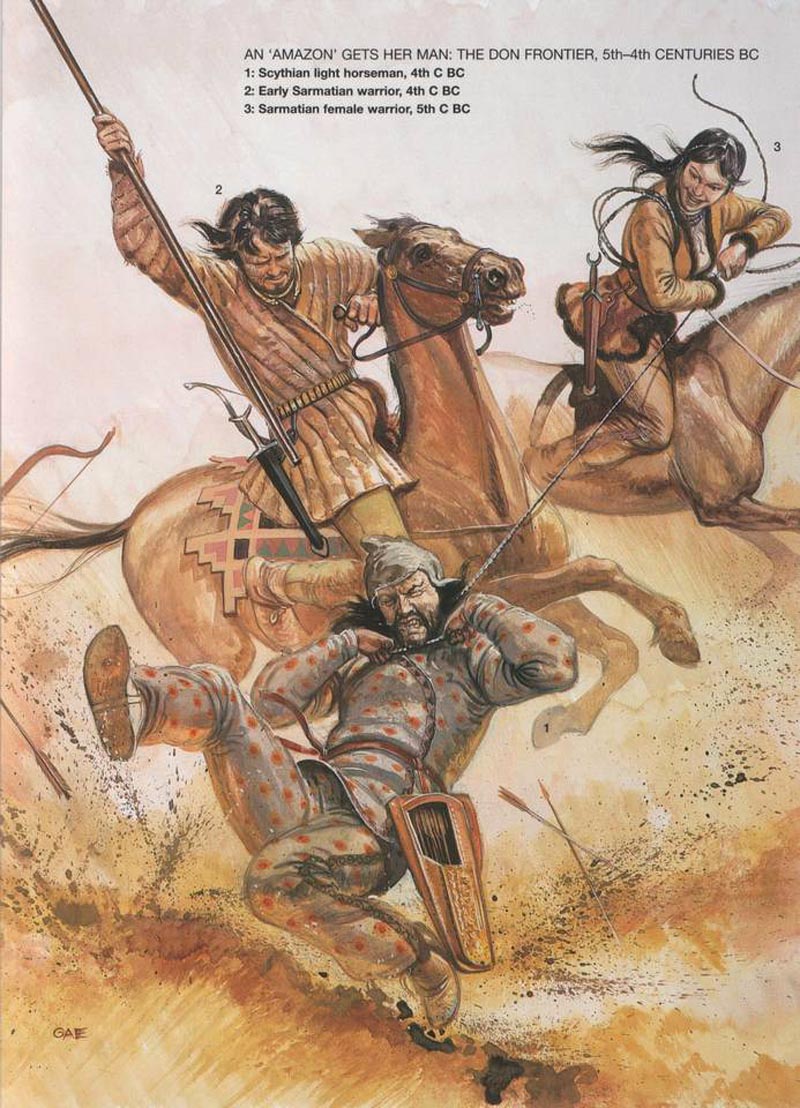
  Sarmatians are usually pictured with a type of jacket called a kurta over their tunics. Kurtas are a type of kaftan, which are worn in various forms by Asian peoples such as Mongols and Indians. Picture a T-tunic in which the front is made of two triangular flaps which cross one over the other and you'll have the general appearance of a kurta (for Sarmatians, it seems the right flap goes on top). The Sarmatians cut them off at mid-thigh and they could have slits up the sides. This kept them from bunching up and pulling or whatnot while riding a horse. Some sort of trim could be included.
The man on the horse is wearing a quilted kurta. The one being attacked is a Scythian. I'm not sure what the woman's jacket was based on.
Wrist straps
  The ends of the sleeves could be longer than the wrist (though they weren't all this way). The reason for this was to create a hand flap which functioned as a sort of glove when the temperature was cold. If you don't want the glove, you pull the end back over your wrist. There's an image of Scythian men with this same modification and they have straps hanging down which would have been sewn to the inside of the sleeve. I'm guessing the straps were used to tie the hand flap closed. In the image, they had the flaps folded back over their wrists and let the ties hang. It looks like the ties end in a big triangular shape.
A pot made by Greeks. They seemed to have made a lot of things depicting the Scythians for the Scythians
  The fronts of these Scythian jackets look a little different from Sarmatian kurtas, though- this particular style has two slits in front- one over the mid thigh and one over the inner-thigh. I haven't seen this in any Sarmatian kurtas.
Scythian kurta with multiple slits
A polka-dotted Scythian
  Sarmatian kurtas could be made out of leather (deer is common) or cotton (which can be quilted). They could also be lined in fur (squirrel seems to be common). Cotton might seem out of time for those of you who have Western personas, but it was around and used for clothing in the East long before it showed up in the West. They could be decorated with floral or geometric designs. Little gold plaques which would have been sewn on are commonly found in kurgans. Fabric paint is another option which is known to have been used by Scythians (One known paint pattern- polka dots. C'est amusant.). There's a leather saddle with felt appliques preserved, so it seems like a logical inference to say leather kurtas could too, but I haven't seen any examples illustrating this. You have the option to include it if you lean heavily towards the "creative" side of the SCA, but unless I find evidence of it, I don't really feel comfortable including them on mine. For the most part, though, Sarmatian kurtas seem relatively unadorned in comparison with Scythian ones.
  Most of the documentation you find will be in images of the Sarmatians created by other people. We actually did get very lucky, though, in that a child's kurta was preserved in a Siberian kurgan, which is now housed in the State Hermitage Museum in St. Petersburg, Russian.
Child's Fur Coat
Fur; l. 35 cm
Tashtyk Culture. 3rd - 4th century
Oglakhty Burial VI, Grave No. 4 (Excavations of Prof. L.R. Kyzlasov), South Siberia, Khakassia Republic, left bank of the River Yenisei, near Mount Oglakhty, Russia
Source of Entry:   Archaeological Expedition to Khakassia of the Moscow State University. 1969

  I just made my first kurta in time to wear at the St. Denys' Day event. I wanted to go the leather route, but unless I had gotten lucky and found enough for sale at an event, my cheapest option was to invoke the unwritten "Ten Foot Rule" (if it looks genuine from ten feet, it's acceptable [unless on enchanted grounds]). Which means that this financially-limited student used tan moleskin from Joanne's Fabrics to imitate deer leather.
  I did some things wrongly because my measurements turned out to be wrong- the jacket doesn't go past my hips, for one- but given that I'm a novice seamstress making my first kurta, I wasn't expecting perfection (another reason I used cheaper fabric). From a lot of the depictions, it seems like they didn't have inserts (gores and gussets), but I didn't trust my patterning skills (or lack thereof) to make one without gussets in which I my arms would still have full mobility, so I included them. But then I more closely examined the child's coat above, and it looks to have gores that go all the way from hem to armpit sewn next to roughly rectangular front pieces. The shape modifications around the arm-body seam look similar to those in the above depiction of Scythian men. I'll try this solution in my next run and see how that goes.
  Because I used woven fabric instead of leather, I had to hem all ends that weren't cut on the bias, though the child's coat didn't have them except maybe on the ends of the sleeves (one side looks like it was hemmed but the other doesn't; not entirely sure what's going on there). Other options I chose were: side slits, no hand flaps, and no decorations
  Below are results of the pattern I actually used. Once I make another, I'll do a second post about the modified pattern. Don't make your own with this pattern, it's only here for future reference so you can see the differences from it and from a standard T-tunic build. There are so many things wrong with it...


Finished product

Waaaaay too short

*--Unless otherwise specified, pictures of artifacts all come from "From the Lands of the Scythians"

From The Land of the Scythians: Ancient Treasures from the Museums of the U.S.S.R., 3000 B.C. - 100 B.C. (Metropolitan Museum of Art Bulletin, Volume XXXII, Number 5, 1975)
Brzezinski, R., and Mielczarek, M., 2002, Men-at-Arms: The Sarmatians 600BC-450AD, Osprey publishing.

Sulimirski, T., 1970,  The Sarmatians, vol. 73 of Ancient Peoples and Places, Praeger Publishers, Inc.

Sunday, September 11, 2011

Literature review: Sulimirski's "The Sarmatians", with some notes on research style

   In 1970, T. Sulimirski published a book called The Sarmatians. This was the first time anyone had tried to collect what was known about the Sarmatians into one place. It was a fantastic achievement combining ancient texts, archeological data, and the knowledge of cultural anthropologists, resulting in a volume filled with a wealth of information.
   This book is a fantastic resource for finding out about grave goods and burial styles at different places and times. A large portion of the book is devoted to this given that they're a major source of information on the Sarmatians. It has some wonderful plates of various goods which someone in the SCA could find quite handy
Another thing prominent in this book is following the various Sarmatian tribes geographically and politically. He records where you could find each of the major tribes throughout the course of their history, why they moved, how they interacted with their neighbors, and when they eventually left or were absorbed into the cultures they were living among. To this end, his most famous figure is a diagram of tribe location and activity through time and space. It's kind of hard to read, but I've included it below for your perusal.

   Like any academic subject, knowledge about the Sarmatians changes over time, and over 40 years have passed since he wrote his book. This means that some of the information found therein is flat out wrong. That doesn't mean Sulimirski did a poor job (it was quite the contrary, actually)- he was working with the information available at the time.

   When I'm researching a new subject, I like to do it one of two ways: 1) Read literature reviews (like Sulimirski) first, and 2) read older papers before newer papers. This does several things. Reading the general syntheses before the specific papers gives me an overall sense of the subject. I can quickly get the gist of the subject as a whole and decide which to study in more detail first rather than wading through specific article after specific article feeling like my knowledge base is growing very slowly.
   Reading older papers first has a pro and a con- The con is that I will have wrong ideas at the start simply because of the nature of the thing. The pro is that I get a better sense of the history of the subject in addition to the subject itself (i.e., how ideas have changed over time, why, who was resistant to things commonly accepted, who drove the new paradigms...). I'm not going to talk shop with people until I've caught up to modern day literature or give any workshops or talks at events (Except for the Alans in Gaul lecture at St. Denys' Day because of the timing. I am going to skip forward in the literature in this instance so I don't say anything wrong.), but I feel like understanding the history behind it gives you a better grasp of it.
   I didn't say it in these exact words before- but you're learning the same way by proxy. If anything I say conflicts between posts, assume the newer one is right.

   I don't know enough yet to list off which information in the book has been overturned, but I can tell you one thing which is wrong- the idea that Eurasians had a matriarchal society in the Stone Age. This comes up because Sarmatian women (early on, at least), are sometimes found buried with weapons. The extrapolation from this is that Sarmatians maintained the matriarchal influence for longer than other cultures.
...The problem is that the whole"prehistoric matriarchal societies which became corrupted into a patriarchal one" is based on conjecture and feminism, not fact. Many people don't think to look into the idea's origins- especially when it sounds like the way they want the world to be. Modern scholars don't accept it. There might be a few hangers-ons (I don't know; in general, I don't read cultural anthropology journals), but that doesn't make it a viable hypothesis (There are a few paleontologists who refuse to accept that birds are dinosaurs despite the overwhelming evidence. We call them the Flat Earth Society.).
I get the impression that Sulimirski either accepted it or was open to the idea of it being correct. Sarmatian women did have more freedom than the Greeks, who told us about the Sarmatians and other cultures in their world; but the Greeks were strongly patriarchal, so any deviation from that in one of the barbaric societies (barbarian meaning "not Greek") was astonishing and disgusting to them, and therefore worth noting because, in their eyes, it made them look more civilized than those crazy people that let their women do what they want. Even women in the Middle East used to have more freedom (this was mentioned in the "SCA Silk Road Persona" panel I went to at Dragon*Con this past weekend). A shift from more egalitarian to patriarchal, rather than matriarchal to patriarchal, is all that's needed to explain it. Assuming an extreme is unnecessary when a simpler explanation will suffice.
   On the other end of things, Sulimirski does acknowledge that  just because you find a bow and arrows in a female grave doesn't mean she spent her entire life as a warrior. She could have been a hunter while the men were away on a raid or at war.

   All this being said, I still recommend this book to anyone interested in a Sarmatian persona. Even if some of the cultural anthropology is incorrect, there is still good information on what sort of artifacts you find among different tribes, time, and places. I've gotten several project ideas after reading this book and found several more lines of research to pursue.

Sulimirski, T., 1970,  The Sarmatians, vol. 73 of Ancient Peoples and Places, Praeger Publishers, Inc.

Wednesday, September 7, 2011

Updates on old posts

I've been reading through T. Sulimirski's The Sarmatians, which was the first instance of current Sarmatian research being gathered into one place. I found a handful of new Sarmatian names in it which I have added to the Personal Names post:
Abeacus
Amage (old name, new instance at a later time?)
Eunones
Galatus
Sauromates
Spaldines
Tasius
Zosines
In looking for more information on these people, I ran across catalogues of coins minted in Bosporus which bore Bosporan kings of Sarmatian descent with Iranian (Sarmatian) names, which gave me even more names to include:
Asander
Aspurgus (old name, new spelling)
Eupator
Inithimeus
Pharsanzes
Rhadamsades
Rhescuporis, Rheskuporis
Synges
Teiranes
Thothorses, Theothorses

I've also added these references to the reference list.
Additionally, Sulimirski's book is so important that I will be writing a post devoted solely to reviewing it once I finish reading it.

Sulimirski, T., 1970,  The Sarmatians, vol. 73 of Ancient Peoples and Places, Praeger Publishers, Inc.
http://www.wildwinds.com/#
http://www.forumancientcoins.com/ 

Wednesday, August 31, 2011

Shire of Shadowdale Event

Hi everyone!

The hiatus is over, though my posts will only be once or twice a month as I'm currently doing a crap-ton of paleontology research and writing. The Sarmatian post I promised in July is still in the works, I'm just making sure I have all my resources straight before writing it.
For now, though, I would like to announce that the Shire of Shadowdale is having an event this year! It's called St. Denys' Day and will be held on October 8th in Oxford, IA, which is just outside of Iowa City and Coralville. I'm the autocrat for the event, which, in non-SCA terms, means I'm in charge of it. The event website is here: http://www.uiowa.edu/~shadowda/StDenys.html It should be a lot of fun.
St. Denys found his fame in Gaul. Gaul was also home to some of the Alans for a while. I plan on giving a lecture on the Alans in Gaul at the event and will post my materials for it afterwards for those who can't be there.

EDIT: It's looking more and more like I won't be giving the lecture. I've spent the past two weeks doing paleo work, which means I haven't had time to do a lot of research into the Alans and get comfortable with them. The only open spot in the schedule was early in the morning when not many people would be there and my time would be better spent making sure everything is being set up as planned.