Tuesday, June 28, 2011

KWHSS 2011: Chevron and friends

Another class I went to was on the triangular ordinaries and field divisions used in armory- and how we might not know them as well as we think. These shapes are: chevrons, piles, chausés and chapés. I should give some definitions before I plunge into the "period practices" the teacher discovered were actually misconceptions.
 
Chevron: a V-shaped ordinary that, by default, runs between the dexter and sinister edges of the field and points up. The Sewell arms illustrate what is considered a "good" chevron in SCA armory. It runs about half the length of the shield and is what would be considered medium thickness. 
Pile: an elongated triangle ordinary extending from the top of the field almost to the bottom. The corners do not reach the corners of the field. In SCA armory, piles tend to be very thick.
Per chevron: a V-shaped field division dividing the field in half. The corners of the V are typically below the per fess line and the point extends almost to the top.
A pile
Chaussé (or shod): a field division extending from the top corners of the shield to the bottom point.
Chapé (or caped): a field division extending from the per fess line to the center of the top edge.
Inverted: flipped along its horizontal axis
Throughout: runs the entire length of the field

With the modifications of inverted and throughout, the line between one field division/ordinary and another can get pretty blurry. A pile inverted throughout looks a lot like a field divided per chevron throughout looks a lot like  field divided chapé.

Chaussé
Chapé

A recent precedent stated that a chevron must divide the field approximately in half, be approximately half the height of the shield, and that nothing but small charges should be able to fit above the point (or below if inverted). This ruling was made to standardize how people draw them because there was a lot of variation. What the teacher of this class discovered is that variation is period. She found flat chevrons, tall chevrons, thick and thin ones, and sizeable charges above the points (sometimes as extensions of the point itself). Basically...whatever creates a balanced look given the rest of the charges is what was used. English armory tends to have flatter, thicker chevrons than continental armory. So if you have an English persona, it's more period to do that- otherwise, it's more period to follow the recent precedent more closely. Swiss love throughout per chevron divisions and chevrons.
In regards to piles, she found that thick piles are very late period. For the rest of their history, they're thin. They're also rare and mostly found in English armory. None of the rolls she examined contained piles inverted.
If you're German and have a piece of armory exhibiting a triangle pointing up, you probably have your field divided chapé.

KWHSS 2011: Period Armorial Style

I just got back from the Knowne World Heraldic and Scribal Symposium 2011 and it was excellent.I mostly went to heraldry classes, but attended two scribal classes as well. I have a lot of information to relay, so I'll break this into several posts. I'm also only giving a very rough sketch of what the teachers went over. If you get a chance to go to this symposium or these classes elsewhere, I highly encourage it.

The first class was on period armorial style. If you were to take a random roll of arms from period and another from the SCA and put them side by side, there would be a lot of differences in what is and is not common. This comes about because after a millennium of time (give or take a few centuries), people's sense of aesthetics is going to change. 
One of the first examples you learn about as a herald is the sense of balance or symmetry. If I were a medieval person with two animal heads side by side on my device, I would have them both facing the same way- probably to dexter. Your average SCA person is going to think the shield looks more pleasing when the heads are either both facing each other or both facing out. Think of it as cutting and pasting vs. reflecting.
 They liked odd numbers in period. My artist fiancé likes to say that odd numbers (particularly three) have good composition. One, three, and five were all common numbers of charges to have in a single charge group. If on a chief, three was most common. That means that if I have bear heads on a band at the top of my shield, I probably have three of them (all facing the same way).
Semys were pretty common in period. A semy is when you take an object, draw a bunch of them, and scatter them across the shield- usually evenly spaced, but sometimes there was some shifting around the edges to fit things in. Objects at the edge of the shield which would be cut off can either be cut off or removed completely- both happened in period and both have been done in the SCA. Some common semys in period are: billets (rectangles, you don't see this much in the SCA), crusily (a certain type of cross), ermine (the fur group including pean, erminois, and counter-ermine), roundelly (circles), and de lys (fleur-de-lys).
The shifting to fit things in the space given I mentioned was common. They liked to fill space and it's considered good heraldic practice to do so today. If I have three mullets (stars)- two in the top half of my shield and one in bottom, the bottom one might be a bit bigger since it has that entire space to fill. If I have a rampant lion (standing on one hind leg, all other feet in front like it's attacking something) on a pale (a vertical bar down the middle of the shield), I'm going to stretch it so it extends the entire length of the pale. And likewise if it's a passant lion (one front limb up, the rest on the ground as if walking) on a chief, again, I will stretch it so that it extends the length of the chief.
The teacher has a Hungarian persona so we learned about Hungarian armory as well: They didn't use chevrons at all. They liked to put crowns on animals. Crosses were not used as ordinaries. Trimounts (three mountains) with a critter on top were common, often with a blue and green field to make a landscape picture- something you don't see in the Anglo-Norman armory SCA heraldry is based on.

Monday, June 6, 2011

Phrygian caps

A couple days ago, I made my first piece of Sarmatian garb- a Phrygian cap. While the name may be unfamiliar, you've all seen them worn by the members of a certain village of blue people.
The association was ever so lovingly pointed out by my fiancé and his best friend. I don't care if it looks silly; it amuses me and I like it. So there. :P
Phrygian caps have been around a long time and worn by many different peoples. The Phrygians in Anatolia are the namesake of the cap, but it spread to other cultures as well. The Greeks associated it with barbarism- which, in the original sense, means "not Greek" and implies an Eastern influence. Among the Romans, it became a symbol of liberty because freed slaves wore it. This association led to its use by French revolutionaries. Their caps were red and bore rosettes. It has since seen use in American and Latin American symbolism for the same reason, including on the seal of my home state.
Basically, it's a tall cap with an asymmetric, rounded apex, usually made in a material soft enough that it flops over. The apex is very blunt. The pointiest I've seen it is on a bust of Queen Dynamis of Bosporus.
According to Salisbury (2001), the cap is actually her royal headdress. The apex is pointier and curvier than most caps you can find pictured. The stars are something I haven't seen elsewhere. 
It also has a trim. The trim is optional- not all caps had it. Both are options for a Sarmatian persona, as illustrated by Köhler (1871).
Köhler's Sarmatians had floppy hats as opposed to Dynamis', which stands up straight. The Dacians on Trajan's column had Phrygian caps which stood up straighter. Given that Sarmatians were raiders and some were also allied with the Dacians during the Dacian wars, it's not a stretch to assume that Sarmatians could have worn hats that stand up too. By the same token, one could also choose to have the back of the hat extend down to cover the neck like the Scythian pictured in Brezinski and Mielczarek (2002). Ear flaps are another modification that was worn, as seen in a hat from Duro-Europas in what is now Lebanon, though I haven't found a record of them among Sarmatians or their contacts. I could just be missing it, so keep it in mind. A pattern for that hat can be found here.
Whether it's floppy or stands up is probably in part due to the fabric and in part to the cut. Wider fabric up top means the hat is less able to stand on its own (since it isn't given shape by your head that high up). If your hat is thicker leather, felt, or felt-lined, it will be stiffer than if it's only made out of linen, wool, or thinner leather.
Köhler indicated that both male and female Sarmatians wore Phrygian caps. Some classical authors say they would go bare-headed (in Brezinski and Mielczarek [2002]), so if you would feel silly wearing a Smurf hat, your outfit would still be complete without.

I had some cheap felt lying around and decided to try making my hat out of it. It's more suitable for the version that stands up. I also chose to make the kind that doesn't extend over the neck or ears. I cut it bigger than it needed to be so I'd have room to play around, then pinned it in various ways until it held the shape I wanted. Because of the shape and size of my fabric, I had to make it in two pieces (normally it would be in one piece). I stitched the edges together with blanket stitching like the Duro-Europas hat. The apex is more concave than I intended, but I'm otherwise happy with how it turned out. Now that I know what shape and size works for my head, I'll make another later on with nicer fabric and put trim on it. I'll make it taller and less concave in the front as well. I'll probably make a floppy one at some point, too.
You can use the third picture below as a base for your own. The dimensions are 11.5 x 8.5 in.


Brezinski and Mielczarek (2002), Men-at-Arms: The Sarmatians 600BC-450AD, Osprey publishing.
Harris, J, 1981, The Red Cap of Liberty: A Study of Dress Worn by French Revolutionary Partisans 1789-94, Eighteenth-Century Studies 14.3, p. 283-312.
Köhler, 1871, Die Trachten der Völker in Bild und Schnitt.
Salisbury, JE, 2001, Women in the Ancient World.

Sunday, May 29, 2011

List: Personal names

When I was researching names for my persona, Ursula George's page and her associated St. Gabriel Report 3315 were the biggest source (all but two from Zgusta's book). Almost all of the names I've read are listed there, but I've come across a few others and wanted to include them in a list here for anyone looking. I've put everything in alphabetical order based on our alphabet rather than the Greek. Read the original report (or Zgusta) if you want to know what the Greek letters were.

As is said in the report, last names often indicate relation to someone else (husband or father). Males simply use the genitive form of their father's name while females use words meaning "wife of" and "daughter of" in addition to the genitive form of their mother or husband's name.

It's also conceivable that if your persona spent a lot of time or was well known among another culture or tribe, they might be known locatively as "Sarmatian/of the Sarmatians" or "<insert tribe name>/of the <insert tribe name> (The former was indicated in the St. Gabriel's report, the latter is my own assertion. EDIT: I've found uses of "So-and-so of the Alans/of Alania in regards to Alanian women married to Georgian kings, so it's definitely an option for a persona in medieval Alania.). 

The third naming option available to much of the SCA is a descriptive last name (job, prominent physical attribute, etc...). I haven't found any precedent for this specifically among Sarmatians, but it's something to think about. EDIT: I've found a use of "the Great" as an epithet for a medieval Alanian king, so that is an option for a medieval Alanian persona (assuming it isn't considered presumptuous).

Most known Sarmatian names were transcribed into Greek (they didn't have a written language of their own), so their naming convention is used. This means they probably aren't exactly the same as what the Sarmatians themselves would have used, but it's what's available to us. Any not recorded in Greek (probably Latin) have an asterisk next to them. Make sure your naming convention for the last name follows the appropriate language or give it in the English form if you aren't sure.

If a name is from a source other than Zgusta, I'll give as much information about it as I can. If you want information on a name from that book (like when the person lived/died) and can't get a copy of it, contact me and I'll check it out from the library as soon as possible. I really wish I could find a copy for sale...

Along with the names themselves, I've listed genitive forms in order to help you with the last name. This list will be updated as I find genitive forms for all the endings. Anyone knowledgeable about Ancient Greek genitives?

Another thing I should note is the intermarriage of Georgians and Alanians in medieval Alania. I've included some names you can find as belonging to Alanians here- only those which cannot trace their male lineage to a source other than the Alans. I haven't included any which are blatantly biblical as opposed to ethnic Alanian (as in Mary of Alania and David Soslan). These seem to pop up when the paternal line is traced back to a male Georgian. I also did not include David's descendants, At'on and Jadaron  of the Osi, or his father, Demetrius, because of their patrilineal origin.  Although they lived among the Ossetians, but I don't know if their names are Ossetian. The names in this paragraph are a viable option for a persona of mixed heritage, the list below is intended for someone who wants to be sure their name is Sarmatian in origin.

Greek genitives
Name endings (original ending first, genitive form second)
-a: 
-as: -a 
-ê: 
-ês:
-is: -ios
-ôn: ônos
-os:  -ou
-us: 

Of the Sarmatians
Male- Saurmatês
Female- Sauromatis

Female-specific
gunê: "wife of"; precedes husband's name
thugatêr: "daughter of"; precedes father's name

Personal names
Female

*Ababa: Recorded by Jordanes. Possibly the Alanic mother of Maximinus Thrax (he was born 172 or 173). His Gothic heritage is disputed (Jordanes thinks the Goths and Getae are the same people and Maximinus was more likely from Thrace). I haven’t found anymore information regarding this name. I’m not sure Jordanes’ information would be considered reliable documentation for passing the name.
*Alda, Alde, Aldi: Recorded by John Skylitzes. Early 11th-century Alanian princess, wife of a Georgian king. Definitely alive from 1027-1033. Info in Alemany (2000) and Tourmanoff (1976).
Amagê: A Sarmatian Queen near the Black Sea in the 4th century BC. Recorded by Polyaenus. Info in Harmatta (1970). Sulimirski records a Queen Amage of the Roxolani in 165-140 BC. I need to get a copy of Harmatta to look into this temporal disparity because he was definitely talking about the same person.
Aritê
*Borena: Alanian princess, wife of a Georgian king.  Definitely alive from 1030-1072. Info in Garland (2006).
*Burdukhan: Alanian mother of Tamar of Georgia. Late 10th century, definitely alive in 1160. Info in Eastmond (1998).

Leimeiê
Mada
Maiôsara
Sarukê
Storanê
Tamura
Tirgataô: Queen of the Ixomatae in the 4th century BC. Recorded by Polyaenus.
Male

Abaziôn
Abdarakos
*Abeacus: In Sulimirski. King of the Siraces in the Kuban valley and steppe north of the northwest Caucasus in 66-63 BC.
Aboagos
Abragos
Abrozeos
Adoês
Akasas, Akkas
Aldis
Alexarthos
Amaiakos,Amaeiakos
Amôspados
Andra[n]akos
Aphtheimakos,Aphthaimakos
Apsachos 
Araouê[g]os
Ardagdakos
Ardaros,Ardarakos,Ardariskos
Argamênos
Argouanagos 
Aroasios
Arsaliôn
Arsêouachos,Arsêoachos,Arsêochos
Arttham[ma]nos, Arthiemmanos 
*Asander: From coins Husband of Dynamis. King of Bosporus from 37-17 BC.
Asanos
Asaros
Aspakos
Aspamitharês
Asphôrougos
Aspourgos, *Aspurgus: First spelling from Zgusta, second from coins. Second was King of Bosporus from 8 BC-38 AD.
*Attaces:  King of the Alans in Hispania. Successor of Respendial. Died in 426 AD (Alemany, 2000) or 418 AD (Bury, 1923).
Auasis
Aubadag[-?]
Aunamos
Aurazakos
Azariôn
Azos, Aziagos
Badagos, Badakês, Padagos
Badas
Bagdochos
Bagdosauos
Bagês, Bagios
Baioraspos
Baiormaios
Banas
Bastakas
Baxagos
Bida[k]ês
Bistês
Bôrakos
Boraspos
Bôrnôn
Bôropsazos
Bradakos
Chanakês
Chardeis
Chodainos
Chôdarzos
Chodekios
Chodiakios, Chozi[a]kos
Chodios
Chôdonakos
Chopharnos
Chophrasmos, Chophrazmos
Choroathos, Choroua[thos]
Chouarsazos
Chounaros
Dadagos, Dadakos
Danarasmakos
Dandaxarthos
Didumoxarthos
*Durgolel, Dorgolel: King of medieval Alania in the 11th century. Info in Garland (2006).
Dosumoxarthos
Eisgoudios
Êlmanos
*Eochar: A king of the Alans in 446. May or may not be the same person as Goar. If he isn't a different person, "Eochar" may be an erroneous recording of "Gochar". Info in Alemany (2000).
Êrakas
Eubarnakos
*Eunones: From Sulimirski. King of the Aorsi in the Don-Volga region in 49 AD. Ally of the Romans and of Cotys, the new Bosporan ruler.
*Eupator: Bosporan king on coins from 155-166 AD.
Gadas
Gadikios, Gadikeios
*Galatus:  In Sulimirski. King of the Roxolani in 179 BC

Gaos
Gasteis, Gastein
*Goar, Gochar: A king of the Alans in Gaul. Born before 390 and died sometie between 446 and 450. Info in Alemany (2000).
Gôdigasos
Godosauos
Gôsakos
Gosôn
Iaphagos
Iauakos
Iazad[agos], Iezdagos, Iezdrados
*Ininthimeus: From coins. A king of Bosporus from 235-240 AD.
Insazagos
Iôdas
Iôdesmagos 
Iramboustos
Irauadis
Irbis
Irganos
Kainaxarthos, Kênexarthos
Kamorsazês, Kamarsazês
Karaxstos, Karaxtos, Karastos
Karsas
Karzoazos, Karzouazos
Kasagos, Kasakos
Kasais
Katokas, Kattas, Katiôn
*Khuddan: Alanian king in the 10th century. Info in Eastmond (1998).
Kopharnos
Kossas,Kosous,Kossous,Kousous,Kos[sô]n
[K]ouridatês (-os)
Kouzaios
Madakos, Madôis
Maiakos
Maipharnos
Maisês
Maniagos
Mardauos
Masas
Mastas, Mastous, Mastounos, Mastarous
Mazis, Mazous
Medosaccus: Husband of Amagê. King of Sarmatians near the Black Sea in the 4th century BC. Recorded by Polyaenus.
Megis
Mêthakos, Mêsakos
Meuakos
Mordos
Mourdagos
Nabazos
Namgênos
Namouchos
Nauakos, Nauagos
Oaroz[b]alakos
Ocho[a]rzanês
Olgasus
Omrasmakos
Orsiomichos
Ossi[gas?]os
Ouachôza[k]os, Ochôdiakos, Ochôziakos
Ouag[a]sis
Ouaras
Ouarazakos
Ouarzbalos
Ouastobalos
Ourbazos
Ourgios
Ousigasos, Ousigos
Oustanos
Ouzia[g]os
Oxardôzis
Pagos
Parspanakos
Pateiros
Pateis, Patias
Pêrakos
Phadinamos, Phazinamos
Phadious, Phazious
Phaldaranos
Phandarazos
Pharnagos, Pharnakês, Pharnakiôn
Pharnarnos
Pharnês
Pharnoxarthos
*Pharsanzes: From coins. A king of Bosporus from 253-254 AD.
Phidas,Phidanous,Phêdanakos,Pidos,Pideis,Pidanos
Phleimnagos,Phlimanakos,Leimanos,Limnakos
Phlianos
Phodakos
Phorêranos
Phorgabakos
Phoriauos
Phoros
Phosakos
Phourtas
Pitopharnakês, Pitpharnakês, Phitopar[nakês?]
Pourthaios, Pourthais, Pourthakês
Radamasis
[R]adameistos
Radamophourtos
Radamphôn
Radampsôn, Radanpsôn
Radamsadios, Radamps[adios]
Raodmêos
Rapakês
Rass[o]gos
Rathagôsos
*Respendial: A king of the Alans in Gaul. Birth and death dates unknown, but definitely alive between 406 and 409 AD. Had been succeeded by 426 AD (Alemany, 2000) or 418 AD (Bury, 1923).
*Rhadamsades: From coins. A king of Bosporus from 308-323 AD.
*Rhescuporis: From coins. Several kings of Bosporus bore this name from 68-342 AD.
Sadimanos
Saitapharnês
*Sambida: A king of the Alans in Valentia in 440. Recorded in Chronica Galla of 452.
Sanagos
*Sangiban : Jordanes records this as the name of the king of the Alani at the Battle of the Catalaunian Plains (451 AD).
Sarakos
Saratos
Saraxazos
Sasas, Sasôn
Sattiôn
Sauagaskos, Sauagas
Sauaiôsos
Sauanôn
*Sauromates: Name born by several members of the Sarmato-Thracian Bosporan dynasty, which ruled from about 33BC to the 4th century AD. Coins with busts of Sauromates I were minted sometime from 90-124 AD. Coins with Sauromates II were minted sometime from 174-211 AD.
Seauagos
Seimeikos
Sênêkas
Siauakos
Siauask[is]
Siauos
Siômachos
Siranos
Sôchoubazos
Sorchakos
Sozirsauos
Sp[a]kos
Spadakos
*Spaldines: From Sulimirski. A king of the Aorsi in 64 BC. Raised an army of 200,000 horsemen to fight in the Bosporan Kingdom's civil war.
Sparophotos
Spharobais
Spithamês
Stormais
Stosarakos
Sturanos
Suarobais
*Synges: From coins. A king of Bosporus from 258-276 AD.
*Tasius: In Sulimirski. King of the Roxolani in 110 BC.
*Teiranes: From coins. A king of Bosporus from 275-279 AD.
*Theothorses/Thothorses: From coins. A king of Bosporus from 275-279 AD. Coins minted sometime from 279-309 AD.
Thirthagos
Thuloganos
Tibês
Tillês
Tiranês, Teiranês, Tiranios
Toumbagos, Toumibagos 
Xaiorsazês
Xartamos, Xarthanos
Xêgodis
Xiamphôkanos
Xobas
Zabagios
Zabandos
Zabargos
*Zosines: In Sulimirski. King of the Siraces in 49 AD. Supported Mithradates VIII against his half-brother Cotys. To save his kingdom, he later sought peace and became a tributary of Rome.
 
Agustí Alemany, 2000, Sources on the Alans: A Critical Compilation, Brill Academic Publishers
Bury, J.B. 1923, History of the Later Roman Empire. Macmillan & Co. Ltd.
Chronica Galla of 452
Eastmond, Antony (1998), Royal Imagery in Medieval Georgia, Penn State Press.
Garland (ed., 2006), Byzantine Women: Varieties of Experience, 800-1200. Ashgate Publishing, Ltd.
Harmatta, J, 1970, Studies in the History and Language of the Sarmatians, Acta antique et archaeologica Tomus XIII.
Herodian, The History of the Roman Empire from the Death of Marcus Aurelius to the Ascension of  Gordian III
Jordanes, The Origins and Deeds of the Goths.
Polyaenus, Stratagems of War. 
Sulimirski, T., 1970,  The Sarmatians, vol. 73 of Ancient Peoples and Places, Praeger Publishers, Inc.
Zgusta, L, 1955, Die Personennamen griechischer Städte der nördlichen Schwarzmeerküste: Die ethnischen Verhältnisse, namentlich das Verhältnis der Skythen und Sarmaten, im Lichte der Namenforschung (Československá akademie ved. Monografie orientálního ústavu 16 ). Praha : Nakladatelstvi československé Akademie Ved.
http://www.forumancientcoins.com/
http://www.wildwinds.com/#

Tuesday, May 24, 2011

List: Books and Articles

 *This post is being updated. Formatting and will be fixed and all my currently cited references added.*
   
 This is a list of books, articles, and the like which have information relevant to someone with a Sarmatian persona. 

  I use a color-coded system to indicate the reliability of the source. 

  • Blue means the source is good and information it contains is up-to-date.  
  • Yellow means the source, while useful, needs context. It may contain some inaccurate information, but be historically important. It could also be written in such a way that it could easily be misinterpreted by someone looking to recreate a Sarmatian persona.  
  • Red means the source is not to be trusted. It could be largely out-of-date, not widely accepted, or pure conjecture.  
  • White is reserved for those sources written before the modern age. Keep in mind that just because something is "written by the ancients" does not mean it's informed. Consider reading a scholarly discourse which gives it context as well.  
  • Purple means I haven't read it through yet and can't comment on it.

Articles:

Books:
Alemany, A.,  2000, Sources on the Alans: A Critical Compilation, Brill Academic Publishers
 
Bachrach, B., 1973, A History of the Alans in the West: From their First Appearance in the Sources of Classical Antiquity Through the Early Middle Ages, University of Minnesota Press, pp. 161.
Brzezinski, R., and Mielczarek, M., 2002, Men-at-Arms: The Sarmatians 600BC-450AD, Osprey publishing.
Bury, J.B. 1923, History of the Later Roman Empire. Macmillan & Co. Ltd.

Colarusa, J., 2002, Nart Sagas From the Caucasus, Princeton University Press, pp. 552.

Davis-Kimball, J., and Behan, M., 2002, Warrior Women: An Archaeologist's Search for History's Hidden Heroines, Warner Books, pp. 268. 
 

Kohler, K., Die Trachten der VölKer in Bild und Schnitt:

Harmatta, J, 1970, Studies in the History and Language of the Sarmatians, Acta antique et archaeologica Tomus XIII.
 
McEvedy, C., 2002, The New Penguin Atlas of Ancient History, the Penguin Group, pp. 128.

 
From The Land of the Scythians: Ancient Treasures from the Museums of the U.S.S.R., 3000 B.C. - 100 B.C. (Metropolitan Museum of Art Bulletin, Volume XXXII, Number 5, 1975)
 
 
Sulimirski, T., 1970,  The Sarmatians, vol. 73 of Ancient Peoples and Places, Praeger Publishers, Inc.
 
Zgusta, L, Die Personennamen griechischer Städte der nördlichen Schwarzmeerküste: Die ethnischen Verhältnisse, namentlich das Verhältnis der Skythen und Sarmaten, im Lichte der Namenforschung (Československá akademie ved. Monografie orientálního ústavu 16 ). Praha : Nakladatelstvi československé Akademie Ved, 1955.

Ancient texts:
Chronica Galla of 452
Herodian, The History of the Roman Empire from the Death of Marcus Aurelius to the Ascension of  Gordian III
Jordanes, The Origins and Deeds of the Goths.
Polyaenus, Stratagems of War.
Websites with artifact catalogues:

http://www.forumancientcoins.com/
http://www.hermitagemuseum.org/fcgi-bin/db2www/quickSearch.mac/gallery?selLang=English&tmCond=sarmatian&Go.x=9&Go.y=12
http://wildwinds.com/coins/greece/i.html

What's a Sarmatian and why did I choose to be one?

If you've heard of the Sarmatians, and haven't learned a lot about history beyond what a standard US world history book deems worthy of mention, it's probably because of the 2004 incarnation of King Arthur. They used the  idea that Sarmatians were the main origin of the King Arthur story to the point that the Knights of the Round Table (Sir Lancelot foremost among them) were portrayed as Sarmatian horsemen in the Roman army (a few Arthurian scholars accept this, most don't; more on this later).

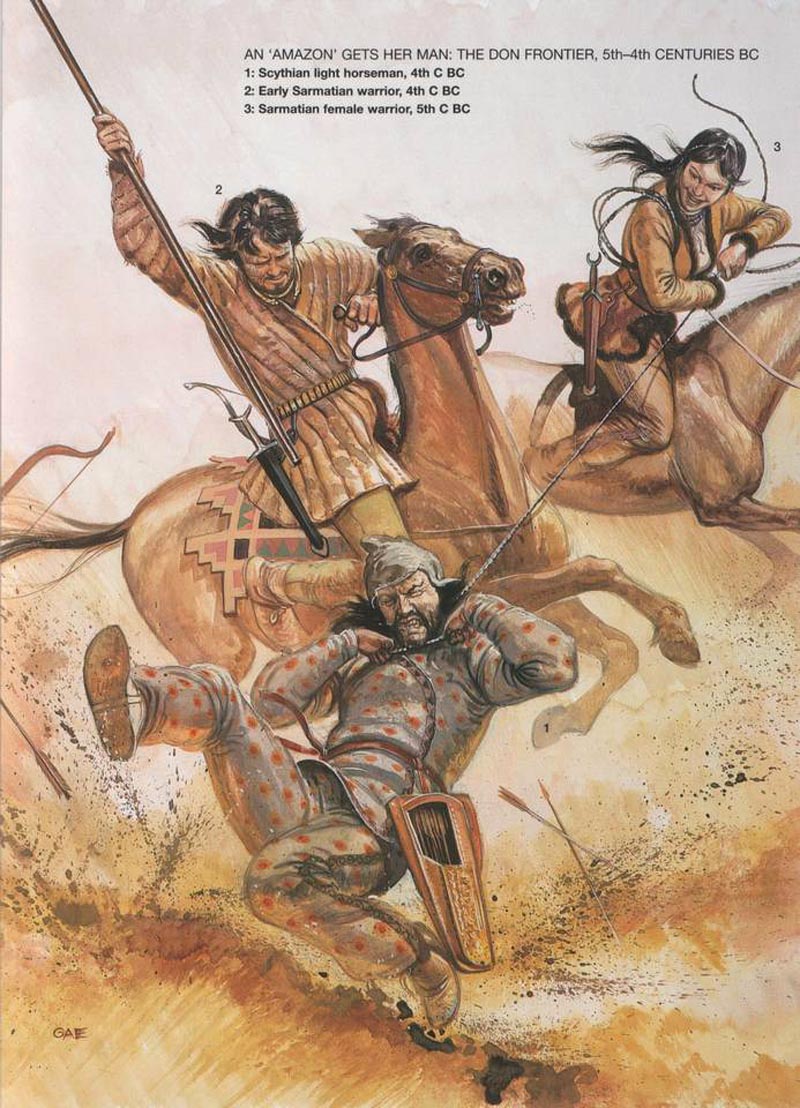
 The most basic thing you should know about the Sarmatians is that "Sarmatian" is a collective term for some of the Indo-Iranian nomadic tribes of horsemen who inhabited the steppes of the southwest areas of the Soviet Union from about 600BC to 450 AD. They spoke a language in the Northeastern Iranian group, whose only representatives spoken today are Ossetic (directly descended from the Scytho-Sarmatian dialects) and Yaghnobi. Sarmatians raided neighboring areas for much of their history, making some tribes a thorn in the side of the Roman Empire. Other Sarmatian tribes joined the Roman legions. They used bows and lances, wore scale mail made of horses hooves or bronze, and lived in wagons. Over the centuries, they were largely driven westward by the Goths and the Huns until they eventually melded with other groups and disappeared as a distinct people.

 I spent the entire summer after my first fighter practice researching various cultures to find the one that felt right for me. At that point fighting was my main interest. I wanted to be authentic in that whatever culture I picked, I, not being male, would have fought had I actually belonged to it. I spent days sifting through every pre-16th century culture whose name I could come across until I found references to the idea that Sarmatians are as a possible source for the legends of the Amazons (more on that later, as well). Turns out some Sarmatian burial sites have female skeletons dressed like male warriors. It was perfect! I continued sifting through other cultures, but they ended up being the only ones with a prominent history of female warriors.


Abaev, VI, A Grammatical Sketch of Ossetian, trans. Stephen P. Hill, ed. Herbert H. Paper, 1964. 
Anthony, DW, The Horse, the Wheel, and Language, Princeton University Press, 2007
Brezinski, R, and Mielczarek, M,  Men at Arms:The Sarmatians 600BC-450AD, Osprey Publishing, 2002.